
[논문 리뷰] DiffFaceSketch: High-Fidelity Face Image Synthesis with Sketch-Guided Latent Diffusion Model
본 논문은 Sketch-Guided Latent Diffusion Model (SGLDM)을 도입하여 단색 스케치를 다층 Auto-Encoder 스케치 조건화와 Stochastic Region Abstraction 데이터 증강을 사용해 고품질 얼굴 이미지를 생성하고, 강한 스케치-일관성과 편집 가능성을 보임을 시연합니다.
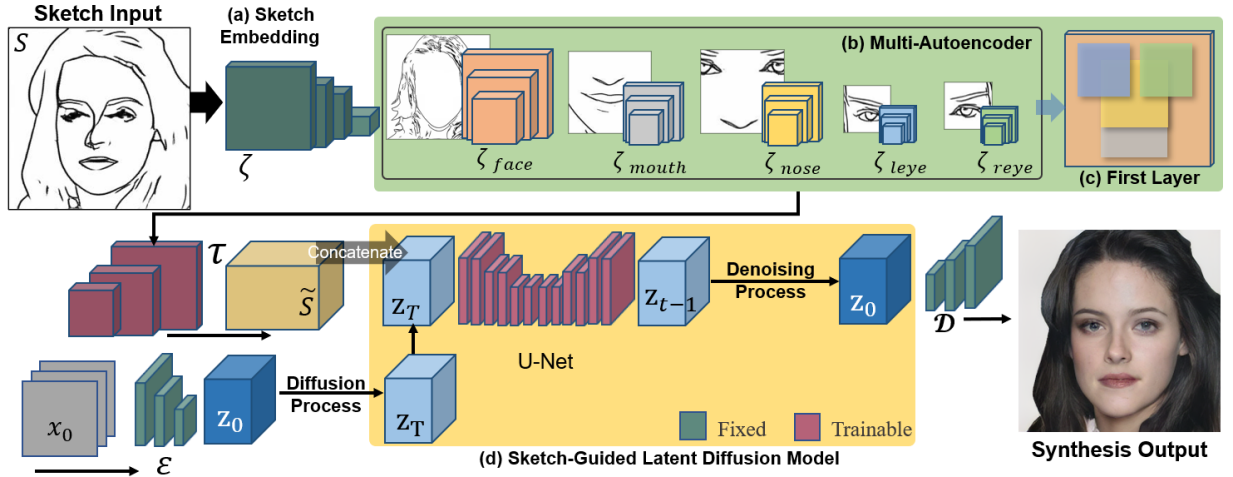
Synthesizing face images from monochrome sketches is one of the most fundamental tasks in the field of image-to-image translation. However, it is still challenging to (1)~make models learn the high-dimensional face features such as geometry and color, and (2)~take into account the characteristics of input sketches. Existing methods often use sketches as indirect inputs (or as auxiliary inputs) to guide the models, resulting in the loss of sketch features or the alteration of geometry information. In this paper, we introduce a Sketch-Guided Latent Diffusion Model (SGLDM), an LDM-based network architect trained on the paired sketch-face dataset. We apply a Multi-Auto-Encoder (AE) to encode the different input sketches from different regions of a face from pixel space to a feature map in latent space, which enables us to reduce the dimension of the sketch input while preserving the geometry-related information of local face details. We build a sketch-face paired dataset based on the existing method that extracts the edge map from an image. We then introduce a Stochastic Region Abstraction (SRA), an approach to augment our dataset to improve the robustness of SGLDM to handle sketch input with arbitrary abstraction. The evaluation study shows that SGLDM can synthesize high-quality face images with different expressions, facial accessories, and hairstyles from various sketches with different abstraction levels.
연구 동기 및 목표
- 단색 스케치에서 고품질 얼굴 이미지를 합성해야 하는 필요성을 시각적 기하학적 정확성 유지의 관점에서 동기화한다.
- 이미지-대-이미지 번역을 위해 잠재 확산 모델을 활용하는 스케치-전용 조건화 프레임워크를 제안한다.
- 지역별 스케치 인코딩과 2단계 학습 과정을 통해 로컬 기하학 및 디테일을 보존한다.
- 데이터 증강(SRA)을 통한 다양한 스케치 추상화 수준에 대한 강건성을 강화한다.
- 스케치-투-얼굴 작업에서 최첨단 방법들과의 품질 및 입력 충실도 측면에서 우수한 충실도와 스케치-일관성을 입증한다.
제안 방법
- 고효율적 고품질 합성을 위한 백본으로 Latent Diffusion Model (LDM)을 사용한다.
- 다양한 얼굴 영역에서의 스케치를 잠재 특징 맵으로 인코딩하는 다중 AE(Multi-AE)를 도입한다.
- 사전 학습된 스케치 임베딩(Multi-AE)과 함께 SGLDM을 조건부 잠재 맵으로 학습하는 2단계 학습 체계를 채택한다.
- 잠재 공간의 denoising U-Net에 대해 스케치 조건 맵 0을 제공하는 조건화 모듈을 정의한다.
- 다양한 추상화 수준으로 스케치를 증강하기 위해 Stochastic Region Abstraction(SRA)을 적용한다.
- 강건성을 높이기 위해 조건 특징에 마스킹 전략을 적용할지 여부를 선택적으로 고려한다( MAE에서 영감을받음).
실험 결과
연구 질문
- RQ1스케치-전용 입력 모델이 입력 스케치 기하학을 보존하면서 고품질의 포토리얼리틱한 얼굴 이미지를 합성할 수 있는가?
- RQ22단계 학습과 영역 인식 스케치 조건화가 공동 학습보다 충실도와 일관성을 향상시키는가?
- RQ3Stochastic Region Abstraction를 통한 데이터 증강이 스케치 추상화 수준에 대한 강건성에 어떤 영향을 미치는가?
- RQ4SGLDM이 품질과 입력 충실도 측면에서 최첨단 스케치-투-얼굴 방법들과 비교하여 어떤 위치에 있는가?
주요 결과
- SGLDM은 스케치-투-얼굴 작업에서 경쟁 방법들보다 입력 일관성과 시각적 충실도가 더 높다.
- 별도로 학습된 Multi-AE 조건화 모듈이 2단계 학습 전략에서 스케치와 얼굴 분포 간의 도메인 매핑을 개선한다.
- SRA 데이터 증강이 서로 다른 추상화 수준의 스케치에 대한 강건성을 증가시킨다.
- 정량적 지표(FID, LPIPS, REC)는 SGLDM이 낮음, 중간, 높음 추상화 수준에서 Pix2pix, Pix2pixHD, Psp보다 유리하게 작용한다.
- SGLDM은 얼굴 아이덴티티의 안정성을 유지하면서(편집 중) 표정, 헤어스타일, 액세서리 등 편집 기능을 시연한다.
이 논문 읽기
누빈트 뷰어에서 원문을 열고, 읽으면서 궁금한 곳을 바로 물어보세요.
누빈트에서 이 논문 읽기이 리뷰는 AI가 논문 원문을 바탕으로 만들었습니다. 인용하기 전에 원문을 확인해 주세요.