
[논문 리뷰] Domain Specialization as the Key to Make Large Language Models Disruptive: A Comprehensive Survey
이 설문은 대형 언어 모델(LLMs)에 대한 도메인 특화 기술을 분류하고 분석하며 접근성(블랙/그레이/화이트 박스)에 기반한 분류법을 제안하고 적용 도메인, 도전 과제 및 미래 추세를 개괄한다.
Large language models (LLMs) have significantly advanced the field of natural language processing (NLP), providing a highly useful, task-agnostic foundation for a wide range of applications. However, directly applying LLMs to solve sophisticated problems in specific domains meets many hurdles, caused by the heterogeneity of domain data, the sophistication of domain knowledge, the uniqueness of domain objectives, and the diversity of the constraints (e.g., various social norms, cultural conformity, religious beliefs, and ethical standards in the domain applications). Domain specification techniques are key to make large language models disruptive in many applications. Specifically, to solve these hurdles, there has been a notable increase in research and practices conducted in recent years on the domain specialization of LLMs. This emerging field of study, with its substantial potential for impact, necessitates a comprehensive and systematic review to better summarize and guide ongoing work in this area. In this article, we present a comprehensive survey on domain specification techniques for large language models, an emerging direction critical for large language model applications. First, we propose a systematic taxonomy that categorizes the LLM domain-specialization techniques based on the accessibility to LLMs and summarizes the framework for all the subcategories as well as their relations and differences to each other. Second, we present an extensive taxonomy of critical application domains that can benefit dramatically from specialized LLMs, discussing their practical significance and open challenges. Last, we offer our insights into the current research status and future trends in this area.
연구 동기 및 목표
- 도메인 이질성, 진화하는 지식, 윤리적 제약으로 인한 LLM의 도메인 특화 적응 필요성을 동기 부여한다.
- LLMs에 대한 접근성(블랙 박스, 그레이 박스, 화이트 박스)에 기반한 도메인 특화 기술의 체계적 분류법을 제공한다.
- 도메인 특화 방법을 광범위한 적용 도메인에 매핑하고 실용적 의의와 남은 문제를 논의한다.
- 도메인 특화 LLM 응용의 현재 연구 현황과 미래 추세에 대한 인사이트를 제공한다.
제안 방법
- 도메인 특화를 위한 4단계의 공통 프레임워크를 제안한다: 정의, 증강, 최적화, 평가.
- 접근성(블랙/그레이/화이트 박스)과 학습/개입 수준(사전 학습, 미세 조정, 추론 시)에 따라 접근법을 분류한다.
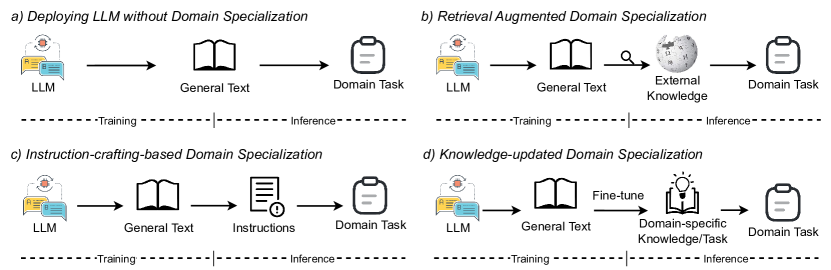
- 세 가지 핵심 접근 클래스: 외부 증강(도메인 지식과 도메인 도구), 프롬프트 설계, 그리고 모델 미세 조정을 관계와 상호 보완성/Trade-off를 포함하여 설명한다.
- 외부 지식, 프롬프트, 매개변수 업데이트를 도메인 특화 작업에 어떻게 결합할 수 있는지 통합 워크플로를 제시한다.
실험 결과
연구 질문
- RQ1다른 접근성 수준 전반에서 LLM 도메인 특화 기법을 가장 잘 설명하는 분류법은 무엇인가?
- RQ2특화된 LLM으로 혜택을 얻을 수 있는 주요 도메인 적용 영역은 무엇이며 어떤 도전 과제를 제기하는가?
- RQ3도메인 적응을 위한 비용, 성능, 일반화 측면에서 외부 증강, 프롬프트 설계, 그리고 모델 미세 조정은 어떻게 비교되는가?
- RQ4도메인 특화 LLM의 발전을 형성하는 향후 방향과 병목 현상은 무엇인가?
주요 결과
- 체계적인 분류법은 도메인 특화 기법을 외부 증강, 프롬프트 설계, 그리고 모델 미세 조정으로 분류하며, 블랙/그레이/화이트 박스 접근성에 맞춰 정렬된다.
- 적용 도메인의 포괄적 매핑이 제공되며, 도메인 특화 LLM의 실용적 의의와 남은 과제를 강조한다.
- 접근 간의 상충 관계를 논의하며, 계산 비용, 구현 용이성, 일반화 등을 포함하고, 상호보완 가능성을 지적한다.
- 식별된 도전 과제로는 외부 지식의 원활한 통합, 대형 지식 베이스로의 확장성, 최신 정보 유지가 있다.

이 논문 읽기
누빈트 뷰어에서 원문을 열고, 읽으면서 궁금한 곳을 바로 물어보세요.
누빈트에서 이 논문 읽기이 리뷰는 AI가 논문 원문을 바탕으로 만들었습니다. 인용하기 전에 원문을 확인해 주세요.