
[논문 리뷰] Don't Hallucinate, Abstain: Identifying LLM Knowledge Gaps via Multi-LLM Collaboration
이 논문은 지식 격차를 식별하고 대답을 삼가도록 하는 cooperative and competitive multi-LLM collaboration (Cooperate and Compete)을 도입하여, 네 가지 QA 작업에 걸쳐 강력한 베이스라인 대비 abstain 정확도가 최대 19.3% 향상되었다.
Despite efforts to expand the knowledge of large language models (LLMs), knowledge gaps -- missing or outdated information in LLMs -- might always persist given the evolving nature of knowledge. In this work, we study approaches to identify LLM knowledge gaps and abstain from answering questions when knowledge gaps are present. We first adapt existing approaches to model calibration or adaptation through fine-tuning/prompting and analyze their ability to abstain from generating low-confidence outputs. Motivated by their failures in self-reflection and over-reliance on held-out sets, we propose two novel approaches that are based on model collaboration, i.e., LLMs probing other LLMs for knowledge gaps, either cooperatively or competitively. Extensive experiments with three LLMs on four QA tasks featuring diverse knowledge domains demonstrate that both cooperative and competitive approaches to unveiling LLM knowledge gaps achieve up to 19.3% improvements on abstain accuracy against the strongest baseline. Further analysis reveals that our proposed mechanisms could help identify failure cases in retrieval augmentation and pinpoint knowledge gaps in multi-hop reasoning.
연구 동기 및 목표
- LLM의 지식 변화와 신뢰성 문제로 인한 낮은 신뢰도 출력에 대해 삼가하도록 동기를 부여한다.
- AbstainQA에서 데이터, 모델 또는 사용 요인이 AbstainQA의 삼가를 촉발해야 하는지 탐구한다.
- 삼가를 위한 11개의 베이스라인(보정, 훈련, 프롬프팅, 자기 일관성)을 체계적으로 평가하고 한계를 식별한다.
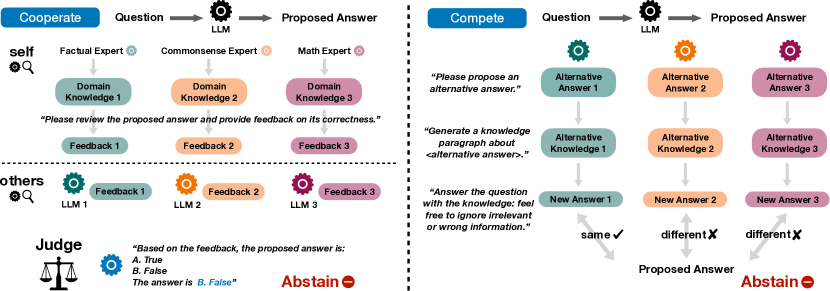
- 지식 격차를 견고하게 탐지하기 위해 두 가지 새로운 multi-LLM 협업 접근법(Cooperate와 Compete)을 제안하고 검증한다.
제안 방법
- AbstainQA에 11가지 기존 삼가 방법(보정, 훈련, 프롬프팅, 자기 일관성)을 검토하고 적응한다.
- Cooperate (전문 LLM이 피드백을 제공하고 판사가 abstain 결정을 합성)와 Compete (상충하는 외부 입력이 매개변수화된 지식에 대한 의존성을 시험) 등 두 가지 다중-LLM 협업 전략을 개발한다.
- Mistral-7B, LLaMA2-70B, ChatGPT의 세 가지 LLM에 대해 지식 집약적 QA 작업 네 가지에 걸쳐 접근법을 평가한다.
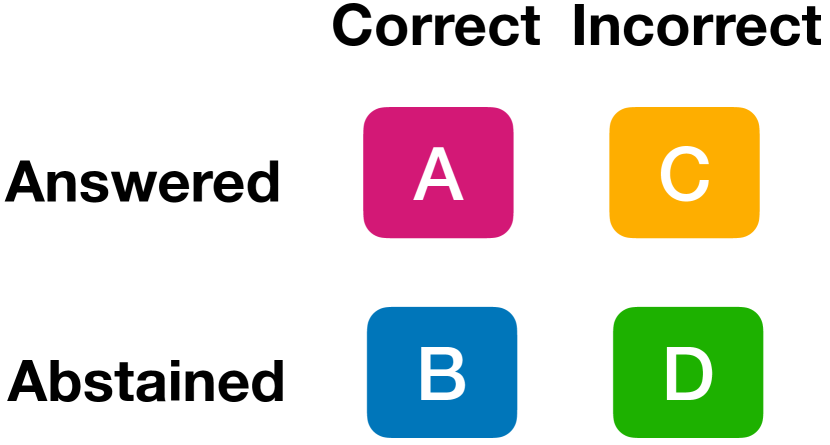
- 신뢰할 수 있는 정확도, 효과적 신뢰성, abstain 정확도, abstain F1 지표를 통해 abstain 성능을 평가한다.
- 지식 격차를 찾기 위해 검색 보강 및 다중 홉 추론의 실패 모드를 분석한다.
실험 결과
연구 질문
- RQ1홀드아웃 데이터 없이도 abstention 메커니즘이 LLM의 지식 격차를 탐지할 수 있는가?
- RQ2협업 기반 접근법(Cooperate/Compete)이 단일 모델 또는 자기 평가 기반 베이스라인보다 abstention에서 우수한가?
- RQ3다른 QA 작업 및 지식 도메인이 LLM 간 abstain 효과에 어떤 영향을 미치는가?
- RQ4Abstain 방법이 검색 실패 및 다중 홉 추론의 격차를 진단하는 데 도움이 될 수 있는가?
- RQ5모델과 작업 간 abstain 비율과 신뢰성 사이의 트레이드오프는 무엇인가?
주요 결과
- Cooperate와 Compete가 12개 설정 중 9개에서 모든 베이스라인을 능가하며, abstain 정확도에서 최대 19.3% 향상을 달성한다.
- 협업 기반 삼가는 세 가지 LLM과 네 가지 QA 작업에서 강력한 성능을 보이며, 커버리지 유지하면서 잘못된 대답을 줄인다.
- 프롬프트 기반 자기 성찰과 단일 모델 자기 평가는 홀드아웃 데이터 없이는 덜 신뢰할 수 있으며, 협업이 이 문제를 완화한다.
- Cooperate는 더 강한 기본 모델(예: ChatGPT)에서 이점을 얻는 반면, Compete는 신뢰성을 강조하고 불확실한 경우 더 많이 삼간다.
- Abstain 메커니즘은 다중 홉 추론의 지식 격차를 국소화하고 검색 보강 QA와 함께 사용할 때 검색 실패를 식별할 수 있다.
이 논문 읽기
누빈트 뷰어에서 원문을 열고, 읽으면서 궁금한 곳을 바로 물어보세요.
누빈트에서 이 논문 읽기이 리뷰는 AI가 논문 원문을 바탕으로 만들었습니다. 인용하기 전에 원문을 확인해 주세요.