
[논문 리뷰] EMO: Emote Portrait Alive -- Generating Expressive Portrait Videos with Audio2Video Diffusion Model under Weak Conditions
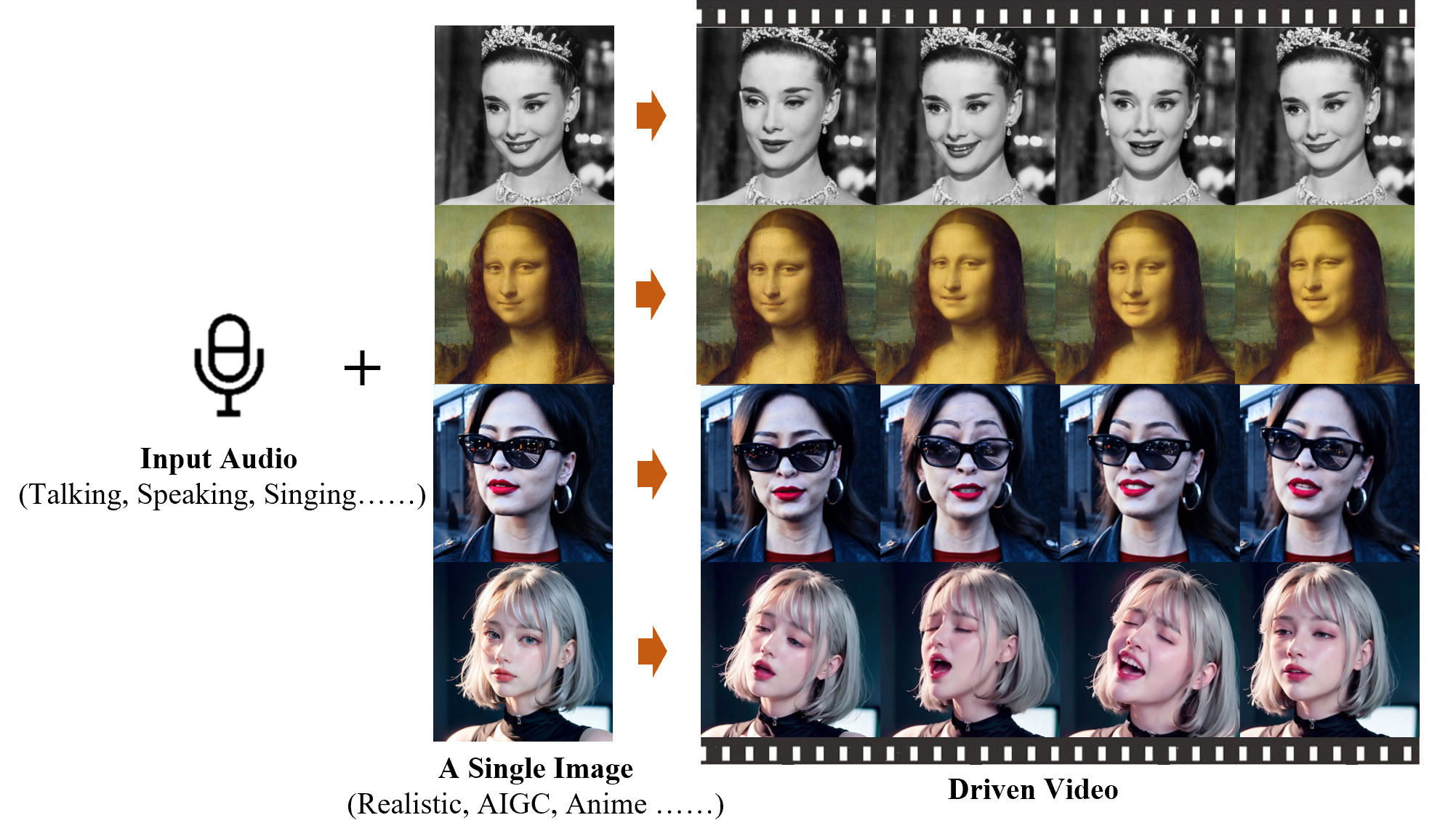
EMO는 3D 모델이나 킷지점 등을 거치지 않고 음성에서 직접 얼굴 운동을 생성하는 확산 기반 음성-비디오 생성 프레임워크를 제안한다. 속도 제어기, 얼굴 영역 제어기, 및 프레임 인코딩을 통합함으로써 실사성, 정체성 유지, 표현력 면에서 최신 기술을 초월하며, 특히 노래나 동적인 머리 운동에 뛰어난 성능을 발휘한다. FID, FVD, E-FID 지표에서 기존 최고 수준의 방법들을 능가한다.
In this work, we tackle the challenge of enhancing the realism and expressiveness in talking head video generation by focusing on the dynamic and nuanced relationship between audio cues and facial movements. We identify the limitations of traditional techniques that often fail to capture the full spectrum of human expressions and the uniqueness of individual facial styles. To address these issues, we propose EMO, a novel framework that utilizes a direct audio-to-video synthesis approach, bypassing the need for intermediate 3D models or facial landmarks. Our method ensures seamless frame transitions and consistent identity preservation throughout the video, resulting in highly expressive and lifelike animations. Experimental results demonsrate that EMO is able to produce not only convincing speaking videos but also singing videos in various styles, significantly outperforming existing state-of-the-art methodologies in terms of expressiveness and realism.
연구 동기 및 목표
- 기존의 3D 모델이나 얼굴 킷지점을 기반으로 하는 대화 헤드 모델의 한계를 해결하기 위해, 표현의 다양성과 자연스러운 운동을 제한하는 요소를 제거한다.
- 중간 표현 없이 음성과 단일 기준 이미지에서 직접 고해상도이고 표현력 있는 비디오를 생성할 수 있도록 한다.
- 확산 샘플링 중에 발생하는 진동이나 얼굴 왜곡 등의 아티팩트를 줄이고 비디오의 안정성을 향상시킨다.
- 다양한 포트레이트 스타일(실사, 애니메이션, 3D 등)과 장시간 음성 입력에서도 정체성과 스타일 일관성을 유지한다.
- 최신 기술 대비 실사성, 정체성 유지도, 표현력 면에서 뛰어난 성능을 달성한다.
제안 방법
- 3D 모델이나 킷지점 기반 중간 표현 없이 음성과 단일 기준 이미지를 입력으로 받아 프레임을 직접 생성하는 음성-비디오 확산 모델을 사용한다.
- 확산 샘플링 중에 프레임 수준의 진동과 얼굴 왜곡을 억제하기 위해 안정적인 하이퍼파라미터인 속도 제어기와 얼굴 영역 제어기를 도입한다.
- ReferenceNet을 영감으로 삼은 참조 인코딩 모듈인 FrameEncoding을 설계하여 전체 비디오 시퀀스 동안 정체성과 스타일 일관성을 유지한다.
- 다양한 언어로 된 연설, 영화, 노래 포함 250시간이 넘는 대규모 음성-비디오 콘텐츠 데이터셋을 기반으로 모델을 훈련시켰다.
- 운동 프레임을 활용해 초기 시퀀스를 초월한 장시간 비디오 생성을 가능하게 하여 입력 음성 길이에 맞는 출력을 확보한다.
- 다양한 머리 자세와 rich한 얼굴 표정을 가진 말하기 및 노래 비디오 생성을 모두 지원한다.
실험 결과
연구 질문
- RQ13D 모델이나 얼굴 킷지점 감독 없이도 확산 기반 음성-비디오 모델이 표현력 있고 자연스러운 대화 헤드 비디오를 생성할 수 있는가?
- RQ2확산 샘플링 중에 얼굴의 진동과 왜곡을 방지하기 위해 음성-비디오 생성을 어떻게 안정화할 수 있는가?
- RQ3단일 기준 이미지로 다양한 시각적 스타일(예: 실사, 애니메이션, 3D 등)에서 정체성과 포트레이트 스타일을 얼마나 잘 유지할 수 있는가?
- RQ4노래와 같은 장시간 음성에 대해 동기화와 표현적 역동성을 유지하면서 일반화 가능한가?
- RQ5정량적 및 정성적 평가에서 기존 최고 수준의 접근법과 비교해 실사성, 정체성 유지도, 표현력 면에서 어떻게 성능을 냈는가?
주요 결과
- EMO는 기존 최고 수준의 방법들인 Wav2Lip(9.38), SadTalker(10.31), DreamTalk(58.80)을 뛰어넘는 새로운 최고 기록인 FID 점수 8.76을 달성했다.
- 모델은 기준선 대비 최저 수준인 FVD 점수 67.66을 기록하여 비디오 품질과 시간적 일관성 면에서 뛰어난 성능을 보였다.
- EMO는 표현력 면에서 최고 수준인 E-FID 점수 0.116를 기록하여 특히 미세한 표정 변화나 동적인 변화에서 뛰어난 표현력을 입증했다.
- 정성적 결과에서는 EMO가 Wav2Lip, SadTalker, DreamTalk에 비해 더 자연스러운 머리 운동과 더 풍부한 얼굴 표정을 생성하는 것으로 나타났다. 특히 노래 시나리오에서 두드러진다.
- 노래와 같은 톤이 있는 음성에서도 정체성 일관성과 입술 운동 동기화를 유지하면서 최대 1분까지의 장시간 비디오 생성에 성공했다.
- SyncNet에서 최고 성능은 기록하지 못했지만, 사용자 연구와 정성적 평가를 통해 표현력과 실사성 면에서 뛰어난 성능을 입증했다.

이 논문 읽기
누빈트 뷰어에서 원문을 열고, 읽으면서 궁금한 곳을 바로 물어보세요.
누빈트에서 이 논문 읽기이 리뷰는 AI가 논문 원문을 바탕으로 만들었습니다. 인용하기 전에 원문을 확인해 주세요.