
[논문 리뷰] Empirical evidence of Large Language Model's influence on human spoken communication
본 연구는 280,000개의 YouTube 자막을 20k+개의 학술 채널에서 분석하고, ChatGPT 편집 텍스트에 고유한 단어 사용이 포스트-ChatGPT 시점에서 크게 증가했음을 발견했으며, 이는 인간이 구어 커뮤니케이션에서 LLM 언어를 점점 더 모방하고 있음을 시사합니다.
From the invention of writing and the printing press, to television and social media, human history is punctuated by major innovations in communication technology, which fundamentally altered how ideas spread and reshaped our culture. Recent chatbots powered by generative artificial intelligence constitute a novel medium that encodes cultural patterns in their neural representations and disseminates them in conversations with hundreds of millions of people. Understanding whether these patterns transmit into human language, and ultimately shape human culture, is a fundamental question. While fully quantifying the causal impact of a chatbot like ChatGPT on human culture is very challenging, lexicographic shift in human spoken communication may offer an early indicator of such broad phenomenon. Here, we apply econometric causal inference techniques to 740,249 hours of human discourse from 360,445 YouTube academic talks and 771,591 conversational podcast episodes across multiple disciplines. We detect a measurable and abrupt increase in the use of words preferentially generated by ChatGPT, such as delve, comprehend, boast, swift, and meticulous, after its release. These findings suggest a scenario where machines, originally trained on human data and subsequently exhibiting their own cultural traits, can, in turn, measurably reshape human culture. This marks the beginning of a closed cultural feedback loop in which cultural traits circulate bidirectionally between humans and machines. Our results motivate further research into the evolution of human-machine culture, and raise concerns over the erosion of linguistic and cultural diversity, and the risks of scalable manipulation.
연구 동기 및 목표
- AI 시스템이 인간의 구어를 문자 텍스트를 넘어 영향 주는지 평가한다.
- 대규모 학술 동영상 세트에서 ChatGPT 출시 이후 단어 사용의 변화를 정량화한다.
- GPT-고유 단어와 구어에서의 채택 간의 관계를 조사한다.
제안 방법
- 학술 기관의 360,445개 YouTube 동영상으로 데이터 세트를 구성하고, 영어 자막 279,480개로 필터링한다.
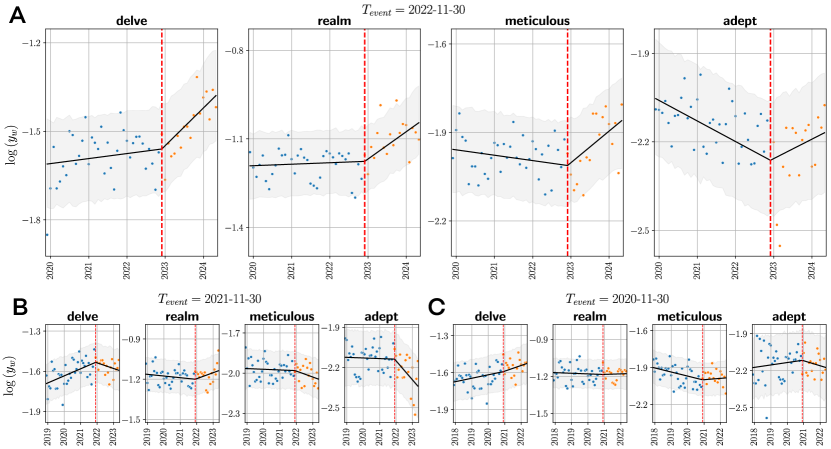
- 자연 변화와 이벤트 전후 변화를 평가하는 계층적 Bayesian Gaussian 회귀로 월별 단어 빈도 추세를 모델링한다.
- Liang et al.의 데이터 세트를 사용하여 GPT-고유 단어를 식별하고 log-빈도 비율 log(P_w,GPT / P_w,human)을 계산한다.
- ChatGPT 출시 이후의 추세-변화 계수 beta_w,GPT를 18개월에 걸쳐 계산한다 (T_event = 2022-11-30).
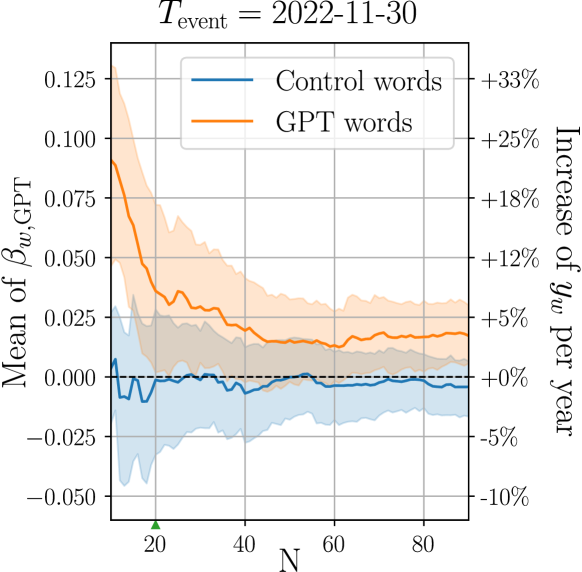
- GPT-단어의 고유성과 구어 채택 간의 상관관계를 평가하고, 상위 N개의 GPT 단어(예: 상위 20개)에 집중한다.
- N과 변화점에 대한 민감도 분석을 통해 강건성을 검증한다.
실험 결과
연구 질문
- RQ1사람은 ChatGPT와 같은 LLM에 노출된 후에도 구어를 바꾸는가, 글쓰기 이상의 영향을 받는가?
- RQ2학술 구어 커뮤니케이션에서 ChatGPT 편집 텍스트에 특징적인 단어의 빈도 변화가 측정 가능한가?
- RQ3ChatGPT 출시 이후 ChatGPT에 더 특징적인 단어일수록 구어에서 채택이 가속될 가능성이 큰가?
- RQ4GPT-단어 고유성과 채택 간의 연관성은 서로 다른 단어 집합과 관찰 창에서 어떻게 작용하는가?
주요 결과
- 포스트-ChatGPT에서 특정 GPT 단어들이 구어에서 가속 채택을 보인다(예: beta_w,GPT가 대략 0.11–0.12이며 95% HDI [0.04, 0.18], [0.02, 0.22]).
- GPT 단어들은 18개월 후에 사전 이벤트 기준선보다 약 35–51% 높은 추세를 경험한다.
- ChatGPT-고유 단어와 구어 채택 증가 사이에 의미 있는 상관관계가 존재하며, 상위 20개 GPT 단어를 고려할 때 가장 강하게 나타난다 (r = 0.63, p < 0.01).
- 컨트롤 단어(하위 N)는 포스트 이벤트 추세 변화가 크지 않아 GPT 단어에 특이성을 시사한다.
- 관찰된 추세 변화는 출시 후 몇 달이 지난 뒤에만 나타나므로 포스트-ChatGPT 데이터가 필요하다.
이 논문 읽기
누빈트 뷰어에서 원문을 열고, 읽으면서 궁금한 곳을 바로 물어보세요.
누빈트에서 이 논문 읽기이 리뷰는 AI가 논문 원문을 바탕으로 만들었습니다. 인용하기 전에 원문을 확인해 주세요.