
[논문 리뷰] Enhanced Controllability of Diffusion Models via Feature Disentanglement and Realism-Enhanced Sampling Methods
이 논문은 일반화된 구성 가능한 확산 프레임워크(GCDM)를 사용하여 분리된 콘텐츠 및 스타일 잠재 코드에 조건을 줌으로써 확산 모델의 제어 가능성성을 향상시킨다. 이 프레임워크는 종속적인 조건 입력과 타임스텝에 따라 가중치를 조정하는 전략을 허용한다. 이 방법은 이전 방법들에 비해 더 세밀하고 현실적인 이미지 번역을 가능하게 하며, 더 나은 분리성과 부드러운 보간을 제공한다.
As Diffusion Models have shown promising performance, a lot of efforts have been made to improve the controllability of Diffusion Models. However, how to train Diffusion Models to have the disentangled latent spaces and how to naturally incorporate the disentangled conditions during the sampling process have been underexplored. In this paper, we present a training framework for feature disentanglement of Diffusion Models (FDiff). We further propose two sampling methods that can boost the realism of our Diffusion Models and also enhance the controllability. Concisely, we train Diffusion Models conditioned on two latent features, a spatial content mask, and a flattened style embedding. We rely on the inductive bias of the denoising process of Diffusion Models to encode pose/layout information in the content feature and semantic/style information in the style feature. Regarding the sampling methods, we first generalize Composable Diffusion Models (GCDM) by breaking the conditional independence assumption to allow for some dependence between conditional inputs, which is shown to be effective in realistic generation in our experiments. Second, we propose timestep-dependent weight scheduling for content and style features to further improve the performance. We also observe better controllability of our proposed methods compared to existing methods in image manipulation and image translation.
연구 동기 및 목표
- 무조건적 또는 단일 조건 생성을 넘어서 확산 모델의 제어 가능성을 향상시키기 위해.
- 기존 방법들이 독립적인 조건 입력을 가정하거나 세밀한 제어 기능이 부족한 점을 해결하기 위해.
- 학습된 별도이지만 조합 가능한 콘텐츠 및 스타일 잠재 공간을 통해 현실적이고 분리된 이미지 번역을 가능하게 하기 위해.
- 샘플링 중에 콘텐츠, 스타일, 그리고 그들의 공동 분포에 대해 동적 제어를 가능하게 하는 추론 시 기법을 개발하기 위해.
- 확산 모델의 인덕티브 바이어스를 활용하기 위해 타임스텝에 따라 조건부 가이던스를 스케줄링하여 더 나은 특징 조합을 이루기 위해.
제안 방법
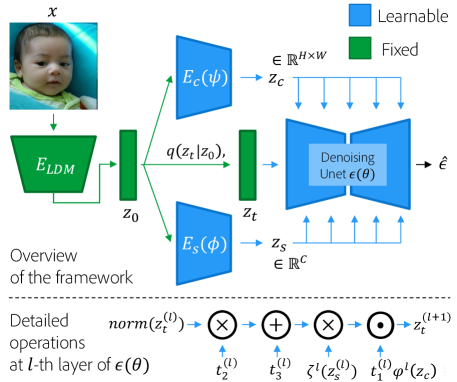
- 콘텐츠로 사용할 공간적 레이아웃 마스크와 스타일로 사용할 평탄화된 의미 임베딩을 별도의 인코더로 학습한 두 개의 별도 잠재 코드에 조건을 줌으로써 잠재 확산 모델을 훈련한다.
- 구조와 외관이라는 별개의 의미 요소를 유지하기 위해 UNet 아키텍처에 콘텐츠 및 스타일 코드를 다르게 주입한다.
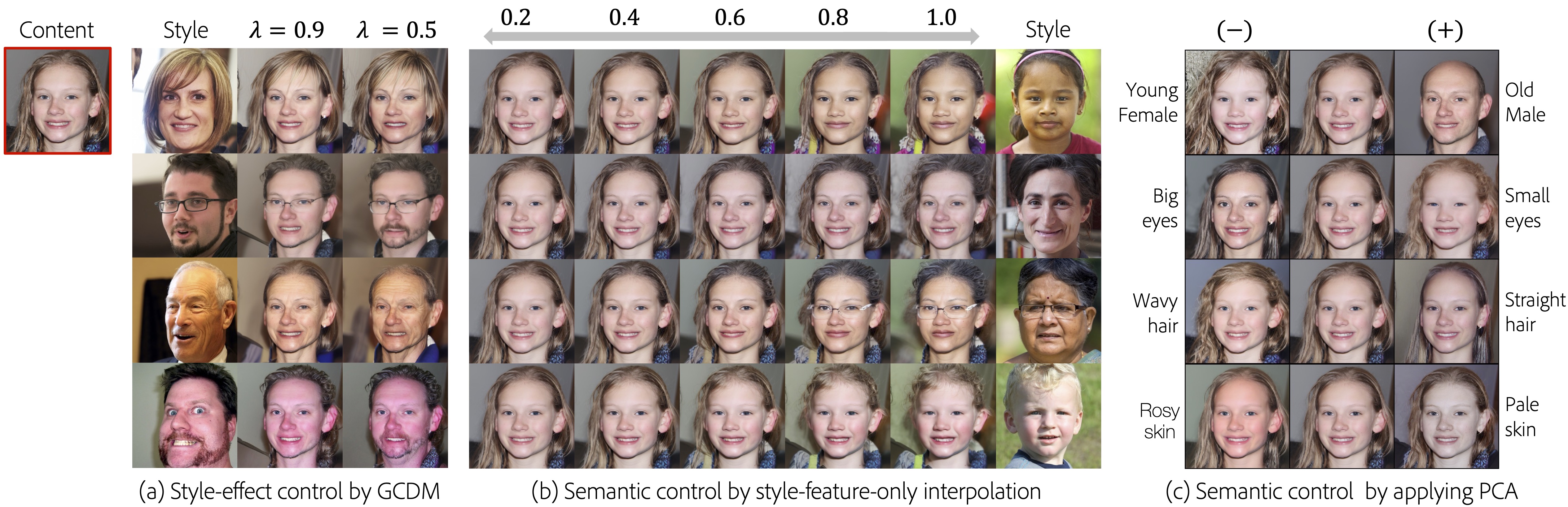
- 종속적인 조건 입력을 처리할 수 있도록 설계된 일반화된 구성 가능한 확산 모델(GCDM)을 제안하여 콘텐츠, 스타일, 그리고 그 상호작용에 대한 동시 제어를 가능하게 한다.
- 스타일 가이던스를 주로 초기 노이즈 제거 단계에서, 콘텐츠 가이던스를 후기 단계에서 적용하는 타임스텝에 따라 가중치를 조정하는 전략을 도입하여 전문가 혼합 모델의 방식을 모방한다.
- 콘텐츠와 스타일 가이던스 간의 부드러운 전환을 위해 시그모이드 기반 스케줄링 함수를 사용하여 생성 품질과 제어 가능성을 향상시킨다.
- 이 프레임워크를 이미지 간 번역 및 텍스트 간 번역에 적용하여 다양한 작업에 대한 일반화 능력을 입증한다.
실험 결과
연구 질문
- RQ1분리된 콘텐츠 및 스타일 잠재변수는 효과적으로 학습되어 확산 모델에 조건을 주어 제어 가능성을 향상시키는 데 유용한가?
- RQ2얼굴 모양과 성별처럼 상호의존적인 조건 입력은 생성 과정에서 어떻게 의미 있는 방식으로 조합될 수 있는가?
- RQ3타임스텝에 따라 조건부 가이던스를 스케줄링하는 것이 확산 기반 이미지 번역에서 이미지 품질과 분리성 향상에 기여하는가?
- RQ4GCDM은 표준 구성 가능한 확산 모델보다 더 현실적이고 의미적으로 일관된 이미지를 생성하는 데 뛰어난 성능을 보이는가?
- RQ5노이즈 제거 과정의 인덕티브 바이어스는 스케줄링을 통해 어떻게 활용되어 특징 조합을 향상시킬 수 있는가?
주요 결과
- 제안된 GCDM 프레임워크는 특히 종속적인 조건 입력이 존재할 경우 기존 CDM에 비해 이미지 품질과 현실성에서 뚜렷한 향상을 보였다.
- 시그모이드 함수를 사용한 타임스텝에 따른 스케줄링 전략은 독립적 또는 선형 스케줄링 전략에 비해 더 자연스러운 생성 결과를 도출했다.
- 학습된 스타일 잠재변수에 대한 PCA 분석을 통해 콘텐츠 구조를 유지하면서도 스타일 코드 간의 부드럽고 분리된 보간이 가능함을 입증했다.
- 콘텐츠와 스타일 잠재변수 간의 효과적인 분리가 이루어졌으며, 스타일 코드는 안경, 헤어 컬러 등의 속성을 잘 포착하고, 콘텐츠 마스크는 레이아웃과 자세를 잘 유지한다.
- 훈련 단계에서 타임스텝 스케줄링을 적용함으로써 분리성과 모델의 특화가 향상되었으며, 암묵적인 전문가 혼합 행동을 유도하는 것으로 보인다.
- 재학습 없이도 학습 가능한 하이퍼파rameter λ를 통해 스타일 번역의 강도를 세밀하게 제어할 수 있다.
이 논문 읽기
누빈트 뷰어에서 원문을 열고, 읽으면서 궁금한 곳을 바로 물어보세요.
누빈트에서 이 논문 읽기이 리뷰는 AI가 논문 원문을 바탕으로 만들었습니다. 인용하기 전에 원문을 확인해 주세요.