
[논문 리뷰] Enhanced Load Forecasting with GAT-LSTM: Leveraging Grid and Temporal Features
이 논문은 그래프 어텐션 네트워크와 LSTM을 결합한 하이브리드 모델인 GAT-LSTM을 제시하여 그리드 토폴로지와 시간적 동역학을 포착하고, 에지 속성을 사용해 단기 부하 예측을 개선한다. 브라질 전력 시스템 데이터셋에서 여러 baselines를 상회한다.
Accurate power load forecasting is essential for the efficient operation and planning of electrical grids, particularly given the increased variability and complexity introduced by renewable energy sources. This paper introduces GAT-LSTM, a hybrid model that combines Graph Attention Networks (GAT) and Long Short-Term Memory (LSTM) networks. A key innovation of the model is the incorporation of edge attributes, such as line capacities and efficiencies, into the attention mechanism, enabling it to dynamically capture spatial relationships grounded in grid-specific physical and operational constraints. Additionally, by employing an early fusion of spatial graph embeddings and temporal sequence features, the model effectively learns and predicts complex interactions between spatial dependencies and temporal patterns, providing a realistic representation of the dynamics of power grids. Experimental evaluations on the Brazilian Electricity System dataset demonstrate that the GAT-LSTM model significantly outperforms state-of-the-art models, achieving reductions of 21. 8% in MAE, 15. 9% in RMSE and 20. 2% in MAPE. These results underscore the robustness and adaptability of the GAT-LSTM model, establishing it as a powerful tool for applications in grid management and energy planning.
연구 동기 및 목표
- 현대 그리드에서 재생에너지(RES) 통합이 높은 상황에서 정확한 단기 부하 예측의 필요성을 제시한다.
- 격자 특성 에지 속성을 공간-시간 모델링에 포함하는 하이브리드 GAT-LSTM 아키텍처를 제안한다.
- 브라질 전력 시스템 데이터셋에서 모델을 최첨단 벤치마크와 비교하여 평가한다.
- Baseline과 비교하여 MAE, RMSE, MAPE의 개선을 보여준다.
제안 방법
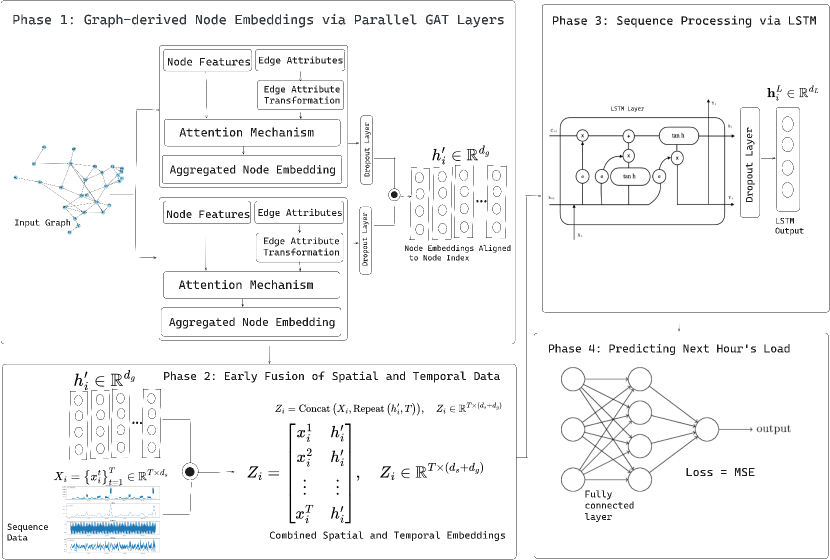
- 에지 속성을 주의 계수에 통합하는 두 개의 병렬 GAT 레이어를 개발한다.
- 공간 그래프 임베딩을 시간 시퀀스 데이터와 조기 융합한 뒤 LSTM에 입력한다.
- 다중 헤드 주의 메커니즘과 LeakyReLU 활성화를 사용해 노드-에지 중요도를 학습한다.
- LSTM 기반 시퀀스 모델로 데이터를 처리하여 시간적 의존성을 포착하고 시간당 예측치를 생성한다.
- 일반화 보장을 위해 Adam 옵티마이저와 학습률 스케줄링, 조기 종료를 사용한 MSE 손실로 학습한다.
- 2019–2020년 브라질 데이터에서 LSTM, GCN-LSTM, EdgeGCN-LSTM, XGBoost를 벤치마크로 비교한다.
실험 결과
연구 질문
- RQ1GAT-LSTM이 단기 시간별 부하 예측에서 벤치마크 모델에 비해 어떤 성능을 보이는가?
- RQ2에지 속성을 GAT 주의 메커니즘에 도입하는 것이 예측 정확도에 어떤 영향을 미치는가?
- RQ3공간 임베딩과 시간 데이터를 조기 융합하는 것이 시간당 예측 성능을 개선하는가?
- RQ4GAT-LSTM은 피크 시간과 비피크 시간에서 정확도 메트릭을 어떻게 처리하는가?
- RQ5브라질 전력 시스템 데이터셋에서 GAT-LSTM을 사용할 때 MAE, RMSE, MAPE의 상대적 이점은 무엇인가?
주요 결과
- GAT-LSTM은 평가된 모델들 사이에서 MAE, RMSE, MAPE 모두에서 가장 우수한 종합 정확도를 달성했다.
- LSTM 대비 MAE를 21.82% 감소시키고 EdgeGCN-LSTM 대비 23.62% 감소시키는 등 상당한 개선을 보였다.
- 브라질 데이터셋에서 GAT-LSTM의 MAE는 64.64 MW, RMSE는 119.06 MW, MAPE는 4.59%를 달성했다.
- XGBoost와 비교하면 GAT-LSTM이 훨씬 낮은 오차를 보이며 MAE 64.64 MW 대 297.47 MW, RMSE 119.06 MW 대 517.69 MW, MAPE 4.59% 대 40.50%이다.
- 조기 학습 분석에서 GAT-LSTM은 빠른 수렴과 안정적인 검증 성능을 보여주며, 에지 기반 GNN 변형들보다 안정성이 더 높다.
- 피크 시간 분석은 급격한 증가 구간에서의 오차 편차가 작아 부하 추세를 강하게 추적하는 경향을 보였으나, 고 기울기 구간에서는 개선 여지가 남아 있음을 시사한다.
이 논문 읽기
누빈트 뷰어에서 원문을 열고, 읽으면서 궁금한 곳을 바로 물어보세요.
누빈트에서 이 논문 읽기이 리뷰는 AI가 논문 원문을 바탕으로 만들었습니다. 인용하기 전에 원문을 확인해 주세요.