
[논문 리뷰] Enhancing IoT Security with CNN and LSTM-Based Intrusion Detection Systems
IoT 트래픽용 CNN-LSTM 하이브리드 침입 탐지 모델을 CICIoT2023 데이터로 학습하고 CICIDS2017에서 검증하여 이진 정상/악성 분류에서 높은 정확도와 낮은 손실을 달성합니다.
Protecting Internet of things (IoT) devices against cyber attacks is imperative owing to inherent security vulnerabilities. These vulnerabilities can include a spectrum of sophisticated attacks that pose significant damage to both individuals and organizations. Employing robust security measures like intrusion detection systems (IDSs) is essential to solve these problems and protect IoT systems from such attacks. In this context, our proposed IDS model consists on a combination of convolutional neural network (CNN) and long short-term memory (LSTM) deep learning (DL) models. This fusion facilitates the detection and classification of IoT traffic into binary categories, benign and malicious activities by leveraging the spatial feature extraction capabilities of CNN for pattern recognition and the sequential memory retention of LSTM for discerning complex temporal dependencies in achieving enhanced accuracy and efficiency. In assessing the performance of our proposed model, the authors employed the new CICIoT2023 dataset for both training and final testing, while further validating the model's performance through a conclusive testing phase utilizing the CICIDS2017 dataset. Our proposed model achieves an accuracy rate of 98.42%, accompanied by a minimal loss of 0.0275. False positive rate(FPR) is equally important, reaching 9.17% with an F1-score of 98.57%. These results demonstrate the effectiveness of our proposed CNN-LSTM IDS model in fortifying IoT environments against potential cyber threats.
연구 동기 및 목표
- 다양한 사이버 공격에 대한 강력한 IoT 보안의 필요성과 IoT 환경에서 효과적인 IDS의 필요성을 자극한다.
- 공간적 및 시간적 특징을 활용하기 위한 CNN-LSTM 하이브리드 IDS를 개발한다.
- 모델의 성능과 일반화 여부를 평가하기 위해 CICIoT2023 및 CICIDS2017 데이터셋에서 평가한다.
- 정확도, 손실, 정밀도, 재현율, F1-스코어, FPR 등의 표준 지표를 통해 성능을 입증한다.
제안 방법
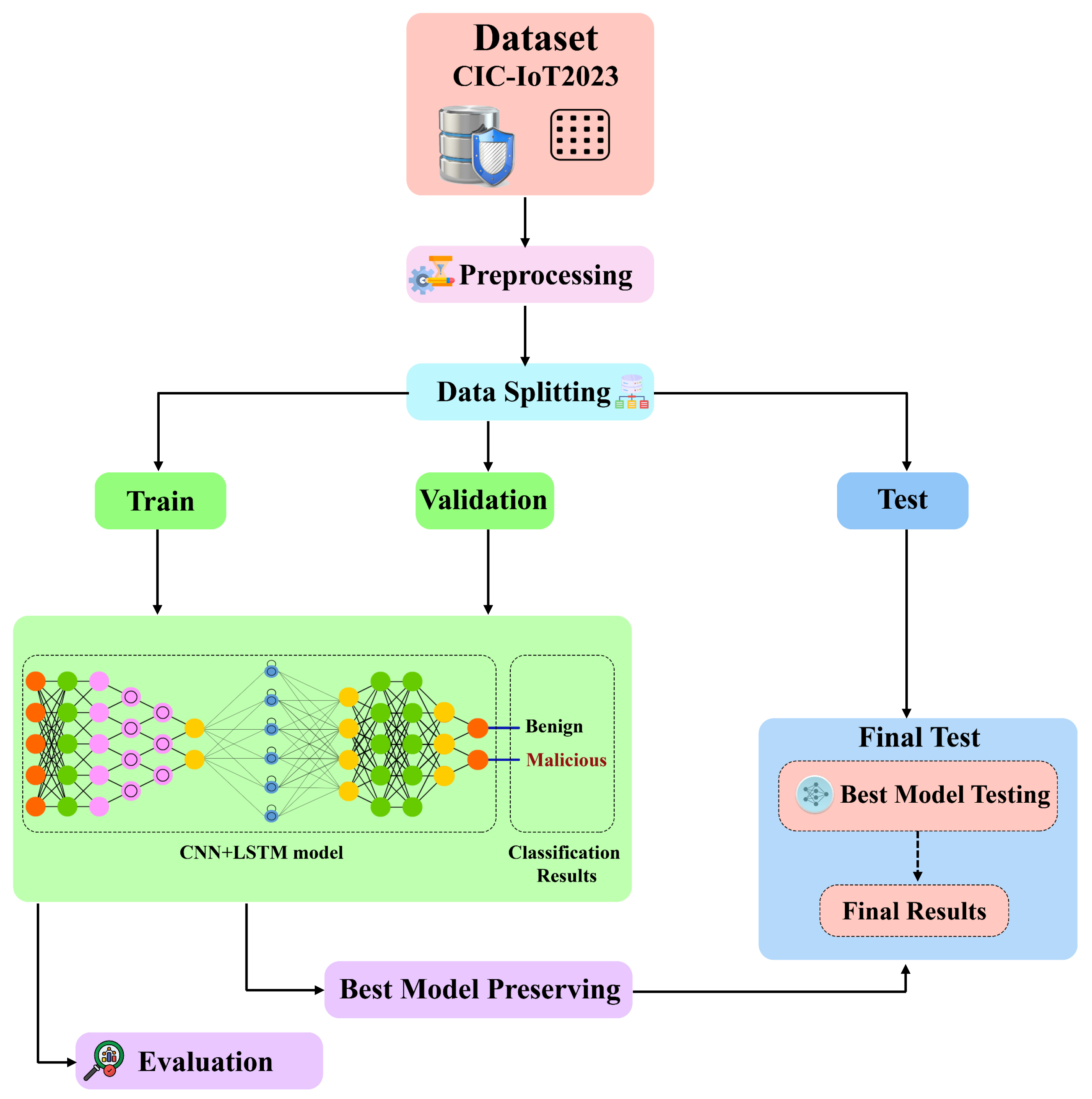
- IoT 트래픽 데이터를 45-피처 벡터로 전처리하고 라벨을 이진 형태로 변환한다.
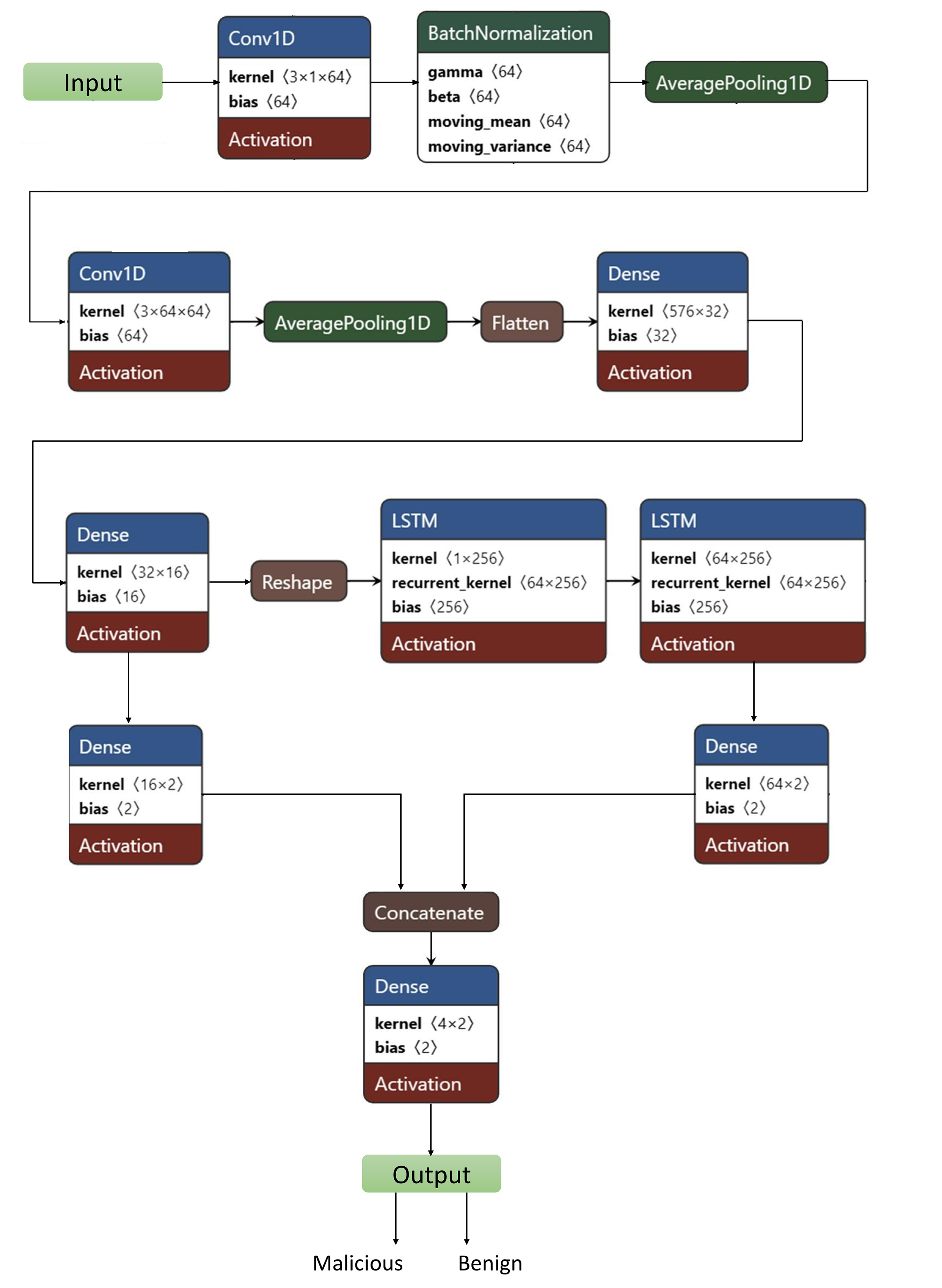
- 배치 정규화와 평균풀링을 사용한 CNN-1D 피처 추출기를 설계하여 공간 패턴을 포착한다.
- CNN 출력과 LSTM 계층을 결합하여 연속적 의존성을 모델링하고 이진 정상/악성 판단을 생성한다.
- CICIoT2023 서브세트에서 80/20 학습/검증 분할로 Adam 옵티마이저를 사용하여 25에폭으로 학습하며, 추가 CICIoT2023 서브세트와 CICIDS2017에서 일반화를 평가한다.
- 정확도, 손실, 정밀도, 재현율, F1-스코어, FPR을 사용하여 성능을 평가하고 ROC/혼동 행렬 분석을 보고한다.
실험 결과
연구 질문
- RQ1CNN-LSTM 하이브리드 모델이 이진 분류 작업에서 IoT 침입 탐지에 단일 모델 접근법보다 우수할 수 있는가?
- RQ2CNN-LSTM IDS가 서로 다른 IoT 트래픽 데이터셋(CICIoT2023 서브세트 및 CICIDS2017)에서 얼마나 잘 일반화되는가?
- RQ3제안된 접근법에서 탐지 정확도와 거짓 양성률 사이의 트레이드오프는 무엇인가?
- RQ4모델이 공간-시간적 특징을 효과적으로 활용하여 정상 IoT 트래픽과 악성 트래픽을 구분하는가?
주요 결과
- CNN-LSTM IDS는 CICIoT2023 첫 번째 서브세트에서 98.42% 정확도, 0.0275의 손실을 달성한다.
- CICIoT2023 두 번째 서브세트에서 일반화 테스트는 98.43% 정확도, 0.0275의 손실 및 9.17% FPR을 보여준다.
- CICIDS2017에서 모델은 97.45% 정확도, 0.06의 손실, 97.17% 정밀도, 97.15% 재현율, 97.07% F1-스코어, 2.08% FPR을 획득한다.
- 오류 행렬에서 정상 트래픽의 정확도는 약 90%, 공격은 약 99%의 정확도를 나타낸다.
- ROC 분석은 높은 TPR과 낮은 FPR로 클래스를 강하게 구분함을 보여준다.
- 최신 연구 방법과 비교했을 때 CICIoT2023 및 CICIDS2017에서 CNN-LSTM 접근법은 보고된 지표 전반에서 우수한 성능을 보인다.
이 논문 읽기
누빈트 뷰어에서 원문을 열고, 읽으면서 궁금한 곳을 바로 물어보세요.
누빈트에서 이 논문 읽기이 리뷰는 AI가 논문 원문을 바탕으로 만들었습니다. 인용하기 전에 원문을 확인해 주세요.