
[논문 리뷰] Equivariant Adaptation of Large Pretrained Models
이 논문은 데이터셋 사전 지식을 반영한 학습 가능한 캐논리컬라이제이션 네트워크를 사용하여 대규모 사전 훈련된 딥러닝 모델이 로테이션과 같은 변환에 대해 등변성(equivariant)이 되도록 하는 경량이며 플러그 앤 플레이(Plug-and-play) 방법을 제안한다. 캐논리컬 형식을 훈련 분포와 일치시킴으로써, 이 방법은 재훈련 없이도 백본 모델의 일반화 능력을 크게 향상시키며, 오직 0.3%의 추가 파라미터와 7.3%의 추론 오버헤드로 SOTA 수준의 분포 외 회전에 대한 강건성을 달성한다.
Equivariant networks are specifically designed to ensure consistent behavior with respect to a set of input transformations, leading to higher sample efficiency and more accurate and robust predictions. However, redesigning each component of prevalent deep neural network architectures to achieve chosen equivariance is a difficult problem and can result in a computationally expensive network during both training and inference. A recently proposed alternative towards equivariance that removes the architectural constraints is to use a simple canonicalization network that transforms the input to a canonical form before feeding it to an unconstrained prediction network. We show here that this approach can effectively be used to make a large pretrained network equivariant. However, we observe that the produced canonical orientations can be misaligned with those of the training distribution, hindering performance. Using dataset-dependent priors to inform the canonicalization function, we are able to make large pretrained models equivariant while maintaining their performance. This significantly improves the robustness of these models to deterministic transformations of the data, such as rotations. We believe this equivariant adaptation of large pretrained models can help their domain-specific applications with known symmetry priors.
연구 동기 및 목표
- 대규모 사전 훈련된 모델을 아키텍처 재설계나 높은 계산 비용 없이도 변환(예: 로테이션)에 대해 등변성 있게 만들기 위한 과제를 해결한다.
- 캐논리컬라이제이션 기반 등변성에서 발생하는 분포 불일치 문제를 극복한다. 여기서 단순한 캐논리컬라이제이션은 입력 분포를 이동시켜 성능을 떨어뜨린다.
- 예측 네트워크에서 등변성을 분리함으로써 기초 모델의 분포 외 변환에 대한 강건한 일반화를 가능하게 한다.
- 캐논리컬라이제이션 함수에 데이터셋 기반 사전 지식이 필수적임을 입증한다. 이는 사전 훈련된 모델의 성능을 등변성 적응 중에도 유지하는 데 핵심적이다.
- 다양한 도메인(이미지, 포인트 클라우드 등)에서 대칭군에 적응시키기 위한 실용적이고 효율적이며 일반화 가능한 프레임워크를 제공한다.
제안 방법
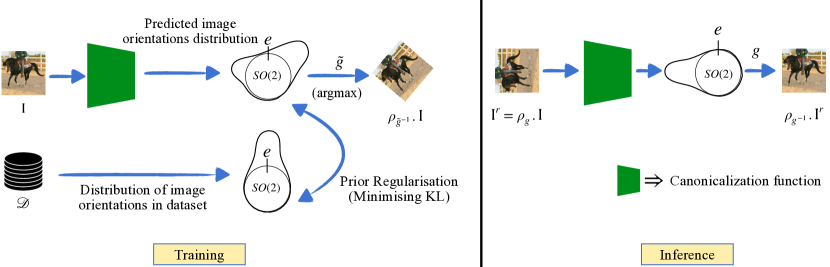
- 학습 가능한 캐논리컬라이제이션 네트워크가 입력 데이터를 사전 훈련된 예측 네트워크에 전달하기 전에 캐논리컬 형식으로 변환함으로써, 등변성과 주요 모델을 분리한다.
- 캐논리컬라이제이션 함수는 예측된 캐논리컬 형식의 분포를 훈련 데이터 분포와 일치시키는 사전 손실을 통해 정규화되어, 백본에 대한 입력이 분포 내에 있도록 보장한다.
- 이 방법은 변환의 군 표현(SO(2), SO(3) 등)을 사용하여 대칭군을 정의하며, 캐논리컬라이제이션 네트워크는 군 변환된 모든 입력을 하나의 캐논리컬 방향으로 매핑하도록 학습한다.
- 다중 전달이 필요한 기존 방법들과는 달리, 각 입력에 대해 단일 순방향 전파만을 사용함으로써 대칭화를 피함으로써 계산 효율성이 높다.
- 이 방법은 플러그인 모듈로 적용 가능하다: 사전 훈련된 모델은 캐논리컬라이제이션된 입력에서만 미세조정되며, 캐논리컬라이제이션 네트워크는 사전 손실을 함께 사용하여 함께 훈련된다.
- 표준 벤치마크(COCO, ShapeNet)를 사용하여 이미지 및 포인트 클라우드 작업에서 평가되었으며, 아블레이션 스터디를 통해 사전 정규화의 필요성을 확인했다.
![Figure 1 : Predicted masks from the Segment Anything Model (SAM) [ 21 ] , showcasing both the original model and our proposed equivariant adaptation for 90 ∘ counter-clockwise rotated input images taken from the COCO 2017 dataset [ 22 ] . Our method makes SAM equivariant to the group of $90^{\circ}$](https://ar5iv.labs.arxiv.org/html/2310.01647/assets/x1.png)
실험 결과
연구 질문
- RQ1경량 캐논리컬라이제이션 모듈이 아키텍처 변경 없이도 대규모 사전 훈련된 모델이 로테이션에 대해 등변성이 되도록 할 수 있는가? 성능 저하도 없이 가능한가?
- RQ2캐논리컬라이제이션 분포와 훈련 데이터 분포 간의 불일치가 사전 훈련된 모델의 등변성 적응 성능에 악영향을 미치는가?
- RQ3사전 정규화가 캐논리컬 형식을 데이터 분포와 일치시키는 데 얼마나 효과적인가? 이는 모델 정확도 유지에 기여하는가?
- RQ4이 방법은 이미지, 포인트 클라우드 등 다양한 모odalities와 SO(2), SO(3) 등의 변환 군에 대해 일반화 가능한가?
- RQ5대규모 모델에서 분포 외 변환에 대한 강건성과 계산 비용 사이의 상호 교환 관계는 어떠한가?
주요 결과
- 제안된 방법은 COCO 및 ShapeNet-part 벤치마크에서 이미지 및 포인트 클라우드 작업 모두에서 기존 방법보다 SOTA 수준의 회전에 대한 강건성을 달성한다.
- 캐논리컬라이제이션 함수에 사전 손실을 추가하면 성능 향상이 뚜렷하게 나타나며, 특히 바닐라 PointNet과 DGCNN가 큰 정확도 하락을 보이는 SO(3)/SO(3) 설정에서 두드러진다.
- 이 방법은 추론 시간을 오직 7.3%만 증가시키며, 파라미터 수는 0.3%만 추가하여 대규모 모델에 있어 매우 효율적임을 입증한다.
- 실험 결과, 사전 정규화 없이 캐논리컬라이제이션을 적용할 경우 분포 이동이 발생하여, 등변성은 달성했지만 사전 훈련된 모델의 성능이 떨어짐을 확인했다.
- 백본 모델이 로테이션 증강 없이 훈련되었더라도, 이 방법은 임의의 로테이션(SO(3))에 대해 강력한 일반화를 가능하게 하며 높은 정확도를 유지한다.
- 아블레이션 스터디를 통해 사전 정규화가 필수적임을 확인했으며, 이를 생략한 모델은 원래 모델의 도메인 내 성능을 유지하지 못한다.
더 나은 연구,지금 바로 시작하세요
논문 읽기부터 검토까지, 연구 시간을 획기적으로 줄여보세요.
카드 등록 없음 · 무료 플랜 제공
이 리뷰는 AI가 만들고, 인간 에디터가 검토했습니다.