
[논문 리뷰] Evaluating Similitude and Robustness of Deep Image Denoising Models via Adversarial Attack
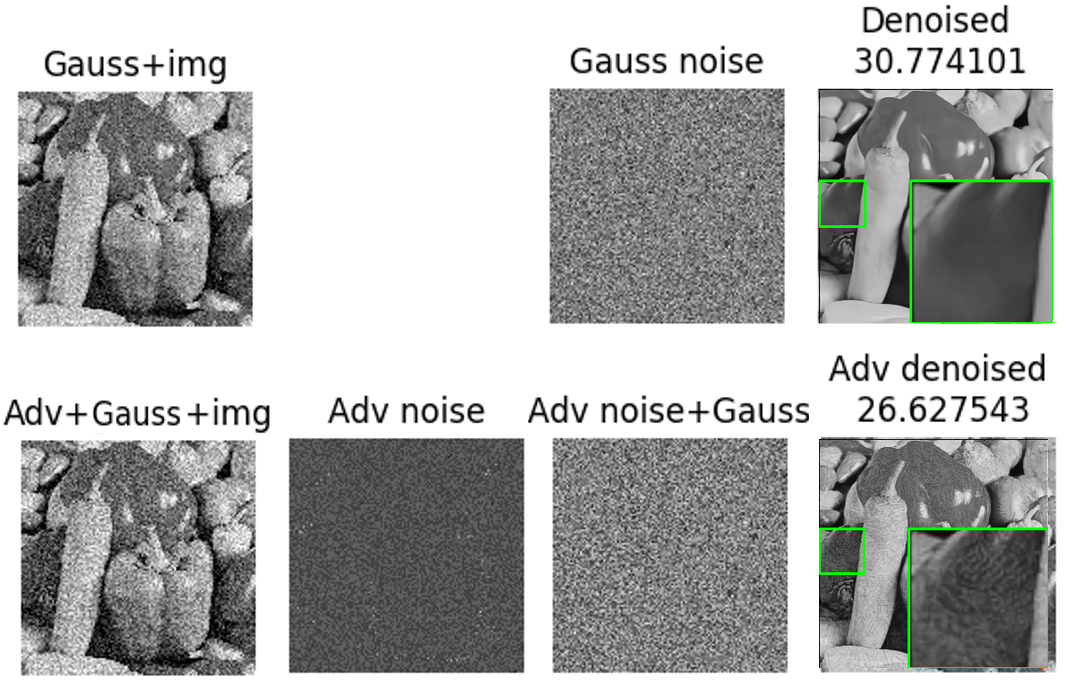
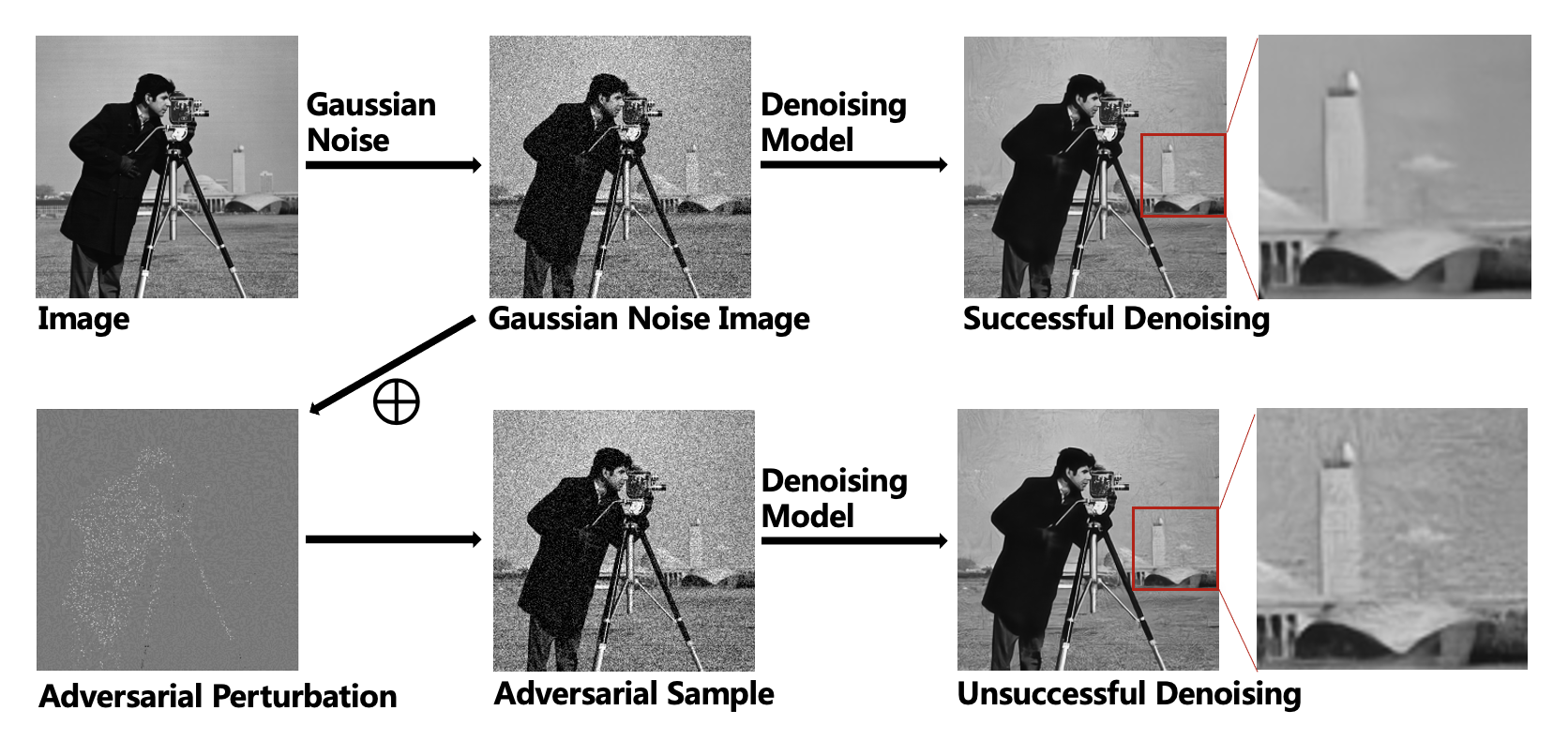
이 논문은 깊이 학습된 이미지 복원 모델의 정 robustness 를 평가하기 위해 노이즈 분포를 유지하는 denoising-PGD 및 L2-denoising-PGD 적대적 공격 방법을 제안한다. 다양한 복원 모델 간 높은 전이 가능성(transferability)을 드러내며, 이는 강력한 국소적 유사성(local similitude)을 시사하며, 데이터 기반 비맹렬(non-blind) 모델이 가장 강건한 것으로 밝혀졌고, BM3D는 적대적 편향에 내재된 저항성을 보였다.
Deep neural networks (DNNs) have shown superior performance comparing to traditional image denoising algorithms. However, DNNs are inevitably vulnerable while facing adversarial attacks. In this paper, we propose an adversarial attack method named denoising-PGD which can successfully attack all the current deep denoising models while keep the noise distribution almost unchanged. We surprisingly find that the current mainstream non-blind denoising models (DnCNN, FFDNet, ECNDNet, BRDNet), blind denoising models (DnCNN-B, Noise2Noise, RDDCNN-B, FAN), plug-and-play (DPIR, CurvPnP) and unfolding denoising models (DeamNet) almost share the same adversarial sample set on both grayscale and color images, respectively. Shared adversarial sample set indicates that all these models are similar in term of local behaviors at the neighborhood of all the test samples. Thus, we further propose an indicator to measure the local similarity of models, called robustness similitude. Non-blind denoising models are found to have high robustness similitude across each other, while hybrid-driven models are also found to have high robustness similitude with pure data-driven non-blind denoising models. According to our robustness assessment, data-driven non-blind denoising models are the most robust. We use adversarial training to complement the vulnerability to adversarial attacks. Moreover, the model-driven image denoising BM3D shows resistance on adversarial attacks.
연구 동기 및 목표
- 딥 이미지 복원 모델이 적대적 공격에 취약한지 조사하기 위해.
- 원래 노이즈 분포를 유지하는 적대적 공격 방법을 개발하여 실험적 타당성을 확보하기 위해.
- 다양한 유형의 복원 모델(비맹렬, 맹렬, 플러그인-앤드-플레이, 언폴딩) 간 적대적 샘플의 전이 가능성(transferability)을 평가하기 위해.
- 적대적 편향을 활용하여 복원 모델 간 국소적 행동 유사성(강건성 유사성, robustness similitude)을 정량화하기 위해.
- 데이터 기반 모델과 하이브리드 기반 모델에 비해 모델 기반 방법(BM3D 등)의 강건성 여부를 평가하기 위해.
제안 방법
- 노이즈가 있는 이미지를 denoiser의 손실 함수에 대한 기울기 업데이트를 반복적으로 사용하여 훼손하는 denoising-PGD를 제안한다.
- L2-denoising-PGD를 도입하여 편향에 L2 제약 조건을 적용함으로써 가우시안 노이즈 분포를 유지하고 실험적 엄밀성을 향상시킨다.
- 각 PGD 반복 전에 무작위 가우시안 편향을 초기화하여 전이 가능성(transferability)을 향상시키면서도 노이즈 분포의 정확성을 유지한다.
- 편향가 이미지 범위 내에 유지되고 학습 동역학이 안정화되도록 클리핑 연산을 적용한다.
- 적대적 샘플의 노이즈 분포를 기준 가우시안 노이즈와 정량적으로 비교하기 위해 워샤프스키안 거리(Wasserstein distance) 지표를 사용한다.
- 강건성 유사성(robustness similitude)을 모델 간 공통의 적대적 샘플 집합의 정도로 측정하여 국소적 행동 유사성을 나타낸다.
실험 결과
연구 질문
- RQ1원래 노이즈 분포를 유지하면서도 깊이 학습된 이미지 복원 모델에 대해 적대적 공격를 효과적으로 적용할 수 있는가?
- RQ2비맹렬, 맹렬, 플러그인-앤드-플레이, 언폴딩 유형의 다양한 깊이 복원 모델 간 적대적 샘플이 얼마나 공유되는가? 이는 행동 유사성(behavioral similitude)을 시사하는가?
- RQ3다양한 모델 유형 간 강건성 유사성(robustness similitude)은 어떻게 달라지며, 특히 데이터 기반 모델과 하이브리드 기반 모델 간의 유사성은 어떠한가?
- RQ4BM3D와 같은 전통적인 모델 기반 방법은 딥러닝 기반 모델에 비해 내재된 저항성을 보이는가?
- RQ5아키텍처 유사성과 적대적 전이 가능성 사이의 관계는 무엇인가?
주요 결과
- L2-denoising-PGD 공격는 노이즈 분포의 정확성을 유지하며, 기준 가우시안 노이즈와의 워샤프스키안 거리가 0.0017로, denoising-PGD의 0.0024보다 유의미하게 낮다.
- 비맹렬(DnCNN, FFDNet 등), 맹렬(DnCNN-B, Noise2Noise 등), 플러그인-앤드-플레이(DPIR, CurvPnP), 언폴딩(DeamNet) 등 테스트된 모든 깊이 복원 모델이 Grayscale 및 컬러 이미지에서 거의 동일한 적대적 샘플 집합을 공유한다.
- 데이터 기반 비맹렬 복원 모델이 가장 높은 강건성 유사성을 보이며, 이는 모델 간 강력한 국소적 행동 유사성을 시사한다.
- 하이브리드 기반 모델(DPIR, CurvPnP 등)도 순수 데이터 기반 비맹렬 모델과 높은 강건성 유사성을 보이며, 이는 공통된 결정 경계를 공유함을 시사한다.
- 전통적인 모델 기반 방법인 BM3D는 딥러닝 기반 모델보다 강건성 면에서 뛰어난 저항성을 보이며, 강력한 내재적 저항성을 가진다.
- 적대적 훈련은 강건성을 향상시키며, 높은 전이 가능성은 적대적 영역이 다양한 모델 간에 연속적이고 공유되는 부분공간(subspace)을 형성하고 있음을 시사한다.
이 논문 읽기
누빈트 뷰어에서 원문을 열고, 읽으면서 궁금한 곳을 바로 물어보세요.
누빈트에서 이 논문 읽기이 리뷰는 AI가 논문 원문을 바탕으로 만들었습니다. 인용하기 전에 원문을 확인해 주세요.