
[논문 리뷰] Explainable Data-driven Modeling of Adsorption Energy in Heterogeneous Catalysis
이 논문은 OC20 데이터를 이용하여 흡착체–촉매 시스템의 흡착 에너지 예측을 설명하기 위해 얕은 ML 모델과 사후 SHAP 분석 및 기호회귀를 결합하여 흡착체 특성을 주요 구동 변수로 강조하고 해석 가능한 관계를 도출한다.
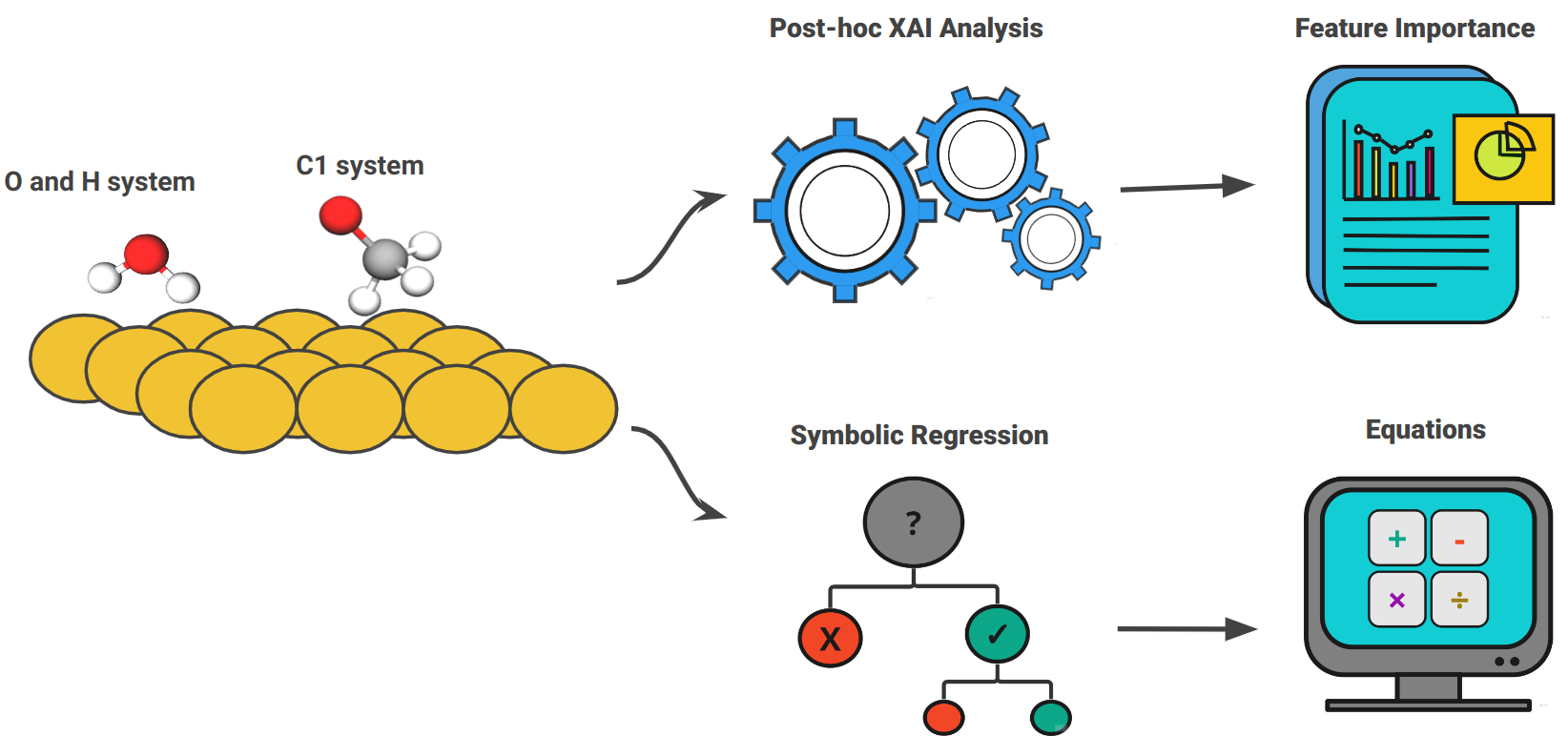
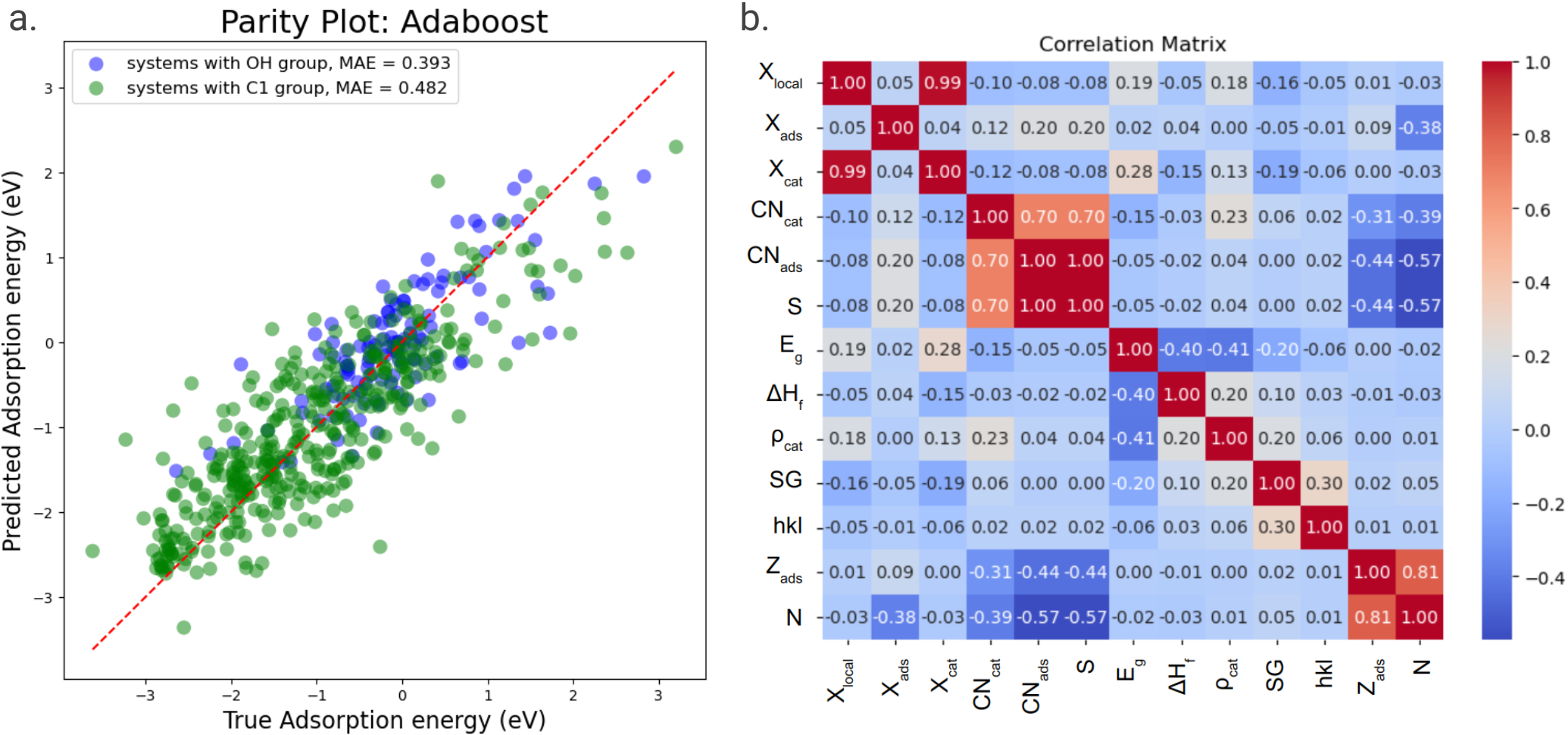
The increasing popularity of machine learning (ML) in catalysis has spurred interest in leveraging these techniques to enhance catalyst design. Our study aims to bridge the gap between physics-based studies and data-driven methodologies by integrating ML techniques with eXplainable AI (XAI). Specifically, we employ two XAI techniques: Post-hoc XAI analysis and Symbolic Regression. These techniques help us unravel the correlation between adsorption energy and the properties of the adsorbate-catalyst system. Leveraging a large dataset such as the Open Catalyst Dataset (OC20), we employ a combination of shallow ML techniques and XAI methodologies. Our investigation involves utilizing multiple shallow machine learning techniques to predict adsorption energy, followed by post-hoc analysis for feature importance, inter-feature correlations, and the influence of various feature values on the prediction of adsorption energy. The post-hoc analysis reveals that adsorbate properties exert a greater influence than catalyst properties in our dataset. The top five features based on higher Shapley values are adsorbate electronegativity, the number of adsorbate atoms, catalyst electronegativity, effective coordination number, and the sum of atomic numbers of the adsorbate molecule. There is a positive correlation between catalyst and adsorbate electronegativity with the prediction of adsorption energy. Additionally, symbolic regression yields results consistent with SHAP analysis. It deduces a mathematical relationship indicating that the square of the catalyst electronegativity is directly proportional to the adsorption energy. These consistent correlations resemble those derived from physics-based equations in previous research. Our work establishes a robust framework that integrates ML techniques with XAI, leveraging large datasets like OC20 to enhance catalyst design through model explainability.
연구 동기 및 목표
- 데이터 기반 ML과 물리 기반 이해 사이의 간극을 흡착 에너지 모델링에서 연결한다.
- 흡착 에너지에 가장 큰 영향을 미치는 흡착체 및 촉매 특징을 식별한다.
- SHAP 분석과 기호회귀를 통해 ML 예측에 대한 해석 가능한 설명을 제공한다.
- 사후 설명과 기호회귀 결과 간의 일관성을 입증한다.
- OC20를 활용하여 설명가능한 모델을 통해 촉매 설계를 돕는다.
제안 방법
- OC20 파생 특징에 대해 얕은 ML 모델(Adaboost, XGBoost, SVR, KRR, LASSO)을 학습시켜 흡착 에너지를 예측한다.
- 사후 SHAP 분석을 적용하여 특징 중요도와 특징 간 상관관계를 결정한다.
- 입력과 흡착 에너지 간의 해석가능한 방정식을 도출하기 위해 PySR을 사용한 기호회귀를 수행한다.
- SHAP에서 도출된 인사이트를 기호회귀 방정식과 비교하여 물리적 타당성을 검증한다.
- 사후 분석에 2886개 시스템의 하위집합을, 수소-흡착체 하위집합에 대해 994개 시스템의 기호회귀를 수행한다.
실험 결과
연구 질문
- RQ1OC20 기반 데이터 세트에서 흡착 에너지 예측에 가장 강하게 영향을 미치는 특징은 무엇인가?
- RQ2SHAP에서 도출된 설명이 기호회귀로 식별된 물리적으로 유도된 관계와 일치하는가?
- RQ3촉매 및 흡착체 특징에 대한 의존성을 간단한 수학적 표현으로 포착할 수 있는가?
- RQ4흡착 에너지 예측에서 흡착체 특징이 촉매 특징에 비해 어떤 차원에서 더 큰 영향을 미치는가?
주요 결과
- SHAP 중요도 상위 다섯 가지 특징: 흡착체 전기음성도, 흡착체 원자 수, 촉매 전기음성도, 유효 배열 수, 흡착체 원자 수의 합.
- 흡착체 특성이 촉매 특성보다 흡착 에너지에 더 큰 영향을 미친다.
- 본 데이터 세트에서 촉매 전기음성도와 흡착 에너지 간 양의 상관관계가 관찰된다.
- 기호회귀는 SHAP 결과와 일치하는 관계를 도출하며, 특히 ΔE_ads ∝ X_cat^2와 같은 다수의 방정식이 나타난다.
- PySR로 도출된 MAE가 일반적으로 Trasatti 기준 방정식보다 낮아 더 간단하고 신뢰할 수 있는 표현임을 시사한다.
- 촉매 벌크의 전기음성도가 표면 전기음성도를 대체하여 흡착 연구에 활용될 수 있다.
이 논문 읽기
누빈트 뷰어에서 원문을 열고, 읽으면서 궁금한 곳을 바로 물어보세요.
누빈트에서 이 논문 읽기이 리뷰는 AI가 논문 원문을 바탕으로 만들었습니다. 인용하기 전에 원문을 확인해 주세요.