
[논문 리뷰] Exposing flaws of generative model evaluation metrics and their unfair treatment of diffusion models
본 논문은 일반적인 평가 지표들(특히 Inception 기반 FID)이 인간 판단과 잘 일치하지 못하고 확산 모델을 불공정하게 판단절하한다는 것을 보여주며, 더 나은 평가를 위한 DINOv2 기반 표현을 제안하고 기억화(memorization) 문제를 강조한다.
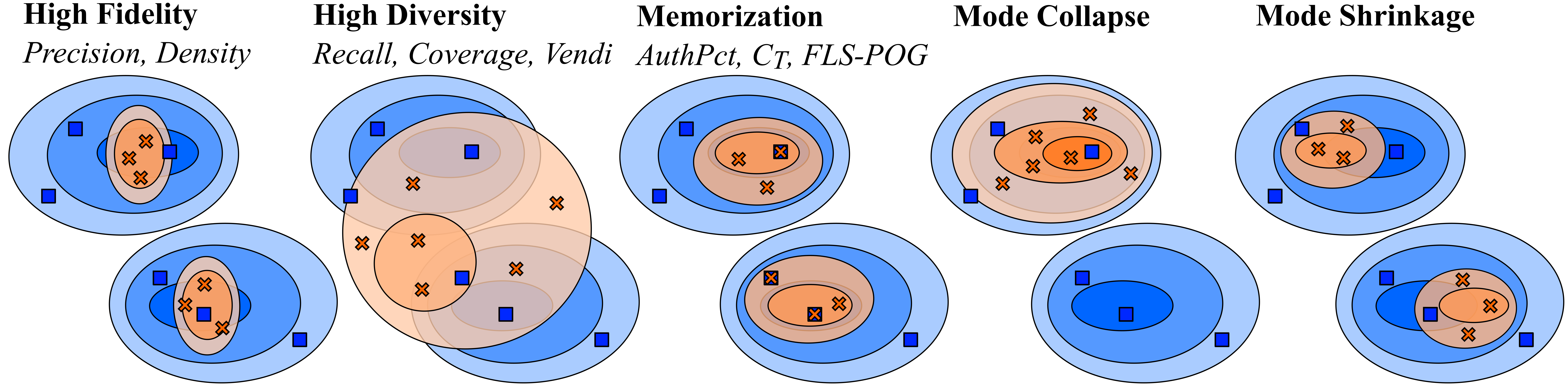
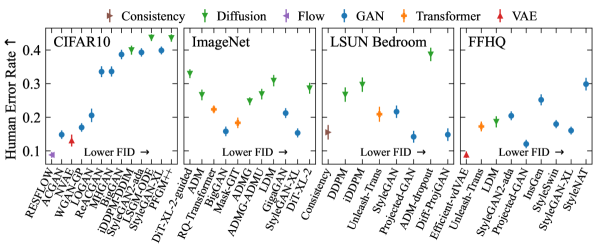
We systematically study a wide variety of generative models spanning semantically-diverse image datasets to understand and improve the feature extractors and metrics used to evaluate them. Using best practices in psychophysics, we measure human perception of image realism for generated samples by conducting the largest experiment evaluating generative models to date, and find that no existing metric strongly correlates with human evaluations. Comparing to 17 modern metrics for evaluating the overall performance, fidelity, diversity, rarity, and memorization of generative models, we find that the state-of-the-art perceptual realism of diffusion models as judged by humans is not reflected in commonly reported metrics such as FID. This discrepancy is not explained by diversity in generated samples, though one cause is over-reliance on Inception-V3. We address these flaws through a study of alternative self-supervised feature extractors, find that the semantic information encoded by individual networks strongly depends on their training procedure, and show that DINOv2-ViT-L/14 allows for much richer evaluation of generative models. Next, we investigate data memorization, and find that generative models do memorize training examples on simple, smaller datasets like CIFAR10, but not necessarily on more complex datasets like ImageNet. However, our experiments show that current metrics do not properly detect memorization: none in the literature is able to separate memorization from other phenomena such as underfitting or mode shrinkage. To facilitate further development of generative models and their evaluation we release all generated image datasets, human evaluation data, and a modular library to compute 17 common metrics for 9 different encoders at https://github.com/layer6ai-labs/dgm-eval.
연구 동기 및 목표
- 다양한 데이터 세트에 걸쳐 현재의 생성 모델 평가 지표가 현실감에 대한 인간 지각과 얼마나 잘 일치하는지 평가한다.
- 인코더 선택(Inception 대 SSL 기반)이 지표의 신뢰도에 어떤 영향을 미치는지 평가한다.
- 다양성, 희소성, 그리고 memorization을 각각의 평가 축으로 조사한다.
- 더 나은 평가 관행을 촉진하기 위해 9개의 인코더에 대해 17개의 지표를 계산하는 데이터 세트, 인간 평가 데이터 및 모듈식 dgm-eval 도구 세트를 제공한다.
제안 방법
- CIFAR10, ImageNet1k, FFHQ, LSUN-Bedroom에서 41개 모델에 대한 대규모 인간 평가를 수행하여 현실감을 측정한다.
- 모델당 100k 이미지를 생성하여 평가 데이터 세트를 형성한다.
- Inception-V3, ConvNeXt 및 일곱 개의 SSL 모델(SimCLRv2, DINOv2, SwAV, MAE, data2vec, CLIP OpenCLIP, DreamSim)을 포함하여 9개의 서로 다른 인코더를 사용하여 17개의 지표를 평가한다.
- 지표 점수를 인간이 평가한 현실감과 비교하여 상관관계와 신뢰성을 평가한다.
- 다양성(Vendi 점수), 희소성 및 memorization(pixel-wise 및 reconstructive)을 분석하여 지표-행동 차이를 설명한다.
- 생성된 데이터 세트, 인간 데이터 및 17개 지표를 포함한 모듈식 dgm-eval 라이브러리를 공개한다.
실험 결과
연구 질문
- RQ1다양한 데이터 세트에 걸쳐 현재의 생성 모델 평가 지표가 현실감에 대한 인간 판단과 상관관계가 있는가?
- RQ2Inception 대 SSL 기반과 같은 서로 다른 인코더가 FID, FD와 같은 평가 지표의 신뢰성에 어떤 영향을 미치는가?
- RQ3확산 모델이 Inception 기반 지표에 비해 GAN에 비해 불공정하게 불이익을 받는가, 그리고 SSL 기반 지표가 이를 해결할 수 있는가?
- RQ4기억화, 다양성, 그리고 희소성이 인간 판단과 지표 간의 불일치를 어느 정도 설명하는가?
주요 결과
- 어떤 기존 지표도 데이터 세트 전반에 걸쳐 인간 평가자와 강하게 상관되지 않는다.
- 확산 모델이 인간이 평가한 현실감에서 GAN보다 우수하지만 Inception 기반 지표(FID 등)로 하향 평가된다.
- Inception-V3를 DINOv2-ViT-L/14로 교체하면 지표와 인간 판단 사이의 정합성이 향상되고 더 풍부한 평가를 제공한다.
- CIFAR10에서 기억화가 명확하게 나타나나 ImageNet/FFHQ/LSUN에서는 뚜렷하지 않으며, 현재의 기억화 지표는 이를 신뢰성 있게 탐지하지 못한다.
- DINOv2 기반 FD 점수는 인간 판단과 더 잘 상관되며 Vendi로 클래스별 평가에서 다양성을 더 잘 포착하여 평가 능력이 향상되었음을 시사한다.
이 논문 읽기
누빈트 뷰어에서 원문을 열고, 읽으면서 궁금한 곳을 바로 물어보세요.
누빈트에서 이 논문 읽기이 리뷰는 AI가 논문 원문을 바탕으로 만들었습니다. 인용하기 전에 원문을 확인해 주세요.