
[논문 리뷰] Extracting Low-/High- Frequency Knowledge from Graph Neural Networks and Injecting it into MLPs: An Effective GNN-to-MLP Distillation Framework
이 논문은 스펙트럼 도메인 인수분해를 사용하여 사전 훈련된 GNN에서 저주파수 및 고주파수 지식을 추출하고 주입함으로써 학생 MLP에 전이하는 새로운 GNN-to-MLP distillation 프레임워크인 FF-G2M을 제안한다. 정보 침몰 문제(고주파수 지식이 훈련 과정에서 저주파수 지식에 의해 압도되는 현상)를 해결함으로써, FF-G2M는 일반 MLP보다 성능을 12.6% 향상시키고, 여섯 개의 데이터셋 평균에서 지도 GNN보다 2.6% 높은 성능을 기록한다.
Recent years have witnessed the great success of Graph Neural Networks (GNNs) in handling graph-related tasks. However, MLPs remain the primary workhorse for practical industrial applications due to their desirable inference efficiency and scalability. To reduce their gaps, one can directly distill knowledge from a well-designed teacher GNN to a student MLP, which is termed as GNN-to-MLP distillation. However, the process of distillation usually entails a loss of information, and ``which knowledge patterns of GNNs are more likely to be left and distilled into MLPs?" becomes an important question. In this paper, we first factorize the knowledge learned by GNNs into low- and high-frequency components in the spectral domain and then derive their correspondence in the spatial domain. Furthermore, we identified a potential information drowning problem for existing GNN-to-MLP distillation, i.e., the high-frequency knowledge of the pre-trained GNNs may be overwhelmed by the low-frequency knowledge during distillation; we have described in detail what it represents, how it arises, what impact it has, and how to deal with it. In this paper, we propose an efficient Full-Frequency GNN-to-MLP (FF-G2M) distillation framework, which extracts both low-frequency and high-frequency knowledge from GNNs and injects it into MLPs. Extensive experiments show that FF-G2M improves over the vanilla MLPs by 12.6% and outperforms its corresponding teacher GNNs by 2.6% averaged over six graph datasets and three common GNN architectures.
연구 동기 및 목표
- 산업 적용에서 GNN의 높은 정확도와 MLP의 추론 효율성 간 격차를 해소하기 위해.
- 기존 GNN-to-MLP distillation 방법이 성능에 떨어지는 이유, 특히 고주파수 지식 손실의 원인을 조사하기 위해.
- GNN에서 유도된 저주파수 및 고주파수 지식 패턴을 모두 유지함으로써 학생 MLP의 성능을 향상시키는 distillation 프레임워크를 개발하기 위해.
- 정보 침몰 문제를 공식적으로 규명하고 해결하기 위해, 이는 distillation 과정에서 고주파수 지식이 저주파수 지식에 의해 가려지는 현상이다.
제안 방법
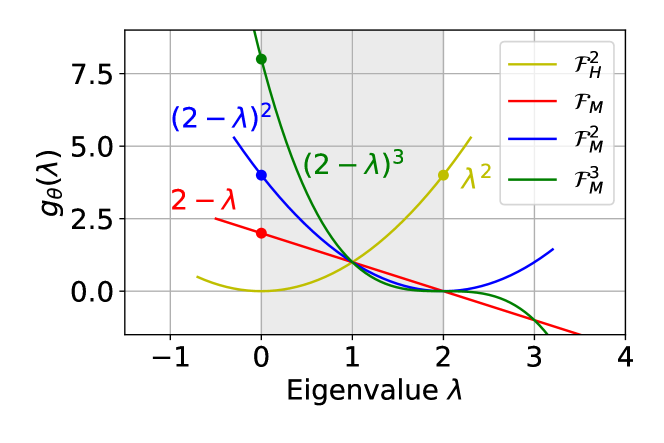
- 그래프 신호 처리를 활용해 스펙트럼 도메인에서 GNN가 학습한 지식을 저주파수 및 고주파수 성분으로 분해한다.
- 저주파수 및 고주파수 성분의 공간 도메인 대응 관계를 유도하여 MLP에 대한 distillation을 가능하게 한다.
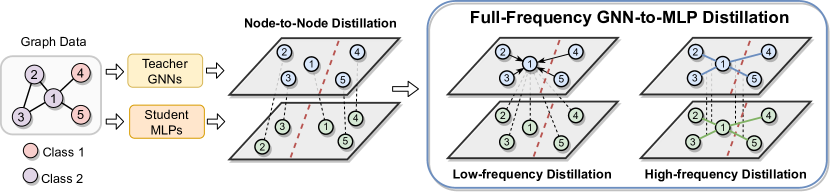
- 두 가지 별도의 distillation 손실을 설계한다: 저주파수 distillation(LFD)은 이웃 근처의 스무딩을 유지하고, 고주파수 distillation(HFD)은 노드 간 거리 차이를 유지한다.
- LFD와 HFD를 통합하여 저주파수 및 고주파수 지식을 동시에 최적화하는 통합된 전주파수 GNN-to-MLP(FF-G2M) 프레임워크를 구성한다.
- 저주파수 및 고주파수 지식 유지 정도를 정량화하기 위해 평균 코사인 유사도와 KL 발산을 평가 지표로 사용한다.
- 메시지 전달 지연 없이 전체 주파수 지식 전이가 가능한, LFD 및 HFD 손실을 함께 사용하여 학생 MLP를 훈련시킨다.
실험 결과
연구 질문
- RQ1GNN-to-MLP distillation 과정에서 어떤 종류의 지식(저주파수 대비 고주파수)이 손실에 가장 취약한가?
- RQ2정보 침몰 문제—고주파수 지식이 저주파수 지식에 의해 압도되는 현상—는 어떻게 발생하며, distillation 성능에 어떤 영향을 미치는가?
- RQ3저주파수 및 고주파수 성분을 동시에 distillation하는 것이 기존 방법보다 더 우수한 성능을 보이는 학생 MLP를 만들 수 있는가?
- RQ4GNN-to-MLP distillation에서 저주파수 지식과 고주파수 지식이 전체 모델 성능에 기여하는 비율은 각각 얼마인가?
- RQ5학생 모델에 데이터 의존성이나 지연을 재도입하지 않고도 두 유형의 지식을 모두 유지할 수 있는 방법이 있는가?
주요 결과
- 제안된 FF-G2M 프레임워크는 일반 MLP보다 성능을 12.6% 향상시키고, 여섯 개의 그래프 데이터셋 평균에서 해당 지도 GNN보다 2.6% 높은 성능을 기록한다.
- 표준 distillation 과정에서 고주파수 지식은 정보 침몰 현상으로 인해 자주 손실되며, 이는 저주파수 패턴이 distillation 과정를 지배하기 때문이다.
- 저주파수 distillation(LFD)만으로도 여섯 개의 데이터셋 전부에서 GLNN를 능가하며, 그래프 구조에 기인한 스무딩을 효과적으로 포착함을 입증한다.
- 고주파수 distillation(HFD)만으로도 일반 MLP보다 성능 향상을 이룰 수 있지만, LFD에 비해 보조적 역할을 하며 보조적인 기여를 한다.
- LFD와 HFD를 함께 사용한 FF-G2M는 상호 보완적 이점을 얻으며, 개별 구성 요소 및 기준 방법보다도 현저히 뛰어난 성능을 기록한다.
- 시각화 및 지표 분석을 통해 FF-G2M는 GLNN나 일반 MLP와 달리 이웃의 밀집도(저주파수)와 상대적 노드 위치 차이(고주파수)를 모두 효과적으로 유지함을 확인했다.
이 논문 읽기
누빈트 뷰어에서 원문을 열고, 읽으면서 궁금한 곳을 바로 물어보세요.
누빈트에서 이 논문 읽기이 리뷰는 AI가 논문 원문을 바탕으로 만들었습니다. 인용하기 전에 원문을 확인해 주세요.