
[논문 리뷰] FastComposer: Tuning-Free Multi-Subject Image Generation with Localized Attention
FastComposer는 로컬화된 크로스-어텐션과 지연된 컨디셔닝으로, tuned-free 이식 없이도 주제별, 다중 주제 이미지 생성을 가능하게 하며, 새로운 주제에 대한 저장 공간이 필요 없고 속도도 크게 향상됩니다.
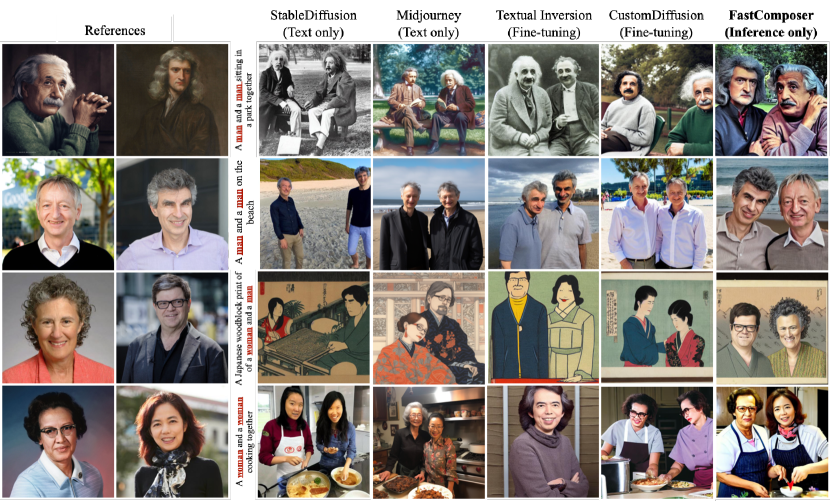
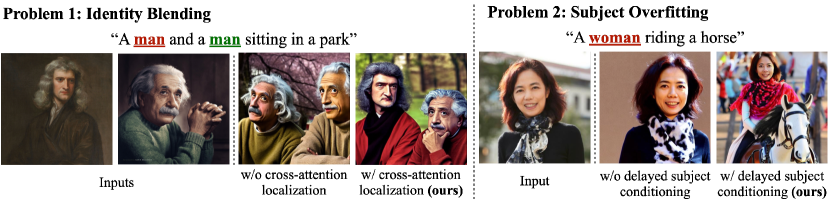
Diffusion models excel at text-to-image generation, especially in subject-driven generation for personalized images. However, existing methods are inefficient due to the subject-specific fine-tuning, which is computationally intensive and hampers efficient deployment. Moreover, existing methods struggle with multi-subject generation as they often blend features among subjects. We present FastComposer which enables efficient, personalized, multi-subject text-to-image generation without fine-tuning. FastComposer uses subject embeddings extracted by an image encoder to augment the generic text conditioning in diffusion models, enabling personalized image generation based on subject images and textual instructions with only forward passes. To address the identity blending problem in the multi-subject generation, FastComposer proposes cross-attention localization supervision during training, enforcing the attention of reference subjects localized to the correct regions in the target images. Naively conditioning on subject embeddings results in subject overfitting. FastComposer proposes delayed subject conditioning in the denoising step to maintain both identity and editability in subject-driven image generation. FastComposer generates images of multiple unseen individuals with different styles, actions, and contexts. It achieves 300$ imes$-2500$ imes$ speedup compared to fine-tuning-based methods and requires zero extra storage for new subjects. FastComposer paves the way for efficient, personalized, and high-quality multi-subject image creation. Code, model, and dataset are available at https://github.com/mit-han-lab/fastcomposer.
연구 동기 및 목표
- 참여 주제별 미세 조정을 대체하기 위해 reference 이미지에서 파생된 주제 임베딩으로 생성을 개인화한다.
- 훈련 중 크로스 어텐션 로컬라이제이션을 통해 다중 주제 생성에서 정체성 혼합을 완화한다.
- 추론 시 지연 주제 컨디셔닝으로 텍스트 기반 편집 가능성을 유지하며 주체 정체성을 보존한다.
- 새로운 다수의 보지 못한 주제에 대해 추론 전용 생성이 가능하도록 고충실도와 효율성을 확보한다.]
- method01
- method02
- method03
- method04
- method05
- method06
- method07
- method08
- method09
제안 방법
- 참조 이미지에서 파생된 주제 임베딩을 이미지 인코더와 MLP를 이용해 텍스트 임베딩과 융합하여 텍스트 프롬프트를 보강한다.
- 주제 보강 컨디셔닝과 크로스 어텐션 맵을 참조 세분화 마스크와 정렬시키는 로컬라이제이션 손실로 정체성 혼합을 방지하며 학습한다.
- 훈련 중 주제 세분화 마스크를 닮도록 크로스 어텐션 맵을 감독하여 로컬라이즈한다.
- 잡음 제거 과정에서 지연된 주제 컨디셔닝을 도입하고 레이아웃 확립을 위해 먼저 텍스트-전용 컨디셔닝을 적용한 후 과정의 후반에 주제 조건화 보강을 적용한다.
- FFHQ로부터 파노픽 마스크와 명사구 정렬을 포함한 주제 보강 이미지-텍스트 데이터셋을 구축하고, 주제 배경을 마스킹한 Stable Diffusion 기반 모델을 학습하여 일반화 성능을 향상한다.
실험 결과
연구 질문
- RQ1튜닝 프리 주제 임베딩으로도 파인튜닝 없이 개인화된 생성을 가능하게 할 수 있는가?
- RQ2크로스 어텐션 로컬라이제이션이 다중 주제 생성에서 정체성 혼합을 줄이는가?
- RQ3지연된 주제 컨디셔닝이 추론 시 정체성을 보존하면서 편집 가능성을 유지하는가?
- RQ4추론 전용 다중 주제 생성의 효율성 향상이 파인튜닝 기반 방법과 비교해 어떠한가?
주요 결과
- FastComposer는 파인튜닝 기반 방법에 비해 300배에서 1200배의 속도 향상과 2.8배의 메모리 감소를 달성한다.
- 새로운 주제에 대해 추가 저장 공간이 필요하지 않다.
- FastComposer를 이용한 단일 주제 생성은 정체성 보존이 더 높고 프롬프트 일관성도 기준과 비교해 경쟁력이 있다.
- 다중 주제 생성은 튜닝 기반 기준선보다 높은 정체성 보존을 유지하며 프롬프트 일관성도 유사 수준이다.
- 크로스 어텐션 로컬라이제이션은 주제 간 정체성 분리를 개선하며, 로컬라이제이션이 없을 때 정체성 보존이 낮아지는 Ablation 결과가 있다.
- 지연된 주체 컨디셔닝은 정체성 보존과 편집 가능성의 균형을 맞추며, 컨디셔닝 비율이 대략 0.6에서 0.8 사이일 때 최적의 결과를 보인다.
이 논문 읽기
누빈트 뷰어에서 원문을 열고, 읽으면서 궁금한 곳을 바로 물어보세요.
누빈트에서 이 논문 읽기이 리뷰는 AI가 논문 원문을 바탕으로 만들었습니다. 인용하기 전에 원문을 확인해 주세요.