
[논문 리뷰] Federated Learning for 6G: Paradigms, Taxonomy, Recent Advances and Insights
6G 프로토콜 스택 전반에 걸친 연합학습(Federated Learning)이 어떻게 통합될 수 있는지에 대한 포괄적 고찰로, PHY, MAC, 네트워크, 전송 및 응용 계층에서의 패러다임, 분류체계, 알고리즘 및 응용을 자세히 다룬다.
Artificial Intelligence (AI) is expected to play an instrumental role in the next generation of wireless systems, such as sixth-generation (6G) mobile network. However, massive data, energy consumption, training complexity, and sensitive data protection in wireless systems are all crucial challenges that must be addressed for training AI models and gathering intelligence and knowledge from distributed devices. Federated Learning (FL) is a recent framework that has emerged as a promising approach for multiple learning agents to build an accurate and robust machine learning models without sharing raw data. By allowing mobile handsets and devices to collaboratively learn a global model without explicit sharing of training data, FL exhibits high privacy and efficient spectrum utilization. While there are a lot of survey papers exploring FL paradigms and usability in 6G privacy, none of them has clearly addressed how FL can be used to improve the protocol stack and wireless operations. The main goal of this survey is to provide a comprehensive overview on FL usability to enhance mobile services and enable smart ecosystems to support novel use-cases. This paper examines the added-value of implementing FL throughout all levels of the protocol stack. Furthermore, it presents important FL applications, addresses hot topics, provides valuable insights and explicits guidance for future research and developments. Our concluding remarks aim to leverage the synergy between FL and future 6G, while highlighting FL's potential to revolutionize wireless industry and sustain the development of cutting-edge mobile services.
연구 동기 및 목표
- AI-네이티브 6G의 동기와 무선 시스템에서 프라이버시 보호 분산 학습을 가능하게 하는 FL의 역할을 설명한다.
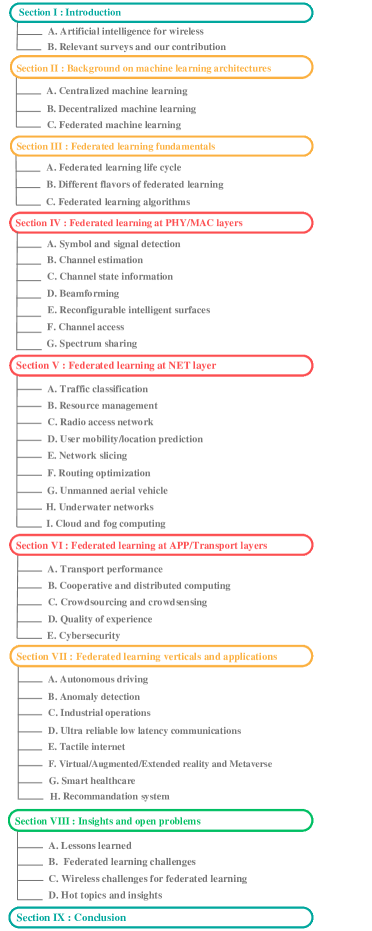
- 6G와 관련된 FL 패러다임(Horizontal, Vertical, Federated Transfer)과 관련 아키텍처의 분류체계를 제시한다.
- 물리 계층(PHY), MAC, NET, 전송 및 응용 계층 전반에 걸친 FL 응용 및 기법을 평가한다.
- 6G 및 그 이상의 미래 영역에서 FL의 통합을 이끌기 위한 도전 과제, 시사점 및 해결해야 할 문제들을 식별한다.
제안 방법
- FL의 기본 원리, 수명 주기, flavors 및 알고리즘을 조사하고 종합한다.
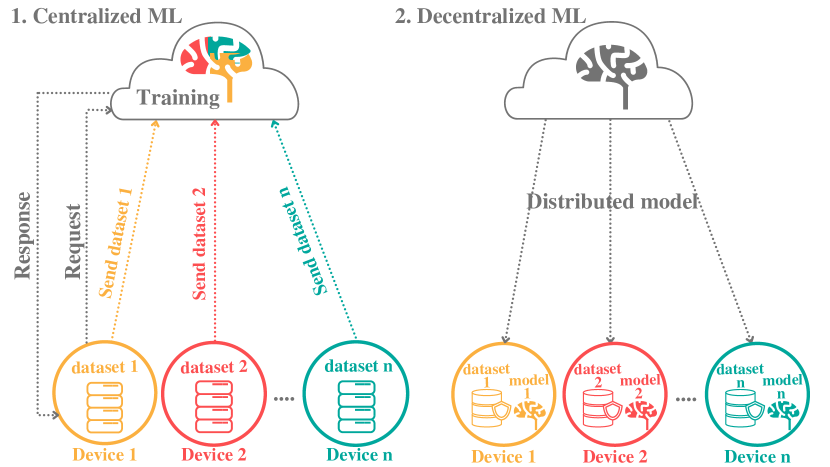
- 프라이버시, 확장성 및 이질성 맥락에서 중앙 집중형 ML, 분산 ML 및 FL을 비교한다.
- 대표적 아키텍처와 프레임워크를 활용하여 PHY, MAC, NET 및 APP 계층에서의 FL 응용을 분석한다.
- 기존 FL 알고리즘(FedAvg, FedSGD, FedProx, FedATT, SimFL)의 정리 및 장단점을 제시한다.
실험 결과
연구 질문
- RQ16G 무선 생태계의 요구에 가장 잘 부합하는 FL 패러다임과 분류체계는 무엇인가?
- RQ2성능 향상과 프라이버시 보장을 위해 PHY, MAC, NET, 전송 및 응용 계층 전반에 걸쳐 FL을 어떻게 배치할 수 있는가?
- RQ36G 무선 네트워크에 FL을 적용하는 데 있어 주요 도전과제와 해결해야 할 이슈는 무엇이며, 어떤 시사점이 향후 연구를 이끄는가?
- RQ4다른 무선 시나리오와 데이터 분포(IID 대 non-IID)에 가장 적합한 FL 알고리즘과 프레임워크는 무엇인가?
주요 결과
- FL은 중앙집중형 ML 및 순수 분산 ML에 비해 프라이버시 보호, 확장성 및 통신 효율성을 갖춘 무선 네트워크에 적합한 학습을 제공합니다.
- FL은 프로토콜 스택 전반에 통합될 수 있으며, PHY에서 APP 계층의 문제를 해결하는 데 있어 효율성과 강건성 측면에서 주목할 만한 이점을 제공합니다.
- 다양한 FL 패러다임(Horizontal, Vertical, Federated Transfer)이 6G 맥락의 다양한 데이터 분포 시나리오를 포괄합니다.
- 수렴 속도, 데이터 이질성 처리 및 통신 오버헤드에서의 트레이드오프를 갖는 다양한 FL 알고리즘이 존재합니다.
- FL을 위한 기존 ML 프레임워크(TFF, PySyft, LEAF, PaddleFL, FATE, IBM FL, FedML)는 실용적인 개발과 실험을 지원합니다.
- 데이터의 비IID성, 동기화, 통신 오버헤드, 이질적인 디바이스 능력 등의 문제는 여전히 남아 있으며, 알고리즘적 및 아키텍처적 해결이 필요합니다.
이 논문 읽기
누빈트 뷰어에서 원문을 열고, 읽으면서 궁금한 곳을 바로 물어보세요.
누빈트에서 이 논문 읽기이 리뷰는 AI가 논문 원문을 바탕으로 만들었습니다. 인용하기 전에 원문을 확인해 주세요.