
[논문 리뷰] FedLoGe: Joint Local and Generic Federated Learning under Long-tailed Data
FedLoGe는 긴급한 데이터 분포 하에서 표현 학습을 통해 희소 등각 티그트 프레임 분류기(SSE-C)와 적응형 특징 재정렬을 통한 글로벌 및 개인화 모델을 동시에 최적화하는 통합된 분산 학습 프레임워크를 제안한다. 글로벌 및 개인화된 성능을 향상시키기 위해 신경 붕괴 기반 설계를 통해 CIFAR-10/100-LT, ImageNet 및 iNaturalist에서 최신 기준 성능을 달성한다.
Federated Long-Tailed Learning (Fed-LT), a paradigm wherein data collected from decentralized local clients manifests a globally prevalent long-tailed distribution, has garnered considerable attention in recent times. In the context of Fed-LT, existing works have predominantly centered on addressing the data imbalance issue to enhance the efficacy of the generic global model while neglecting the performance at the local level. In contrast, conventional Personalized Federated Learning (pFL) techniques are primarily devised to optimize personalized local models under the presumption of a balanced global data distribution. This paper introduces an approach termed Federated Local and Generic Model Training in Fed-LT (FedLoGe), which enhances both local and generic model performance through the integration of representation learning and classifier alignment within a neural collapse framework. Our investigation reveals the feasibility of employing a shared backbone as a foundational framework for capturing overarching global trends, while concurrently employing individualized classifiers to encapsulate distinct refinements stemming from each client's local features. Building upon this discovery, we establish the Static Sparse Equiangular Tight Frame Classifier (SSE-C), inspired by neural collapse principles that naturally prune extraneous noisy features and foster the acquisition of potent data representations. Furthermore, leveraging insights from imbalance neural collapse's classifier norm patterns, we develop Global and Local Adaptive Feature Realignment (GLA-FR) via an auxiliary global classifier and personalized Euclidean norm transfer to align global features with client preferences. Extensive experimental results on CIFAR-10/100-LT, ImageNet, and iNaturalist demonstrate the advantage of our method over state-of-the-art pFL and Fed-LT approaches.
연구 동기 및 목표
- 기존 방법이 균형 잡힌 데이터를 가정하거나 글로벌 모델만 최적화하는 바탕으로, 긴급한 데이터 하에서 개인화된 클라이언트 성능를 간과하는 문제를 해결하기 위해.
- 긴급하고 이질적인 클라이언트 데이터를 가진 분산 학습에서 글로벌 모델과 개인화된 모델 성능을 동시에 향상시키기 위해.
- 희소하고 등각 티그트 프레임 분류기를 통해 잡음이 많은 특징을 제거하고 주도적인 특징을 강화함으로써 표현 학습 메커니즘을 설계하기 위해.
- 노름 기반 재정렬을 통해 글로벌 및 로컬 특징을 신속하고 적응적으로 정렬하여 클라이언트 고유의 선호도를 유지하기 위해.
- 실제 긴급한 설정에서 CIFAR-100-LT, ImageNet 및 iNaturalist를 포함한 다양한 벤치마크에서 프레임워크를 검증하기 위해.
제안 방법
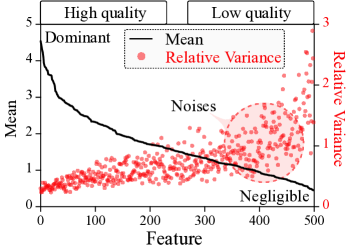
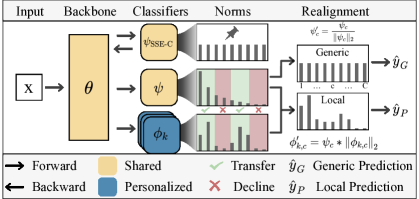
- 희소하고 구조화된 분류기인 정적 희소 등각 티그트 프레임 분류기(SSE-C)를 도입하여, 등각성과 희소성을 강제로 적용함으로써 잡음이 많은 특징을 억제하고 표현 학습을 향상시킨다.
- 글로벌 표현 학습을 위한 공유 백본을 사용하면서도, 클라이언트 고유의 분류기를 통해 로컬 데이터 분포에 적응할 수 있도록 한다.
- 신경 붕괴 원리를 적용하여 클래스 평균과 특징 프로토타입의 수렴을 유도함으로써 일반화 및 안정성을 향상시킨다.
- 보조 글로벌 분류기와 개인화된 유클리드 노름 전달을 활용하여 글로벌 및 로컬 특징 재정렬을 위한 글로벌 및 로컬 적응형 특징 재정렬(GLA-FR)을 설계한다.
- 학습 안정성과 수렴 개선을 위해 가속도 인자 γ를 가진 노름 등가 손실을 사용한다.
- 특징의 크기를 기반으로 분류기 가중치에 대한 희소 자르기 기법을 적용하여 영향력이 낮고 분산이 큰 특징을 선택적으로 제거함으로써 강건성을 향상시킨다.
실험 결과
연구 질문
- RQ1공유 백본과 희소한 구조적 분류기를 사용하면 긴급한 데이터 하에서 분산 학습의 표현 학습을 향상시킬 수 있는가?
- RQ2데이터가 긴급하고 이질적인 상황에서 글로벌 및 개인화된 모델 성능을 동시에 최적화할 수 있는가?
- RQ3분류기의 희소성과 등각성이 불균형한 분산 환경에서 잡음 감소 및 특징 품질 향상에 얼마나 기여하는가?
- RQ4노름 전달을 통한 적응형 특징 재정렬은 글로벌 성능을 훼손시키지 않고도 효과적으로 글로벌 특징을 클라이언트 고유의 선호도에 맞출 수 있는가?
- RQ5SSE-C와 GLA-FR의 통합이 다양한 긴급 벤치마크에서 일관된 성능 향상을 이끌어낼 수 있는가?
주요 결과
- FedLoGe는 CIFAR-100-LT에서 최신 기준 성능을 달성하였으며, 모든 클래스 그룹에서 글로벌 모델 및 개인화된 모델 정확도 면에서 모든 베이스라인을 압도한다.
- ImageNet-LT 및 iNaturalist-160k에서 FedLoGe는 중간 및 꼬리 클래스에서 특히 뚜렷한 정확도 향상을 보이며, 긴급 분포에 대한 강건성을 입증한다.
- 제거 실험을 통해 SSE-C는 밀도 있는 ETF 대비 글로벌 및 개인화된 모델 성능 향상을 확인하였으며, GLA-FR와 조합했을 때 최적 성능를 기록한다.
- SSE-C에서 의미 없는 특징(낮은 평균 크기)을 제거하는 것은 성능에 거의 영향을 주지 않지만, 주도적인 특징을 제거하면 성능이 급격히 떨어지므로 효과적인 특징 우선순위 부여가 이루어졌음을 확인한다.
- 민감도 분석 결과, CIFAR-10/100-LT에서는 γ 값 1.0이 최적이며, ImageNet 및 iNaturalist에서는 1.6가 최적임을 확인하였으며, SSE-C에서 약 60%의 희소도에서 성능이 최고에 이르렀다.
- 90%까지의 높은 희소도에서도 모델이 강력한 성능 유지를 보이며, 이는 희소성이 성능을 떨어뜨리는 것이 아니라 오히려 강건성을 향상시킨다는 것을 시사한다.
이 논문 읽기
누빈트 뷰어에서 원문을 열고, 읽으면서 궁금한 곳을 바로 물어보세요.
누빈트에서 이 논문 읽기이 리뷰는 AI가 논문 원문을 바탕으로 만들었습니다. 인용하기 전에 원문을 확인해 주세요.