
[논문 리뷰] Feedback-Free Starbursts at Cosmic Dawn: Observable Predictions for JWST
논문은 표준 우주론에서 분석적 피드백 없는 스타버스트(FFB) 모델을 확장하여 JWST 관측 가능 고적점 고갈 은하의 특성을 예측하며, 증가된 별 형성 효율성, 별질량 및 UV 광도 함수, 그리고 버스트형 별 형성 이력을 포함한다.
We extend the analysis of a physical model within the standard cosmology that robustly predicts a high star-formation efficiency (SFE) in massive galaxies at cosmic dawn due to feedback-free starbursts (FFBs). It implies an excess of bright galaxies at z>~10 compared to the standard models based on the low SFE at later epochs, an excess indicated by JWST observations. Here we provide observable predictions based on the analytic FFB scenario. These can be compared with simulations and JWST observations. We approximate the SFE as a function of redshift and mass, assuming a maximum SFE of 0.2~1 in the FFB regime. From this, we derive the evolution of the galaxy mass and luminosity functions as well as the evolution of stellar and star-formation densities. We then predict the star-formation history (SFH), galaxy sizes, outflows, gas fractions, metallicities, and dust attenuation, all as functions of mass and redshift in the FFB regime. The major distinguishing feature is the occurrence of FFBs above a mass threshold that declines with redshift. The luminosities and star formation rates in bright galaxies are predicted to be in excess of extrapolations of standard empirical models and cosmological simulations, an excess that grows from z~9 to higher redshifts. The FFB phase of ~100 Myr is predicted to show a characteristic SFH that fluctuates on a timescale of ~10 Myr. The stellar systems are compact (Re~0.3 kpc at z~10 and declining with z). The galactic gas consists of a steady wind driven by supernovae from earlier generations, with high outflow velocities (FWHM~1400-6700km/s), low gas fractions (<0.1), low metallicities (<~0.1 solar), and low dust attenuation ($A_{UV}$~0.5 at z~10 and declining with z). We make tentative comparisons with current JWST observations for initial insights, anticipating more complete and reliable datasets for detailed quantitative comparisons in the future.
연구 동기 및 목표
- 코스믹 dawn에서 피드백 없는 스타버스트(FFB)로 인한 대형 은하에서 높은 별 형성 효율이 기대된다는 점을 동기화한다.
- FFB 프레임워크 내에서 적색편이(z)와 헤일로 질량에 대한 해석적 SFE를 도출한다.
- FFB 영역 하에서 관측 가능한 은하 특성(질량 및 광도 함수, 밀도, 크기, 가스 분수, 금속 함량, 먼지)을 예측한다.
- FFB 예측을 외삽된 고-z UM 모델 및 표준 SAM과 비교하고 초기 JWST 관측 인상을 논의한다.
- 공동체 사용을 위한 FFB 예측 재현용 디지털 표와 코드 제공을 한다.
제안 방법
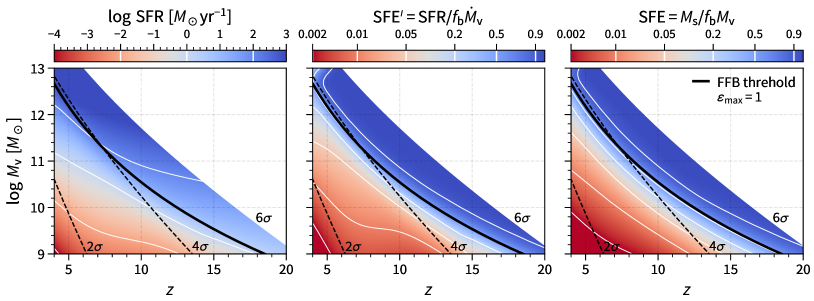
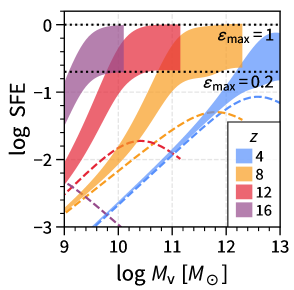
- FFB 시나리오를 SFE가 UM과 유사한 낮은 값에서 FFB 영역의 최대 SFE epsilon_max로 전이되는 형태로 표현한다(epsilon_max는 0.2–1 범위).
- SFR을 <SFR_ffb> = epsilon_max f_b dot{M}_v 위의 FFB 임계치 M_v,ffb(z)에서 임계치를 가로질러 부드럽게 전이시키는 시그모이드 함수로 모델링한다.
- 질량 적분 시간 차이인 SFR_um+ffb와 SFR_um의 차이를 UM 기준선에 더해 median stell ar mass M_s(M_v,z)을 계산한다(Eq. 7).
- 질량 함수 Phi(log M_s)을 조건부 M_s|M_v와 헤일로 질량 함수 n(M_v)를 컨볼루션하여 도출한다(Eq. 10).
- M_v에서 고정된 M_v의 가우시안 분포 및 M_s와의 중간 관계를 이용해 UV 광도 함수 Phi(M_UV)을 도출한다(Eq. 11, Eq. 12).
- 예상된 질량 및 광도 함수로부터 우주 밀도 rho_s(z), rho_UV(z), rho_SFR(z)를 추정한다(Eqs. 13–15).
실험 결과
연구 질문
- RQ1피드백 없는 스타버스트(FFB)가 은하의 형성을 지배하는 붕괴적 질량 및 헤일로 질량 범위는 어디인가?
- RQ2FFB가 z ≳ 6–15에서 표준 모델과 비교하여 stell ar mass function 및 UV 광도 함수를 어떻게 수정하는가?
- RQ3FFB 영역에서의 예상 우주 밀도(별, UV, SFR)는 무엇이며 어떻게 진화하는가?
- RQ4FFB 은하에서의 특징적 별 형성 이력 및 관측 가능한 버스트 신호는 무엇인가?
- RQ5FFB 예측이 UniverseMachine/프로젝션 UM 외삽 및 JWST 데이터와 어떻게 비교되는가?
주요 결과
- FFB는 질량-적색편차 임계선 M_v,ffb(z)를 확립하고, 이 임계치를 넘은 은하들은 epsilon_max가 최대 1까지 도달하는 FFB 영역에 진입한다(0.2–1 범위 탐색).
- FFB는 redshift ≥ 6에서 표준 UM/SAM 모델에 비해 더 밝은 UV 광도 함수와 더 큰 별질량을 예측하며, 적색편이가 높을수록 과잉이 커진다.
- epsilon_max = 0.2–1인 경우 질량 함수는 z ∼ 10 및 그 이후까지 M_s ≳ 10^9–10^10 M_sun인 질량이 큰 은하가 더 풍부하게 나타난다.
- FFB 시나리오의 UVLF는 UM/SAM에 비해 특히 z ∼ 9–12에서 크게 상승하며 먼지 보정 후에도 차이가 남고, epsilon_max ∼ 0.2–0.5일 때 z ∼ 12에서 초기 JWST 데이터와 맞출 가능성이 있다.
- FFB 단계는 약 ~100 Myr 지속되며 ~10 Myr 간섭이 있는 버스트형 SFH를 특징으로 하고, 은하 크기는 촘촘하고(R_e ≈ 0.3 kpc at z ∼ 10), 바람 속도: FWHM ≈ 1400–6700 km/s, 가스 분율은 0.1 미만, 금속 함량은 ≲ 0.1 Z_sun, UV 차단 A_UV ≈ 0.5 (z ∼ 10)로 z가 증가할수록 감소한다.
- JWST 데이터와의 비교에 따르면 epsilon_max ∼ 0.2–0.5에 대해 대략적인 일관성이 시사되지만, 결과는 초기 단계이며 완전한 데이터에 좌우된다.
- 저자들이 제공하는 예측 재현용 디지털 표와 코드를 제공한다.
이 논문 읽기
누빈트 뷰어에서 원문을 열고, 읽으면서 궁금한 곳을 바로 물어보세요.
누빈트에서 이 논문 읽기이 리뷰는 AI가 논문 원문을 바탕으로 만들었습니다. 인용하기 전에 원문을 확인해 주세요.