
[논문 리뷰] Fermionic quantum criticality through the lens of topological holography
이 논문은 (1+1)d 시스템에서 페르미온 양자临계점과 급작스럽게 열리는 상태를 연구하기 위해 위상적 홀로그래피 프레임워크를 제안한다. 이는 한 차원 높은 곳에서의 대칭 위상장이론(SymTFT)을 사용하여 페르미온 전역 대칭과 스핀 구조를 코딩한다. 페르미온화된 SymTFT 경계를 통해 기이한 양자临계점, 즉 페르미온 대칭 강화 및 급작스럽게 열린 SPT/SSB 상태를 식별하고, $Χ_2^F$, $Χ_2\timesΧ_2^F$, $Χ_4^F$, 비가역적 $\text{Rep}(S_3)$ 대칭 하에서 고립된 상태와 전이를 분류한다.
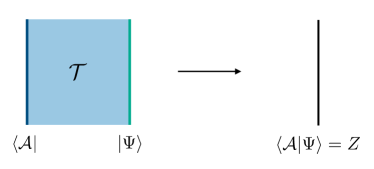
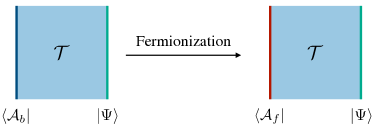
We utilize the topological holographic framework to characterize and gain insights into the nature of quantum critical points and gapless phases in fermionic quantum systems. Topological holography is a general framework that describes the generalized global symmetry and the symmetry charges of a local quantum system in terms of a slab of a topological order, termed as the symmetry topological field theory (SymTFT), in one higher dimension. In this work, we consider a generalization of the topological holographic picture for $(1+1)d$ fermionic quantum phases of matter. We discuss how spin structures are encoded in the SymTFT and establish the connection between the formal fermionization formula in quantum field theory and the choice of fermionic gapped boundary conditions of the SymTFT. We demonstrate the identification and the characterization of the fermionic gapped phases and phase transitions through detailed analysis of various examples, including the fermionic systems with $\mathbb{Z}_{2}^{F}$, $\mathbb{Z}_{2} imes \mathbb{Z}_{2}^{F}$, $\mathbb{Z}_{4}^{F}$, and the fermionic version of the non-invertible $ ext{Rep}(S_{3})$ symmetry. Our work uncovers many exotic fermionic quantum critical points and gapless phases, including two kinds of fermionic symmetry enriched quantum critical points, a fermionic gapless symmetry protected topological (SPT) phase, and a fermionic gapless spontaneous symmetry breaking (SSB) phase that breaks the fermionic non-invertible symmetry.
연구 동기 및 목표
- 위상적 홀로그래피 프레임워크를 (1+1)d 페르미온 양자 시스템으로 확장하여 일반화된 전역 대칭과 그 이상성(anomalies)을 기술한다.
- SymTFT의 고립된 경계 조건과 양자장론에서의 페르미온화 절차 사이의 정확한 대응 관계를 수립한다.
- 다양한 페르미온 전역 대칭, 즉 $Χ_2^F$, $Χ_2\timesΧ_2^F$, $Χ_4^F$, 비가역적 $\text{Rep}(S_3)$ 하에서 고립된 상태와 양자临계점의 분류 및 특성화를 수행한다.
- 명시적인 예시를 통해 새로운 페르미온 양자临계점, 즉 대칭 강화, 급작스럽게 열린 SPT, 급작스럽게 열린 SSB 상태를 식별하고 분석한다.
- 스핀 구조와 페르미온 통계가 위상적 바탕(SymTFT)에서 어떻게 유도되고 경계 조건 및 anyon 응집 패턴에 어떻게 코딩되는지 보여준다.
제안 방법
- (2+1)d SymTFT를 사용한 위상적 홀로그래피 '샌드위치' 구조를 활용하여, (1+1)d 페르미온 시스템을 특정 anyon 바탕과 고립된 경계 조건을 가진 (2+1)d SymTFT의 경계로 실현한다.
- SymTFT 내에서 초대칭 라그랑지안 대수 구조를 통한 페르미온화를 적용하여, 페르미온 경계 조건의 선택이 경계 이론의 스핀 구조와 통계에 어떻게 연결되는지 분석한다.
- 양자장론에서의 공식적 페르미온화 공식을 적용하여, $Χ_2$ 대칭을 가진 보존 SymTFT를 anyon 응집을 통해 페르미온 SymTFT로 변환한다.
- 특히 $e$, $m$, $f$ 및 그 조합의 anyon 응집을 분석하여 SymTFT 바탕에서 가능한 anyon 응집을 분류함으로써 고립된 상태와 전이를 분석한다.
- 토리크 코드에서 스핀 구조(A/P)와 anyon 기저의 분할 함수 사이의 대응 관계를 사용하여, 페르미온 최소 모델 분할 함수를 유도한다.
- 초대칭 라그랑지안 대수의 개념을 활용하여, 페르미온 고립 경계를 분류하고 경계 CFT에서 페르미온 대칭 전하와 통계의 기원을 식별한다.
실험 결과
연구 질문
- RQ1위상적 홀로그래피 프레임워크는 (1+1)d 양자 시스템에서 페르미온 전역 대칭과 그 이상성의 특성을 기술하기 위해 어떻게 일반화될 수 있는가?
- RQ2스핀 구조는 SymTFT 구성에서 어떤 정확한 역할을 하는가? 그리고 경계 조건과 anyon 응집 패턴에 어떻게 코딩되는가?
- RQ3비가역적 또는 고차원 대칭, 예를 들어 $Χ_4^F$ 또는 $\text{Rep}(S_3)$ 대칭을 가진 페르미온 시스템에서 어떤 기이한 양자临계점이 나타나는가?
- RQ4SymTFT 바탕에서의 페르미온화와 anyon 응집은 경계 이론에서 고립된 SPT 및 SSB 상태의 기원에 어떻게 기여하는가?
- RQ5SymTFT 프레임워크를 사용하여 $Χ_2^F$, $Χ_2\timesΧ_2^F$, $Χ_4^F$, $\text{Rep}(S_3)$ 대칭을 가진 페르미온 사슬에서 고립된 상태와 전이의 분류는 어떻게 이루어지는가?
주요 결과
- 논문은 비트리비얼한 anyon 응집 패턴에서 기인하는 두 가지 다른 유형의 페르미온 대칭 강화 양자临계점(SPT-SSB 및 SPT-키타에프)을 SymTFT 구성으로 식별한다.
- 특히 $Χ_4^F$ 대칭을 가진 사슬에서는 새로운 페르미온 급작스럽게 열린 SPT 상태가 나타나며, 이는 페르미온 대칭을 유지하지만 바탕의 위상적 순서를 깨뜨리는 비트리비얼한 anyon 응집 패턴으로 특징지어진다.
- $Χ_2\timesΧ_2^F$ 대칭의 경우, 비트리비얼한 고립된 경계 조건이 존재하며, 이는 $Χ_2^D$ 모odulo 이소스 모델로 기술되며, 중심 전하 $c=1/2$ 를 가진 비트리비얼 고정점으로 식별된다.
- $Χ_2\timesΧ_2^F$ 시스템에서 GW와 SSB 상태 사이의 전이는 이소스 모델과 메이저라 페르미온이 결합된 이론으로 기술되며 중심 전하 $c=1$ 을 가진다.
- $Χ_4^F$ 대칭 시스템에서, 비트리비얼 상태와 SSB 상태 사이의 임계점은 자유 메이저라 페르미온과 결합된 3-포츠 모델로 기술되며 중심 전하 $c=1.75$ 를 가진다.
- 비가역적 $\text{Rep}(S_3)$ 대칭의 경우, 비트리비얼 상태와 SSB 상태 사이의 임계점은 중심 전하 $c=1.75$ 를 가진 $m=5$ 페르미온 최소 모델로 식별되며, 키타에프와 SSB 상태 사이의 전이 역시 동일한 $m=5$ 페르미온 최소 모델로 기술된다.
이 논문 읽기
누빈트 뷰어에서 원문을 열고, 읽으면서 궁금한 곳을 바로 물어보세요.
누빈트에서 이 논문 읽기이 리뷰는 AI가 논문 원문을 바탕으로 만들었습니다. 인용하기 전에 원문을 확인해 주세요.