
[논문 리뷰] Finding the right XAI method -- A Guide for the Evaluation and Ranking of Explainable AI Methods in Climate Science
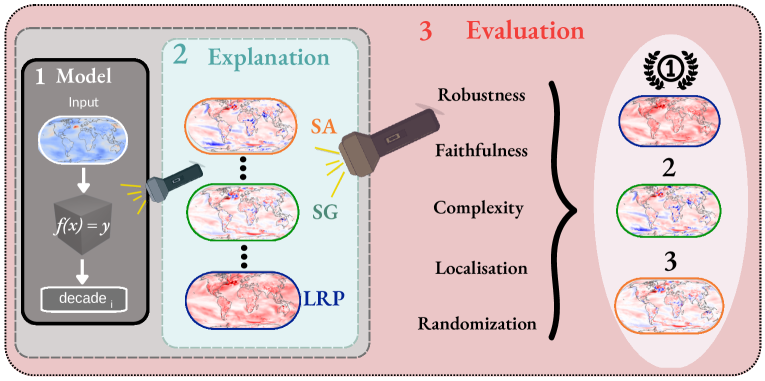
논문은 기후에 초점을 맞춘 XAI 평가 프레임워크를 제시하고, 로컬 XAI 방법들을 강건성, 충실도, 무작위화, 로컬라이제이션, 복잡성 측면에서 비교하며, 기후 과제에 적합한 XAI 방법을 랭크하고 선택하기 위한 가이드라인을 제공한다.
Explainable artificial intelligence (XAI) methods shed light on the predictions of machine learning algorithms. Several different approaches exist and have already been applied in climate science. However, usually missing ground truth explanations complicate their evaluation and comparison, subsequently impeding the choice of the XAI method. Therefore, in this work, we introduce XAI evaluation in the climate context and discuss different desired explanation properties, namely robustness, faithfulness, randomization, complexity, and localization. To this end, we chose previous work as a case study where the decade of annual-mean temperature maps is predicted. After training both a multi-layer perceptron (MLP) and a convolutional neural network (CNN), multiple XAI methods are applied and their skill scores in reference to a random uniform explanation are calculated for each property. Independent of the network, we find that XAI methods Integrated Gradients, layer-wise relevance propagation, and input times gradients exhibit considerable robustness, faithfulness, and complexity while sacrificing randomization performance. Sensitivity methods -- gradient, SmoothGrad, NoiseGrad, and FusionGrad, match the robustness skill but sacrifice faithfulness and complexity for randomization skill. We find architecture-dependent performance differences regarding robustness, complexity and localization skills of different XAI methods, highlighting the necessity for research task-specific evaluation. Overall, our work offers an overview of different evaluation properties in the climate science context and shows how to compare and benchmark different explanation methods, assessing their suitability based on strengths and weaknesses, for the specific research problem at hand. By that, we aim to support climate researchers in the selection of a suitable XAI method.
연구 동기 및 목표
- 기후과학에서 ground-truth 설명의 부족을 해결하여 기후과학에서 신뢰할 수 있는 XAI를 촉진한다.
- 설명을 정량화하기 위한 다섯 가지 특성을 가진 형식적 평가 프레임워크를 제안한다.
- 기후 관련 데이터로 CNN 및 MLP 아키텍처에서 다수의 로컬, 모델-의식 XAI 방법을 비교한다.
- 연구자들이 기후 작업에 적합한 XAI 방법을 선택하는 데 도움을 주는 랭킹 가이드를 제공한다.
제안 방법
- CESM1 2m 온도 지도(1920–2080)에서 MLP와 CNN을 학습시켜 10년대를 예측하고, 평가를 위해 20개 클래스 분류와 연도 회귀를 사용한다.
- Gradient, InputGradients, Integrated Gradients, Layerwise Relevance Propagation, SmoothGrad, NoiseGrad, FusionGrad 를 이용하여 예측에 대한 설명에 대한 로컬-모델 인식 XAI 방법들을 적용한다.
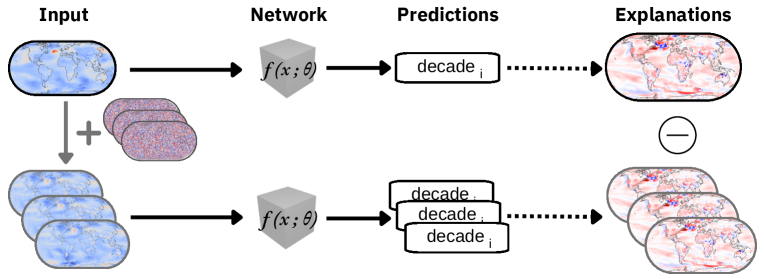
- 다섯 가지 XAI 평가 특성(강건성, 충실도, 무작위화, 로컬라이제이션, 복잡성)과 해당 지표들(예: Local Lipschitz Estimate, Avg-sensitivity, ROAD, Faithfulness Correlation, TopK, RRA, 엔트로피, 지니 지수 기반 희소성)을 정의하고 계산한다.
- 기후 데이터의 메트릭 타당성을 평가하기 위해 무작위 기준 테스트를 사용하여 메트릭 점수를 방법 간에 정규화하고 비교한다.
- 특성별로 XAI 방법을 순위를 매기고 특정 기후 작업에 적합한 방법을 선택하는 데 대한 지침을 제공한다.
실험 결과
연구 질문
- RQ1어떤 XAI 방법들이 기후 모델 예측에 대해 강건하고 충실하며 로컬화된 설명을 제공하는가?
- RQ2CNN과 MLP 아키텍처의 기후 데이터에 대해 모델-의식 로컬 XAI 방법은 강건성, 충실도, 로컬라이제이션, 무작위화, 복잡성 측면에서 어떻게 비교되는가?
- RQ3평가 기반 랭킹 체계가 기후 과학 적용에서 적절한 XAI 방법을 선택하는 데 실무자들에게 도움이 될 수 있는가?
주요 결과
- Integrated Gradients, Layer-wise Relevance Propagation (LRP) 및 InputGradients는 강건성, 충실도는 우수하고 복잡도는 중간 수준이지만 무작위화는 낮다.
- Gradient 계열 방법(Gradient, SmoothGrad, NoiseGrad, FusionGrad)은 대체로 강건성과 충실도가 약하지만 무작위화 특성은 개선된다.
- 입력 섭동을 이용한 설명(SmoothGrad, FusionGrad)이 기후 데이터에서 일관되게 강건성/충실도를 향상시키지 않는다.
- 동일 예측에 대한 XAI 방법 간 설명의 변동성이 크게 나타나며, 방법 선택이 과학적 결론에 미치는 위험을 강조한다(예: 북대서양 지역의 중요도는 방법에 따라 달랐다).
- 본 연구는 메트릭 기반 가이드라인과 기후 과제 요구사항에 맞춘 XAI 방법 선정 랭킹 프레임워크를 제공한다.
이 논문 읽기
누빈트 뷰어에서 원문을 열고, 읽으면서 궁금한 곳을 바로 물어보세요.
누빈트에서 이 논문 읽기이 리뷰는 AI가 논문 원문을 바탕으로 만들었습니다. 인용하기 전에 원문을 확인해 주세요.