
[논문 리뷰] Fine-tuning multilingual language models in Twitter/X sentiment analysis: a study on Eastern-European V4 languages
이 연구는 러시아-우크라이나 전쟁 기간 동안 동유럽 V4 언어(체코어, 슬로바크어, 폴란드어, 헝가리어)의 트위터/X 데이터를 대상으로 다국어 LLM을 미세조정하여 요소 기반 감성 분석을 수행한다. 훈련 데이터가 제한되어 있음에도 불구하고(최소 6,000건의 트윗), DeepL 번역을 활용한 미세조정된 Llama2 및 Mistral 모델이 문맥 기반 GPT-4 및 기타 모델을 능가하여 SOTA 수준의 성능을 달성하였으며, 이는 모델 및 언어에 특화된 미세조정 효과를 시사한다.
The aspect-based sentiment analysis (ABSA) is a standard NLP task with numerous approaches and benchmarks, where large language models (LLM) represent the current state-of-the-art. We focus on ABSA subtasks based on Twitter/X data in underrepresented languages. On such narrow tasks, small tuned language models can often outperform universal large ones, providing available and cheap solutions. We fine-tune several LLMs (BERT, BERTweet, Llama2, Llama3, Mistral) for classification of sentiment towards Russia and Ukraine in the context of the ongoing military conflict. The training/testing dataset was obtained from the academic API from Twitter/X during 2023, narrowed to the languages of the V4 countries (Czech Republic, Slovakia, Poland, Hungary). Then we measure their performance under a variety of settings including translations, sentiment targets, in-context learning and more, using GPT4 as a reference model. We document several interesting phenomena demonstrating, among others, that some models are much better fine-tunable on multilingual Twitter tasks than others, and that they can reach the SOTA level with a very small training set. Finally we identify combinations of settings providing the best results.
연구 동기 및 목표
- 러시아-우크라이나 전쟁의 맥락에서 동유럽 V4 언어(체코어, 슬로바크어, 폴란드어, 헝가리어)에 대한 다국어 및 저자원 감성 분석 모델의 부족을 해결한다.
- 소규모 미세조정된 LLM이 저자원, 다국어 트위터 감성 분석에서 GPT-4와 같은 대규모 통합 모델을 능가할 수 있는지 조사한다.
- 번역(Helsinki, DeepL)과 문맥 기반 학습이 다양한 언어와 감성 타겟에 걸쳐 모델 성능에 미치는 영향을 평가한다.
- 대표되지 않는, 갈등 민감도가 높은 언어에서 요소 기반 감성 분류를 위한 최적의 모델 및 하이퍼파라미터 조합을 규명한다.
제안 방법
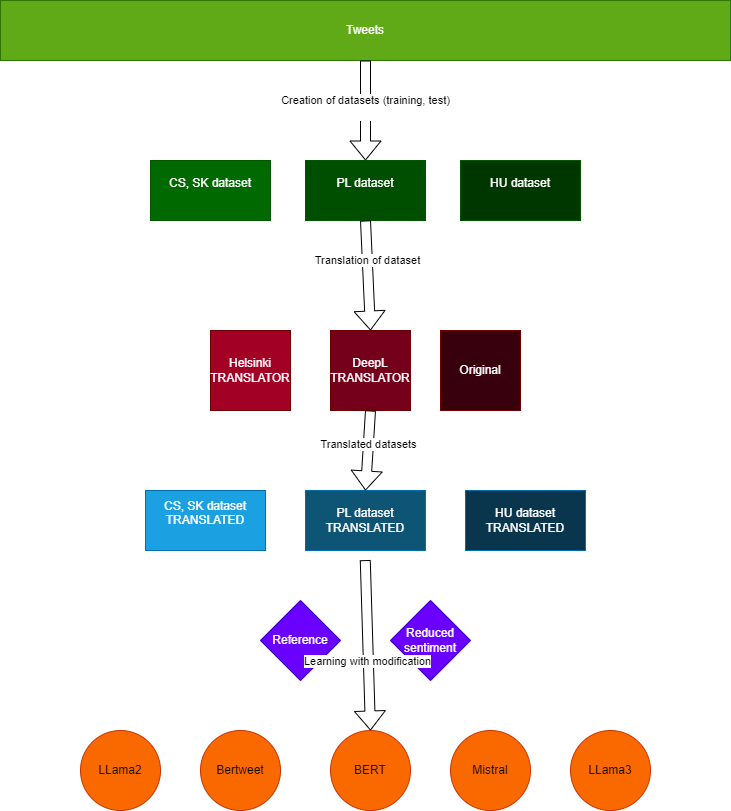
- 2023년 동안 학술 API를 통해 트위터/X 데이터를 수집하여 V4 언어 및 러시아-우크라이나 갈등과 관련된 키워드를 필터링하였다.
- 러시아 및 우크라이나에 대한 감성 극성(부정/중립/긍정)을 고려한 언어별 수작업 주석이 부여된 데이터셋을 구축하였다.
- 원본 트윗을 헬싱키 및 DeepL 번역기로 영어로 번역하여 총 아홉 개의 실험 데이터셋을 생성하였다.
- 이중 및 삼중 분류를 사용하여 각 언어 및 번역 변형에 대해 다섯 개의 LLM(BERT, BERTweet, Llama2, Llama3, Mistral)을 미세조정하였다.
- _macro 평균 정밀도, 재현율, F1 점수를 사용하여 모델을 평가하였으며, GPT-4는 제로샷 기준 모델로 사용되었다.
- 문맥 민감성 및 미세조정 효율성을 평가하기 위해 문맥 기반 학습 및 기준 트윗 사용과 같은 변형을 테스트하였다.
실험 결과
연구 질문
- RQ1저자원, 다국어 트위터 데이터에 대해 미세조정된 소규모 다국어 모델이 V4 언어의 요소 기반 감성 분석에서 SOTA 성능을 달성할 수 있는가?
- RQ2트윗을 영어로 번역하는 것이 원본 언어를 사용할 때보다 다국어 LLM의 성능에 어떤 영향을 미치는가?
- RQ3GPT-4를 사용한 문맥 기반 학습이 이 특정 작업 및 언어 세트에서 미세조정된 모델보다 뛰어나게 작용하는가?
- RQ4특히 문화적·정치적으로 민감한 맥락에서 감성 분류 성능에 모델 또는 언어에 특화된 차이가 존재하는가?
- RQ5이 작업에서 경쟁적인 성능을 달성하기 위해 필요한 최소 효과적 훈련 크기는 얼마인가?
주요 결과
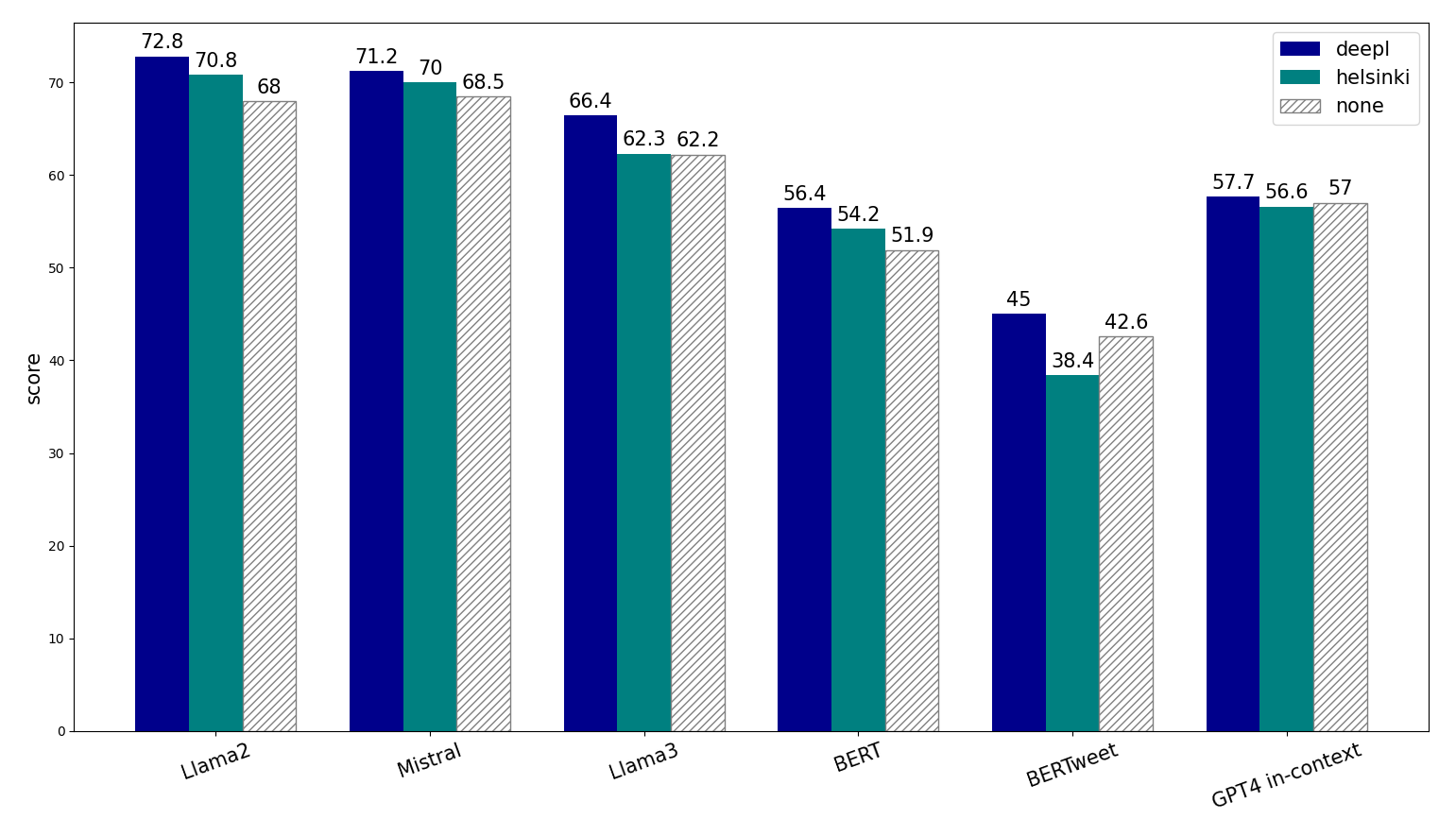
- 최소 6,000건의 다국어 트윗으로도 미세조정을 통해 SOTA 성능을 달성하였으며, 이는 GPT-4의 문맥 기반 학습을 크게 능가하였다.
- Llama2 및 Mistral 모델은 DeepL 번역과 조합하여 가장 우수한 성능을 보였으며, 여러 언어별 평가에서 GPT-4를 능가하였다.
- Llama3, BERTweet, GPT-4는 Llama2 및 Mistral에 비해 유의미하게 열등한 성능을 보였으며, 이는 성능이 모델에 매우 의존적임을 시사한다. 이는 유사한 아키텍처 간에도 마찬가지로 적용된다.
- 원본 언어를 사용하는 것보다 영어로의 번역이 일관된 성능 향상을 제공하였으며, 이는 다국어 사전 훈련 모델의 경우에도 영어 기반 표현이 제로샷 일반화 능력을 향상시킨다는 것을 시사한다.
- 모델은 언어별 편향을 보였으며, 특히 헝가리어에서는 긍정 클래스의 재현율이 부정 클래스보다 약 10% 낮아, 부정으로 과도하게 분류하는 경향이 있었다.
- 미세조정은 모델 행동을 목표 요소(예: 러시아 또는 전쟁에 대한 감성)와 효과적으로 일치시켰으며, 짧고 맥락이 부족한 트윗에서도 잘못된 분류를 줄였다.
이 논문 읽기
누빈트 뷰어에서 원문을 열고, 읽으면서 궁금한 곳을 바로 물어보세요.
누빈트에서 이 논문 읽기이 리뷰는 AI가 논문 원문을 바탕으로 만들었습니다. 인용하기 전에 원문을 확인해 주세요.