
[논문 리뷰] FOCAL: Contrastive Learning for Multimodal Time-Series Sensing Signals in Factorized Orthogonal Latent Space
FOCAL은 다중 모달 시계열 데이터에서 공유 특성과 모달리티-전용 특징을 모두 학습하는 자기지도 대조 프레임워크를 제안한다. 이는 요인화된 직교 잠재 공간에서 표현을 학습하고, 표현과 다운스트림 작업을 개선하기 위한 시간적 지역성 제약을 포함한다.
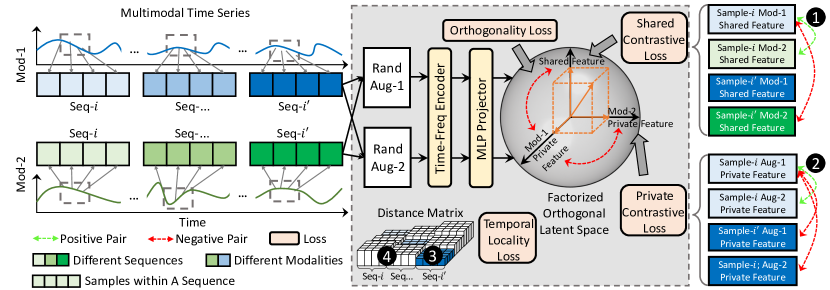
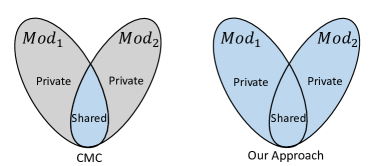
This paper proposes a novel contrastive learning framework, called FOCAL, for extracting comprehensive features from multimodal time-series sensing signals through self-supervised training. Existing multimodal contrastive frameworks mostly rely on the shared information between sensory modalities, but do not explicitly consider the exclusive modality information that could be critical to understanding the underlying sensing physics. Besides, contrastive frameworks for time series have not handled the temporal information locality appropriately. FOCAL solves these challenges by making the following contributions: First, given multimodal time series, it encodes each modality into a factorized latent space consisting of shared features and private features that are orthogonal to each other. The shared space emphasizes feature patterns consistent across sensory modalities through a modal-matching objective. In contrast, the private space extracts modality-exclusive information through a transformation-invariant objective. Second, we propose a temporal structural constraint for modality features, such that the average distance between temporally neighboring samples is no larger than that of temporally distant samples. Extensive evaluations are performed on four multimodal sensing datasets with two backbone encoders and two classifiers to demonstrate the superiority of FOCAL. It consistently outperforms the state-of-the-art baselines in downstream tasks with a clear margin, under different ratios of available labels. The code and self-collected dataset are available at https://github.com/tomoyoshki/focal.
연구 동기 및 목표
- 공유 정보와 모달리티-독점 정보를 모두 활용하여 다중 모달 시계열 표현 학습을 촉진한다.
- 공유 특징과 개인적 모달 특성을 분리하기 위해 요인화된 직교 잠재 공간을 개발한다.
- 사전학습 동안 시계열 구조를 존중하기 위한 시간적 지역성 제약을 도입한다.
- 공유, 개인, 직교성 및 시간 제약에 대한 구체적인 손실 항을 제시한다.
- 여러 데이터셋과 백본에 걸쳐 다운스트림 성능의 향상을 시연한다.
제안 방법
- 각 모달리티를 공유 구성요소와 개인 구성요소가 있는 요인화된 잠재 공간으로 인코딩한다.
- 공유 공간과 개인 공간에서 모달리티별 및 교차 모달리티 대조 손실을 적용한다(공유 공간에서 InfoNCE; 개인 공간에서 NT-Xent).
- 공유 구성요소와 개인 구성요소 간의 직교성 및 서로 다른 모달리티의 개인 공간 간의 직교성을 강제한다.
- 사전학습 중 시간적 지역성 제약을 부과한다: intra-시퀀스 거리의 평균이 시퀀스 간 거리의 평균보다 작거나 같도록.
- 메모리 은행 없이 모달리티별 무작위 증강 및 배치 내 대조적 비교로 학습한다.
실험 결과
연구 질문
- RQ1모달리티-공유 정보와 모달리티-개인 정보를 명시적으로 모델링함으로써 다중 모달 시계열 표현을 어떻게 더 풍부하게 만들 수 있는가?
- RQ2공유/개인 공간 간의 직교성을 강제하는 것이 다중 모달 센싱의 다운스트림 판별력을 향상시키는가?
- RQ3시간적 지역성 제약이 자기지도 사전학습 중 시계열 구조를 더 잘 존중하게 만드는가?
- RQ4다양한 데이터셋에서 FOCAL의 구성요소가 다운스트림 분류 및 클러스터링 작업에 미치는 영향은 무엇인가?
- RQ5레이블 부족에 견고하고 백본 인코더 간에 전이 가능한가?
주요 결과
- FOCAL은 선형 탐지 및 KNN 미세조정에서 4개의 다중 모달 데이터셋과 두 백본에 대해 11개의 기준선보다 일관되게 우수한 성능을 보였다.
- 개인 공간 및 직교성 제약이 공유 정보만 사용하는 경우보다 현저한 향상을 제공한다.
- 시간 제약은 수렴 속도를 높이고 사전학습 중 의미적 구조를 개선한다.
- 시간 제약은 FOCAL 프레임워크 자체를 넘어서는 여러 베이스라인을 개선하는 플러그인으로 작용한다.
- 변수 제거(Ablation) 실험에서 개인 공간이나 직교성을 제거하면 성능이 저하되며, 시간 제약이 추가 이득을 제공한다.
이 논문 읽기
누빈트 뷰어에서 원문을 열고, 읽으면서 궁금한 곳을 바로 물어보세요.
누빈트에서 이 논문 읽기이 리뷰는 AI가 논문 원문을 바탕으로 만들었습니다. 인용하기 전에 원문을 확인해 주세요.