
[논문 리뷰] Formation of primordial black hole binaries and their merger rates
이 논문은 초기 우주에서의 이중성 및 삼중성 과정에 중점을 두어 원시 블랙홀(PBH) 이중체 형성과 병합률에 대한 종합적인 이론적 프레임워크를 수립한다. $ f_{\text{PBH}} \lesssim 0.1 $인 경우 초기 이중체 이중체가 병합률을 지배하지만, $ f_{\text{PBH}} $ 가 높아질수록 천체 역학적 만남에 의한 억제 작용이 두드러지며, 이에 따라 집합화가 강화되고 더 단단한 이중체가 형성되면서 삼중체 채널이 지배적일 수 있다.
We review the theory behind the formation of primordial black hole binaries and their merger rates. We consider the binary formation in the early and late Universe, emphasising the former as it gives the dominant contribution of the present primordial black hole merger rate. The binaries formed in the early Universe are highly eccentric so their interactions with other primordial black holes can significantly increase their coalescence times and thereby suppress the merger rate. We discuss in detail how the suppression of the merger rate arising from such interactions can be estimated and how such interactions lead to the formation of another, much harder, binary population that contributes to the present merger rate if more than 10% of dark matter consists of primordial black holes with a relatively narrow mass distribution. When the primordial abundance is below 1%, encounters between primordial black holes are unlikely and their effect on the merger rate becomes negligible.
연구 동기 및 목표
- 초기 우주에서 원시 블랙홀(PBH) 이중체의 형성 메커니즘과 현재 병합률에 기여하는 방식을 이해하는 것.
- 특히 높은 PBH 비율에서 다른 PBH들과의 천체 역학적 만남이 초기 이중체 이중체의 병합률을 어떻게 억제하는지 수량화하는 것.
- 다양한 PBH 질량 함수와 집합화 조건 하에서 초기 형성 채널과 후기 형성 채널 간의 상대적 중요성을 평가하는 것.
- 세 가지 채널(이중체, 삼중체, 후기 형성)에 대한 병합률 밀도에 대한 해석적 표현을 유도하며, 삼중체 역학 및 질량 함수 확장 보정을 포함하는 것.
- 초기 PBH 집합화가 이중체 형성과 파괴에 미치는 영향을 평가하며, 특히 초기 삼중체 채널에 초점을 맞추는 것.
제안 방법
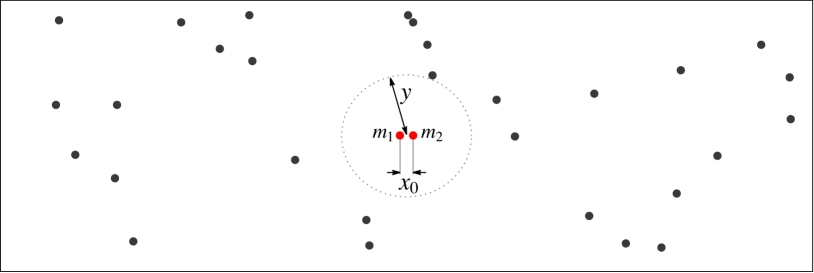
- 기하학적 단위($ c = G = 1 $)를 사용하고, $ \ln m $ 에 대해 정규화된 PBH 질량 함수 $ \psi(m) $ 를 정의하여 PBH 집단의 통계적 처리를 가능하게 한다.
- 네 가지 채널(초기 이중체, 초기 삼중체, 후기 이중체, 후기 삼중체)에 대해 병합률 밀도 $ \mathrm{d}R/\mathrm{d}\ln m_1\mathrm{d}\ln m_2 $ 를 유도한다.
- 중력파 에너지 손실 및 삼중체 역학에 대한 분석 모델을 적용하며, 각운동량 분포와 경화도를 제어하는 파rameter인 $ \mathcal{K} \approx 4.0 $ 과 $ \gamma $ 를 포함한다.
- PBH 집합화 효과를 $ f_{\text{PBH}} $ 의 재스케일링을 통해 모델링하며, 국소 밀도 증가를 $ \delta $ 로 표현하고, 이로 인한 파괴 및 형성률에 미치는 영향을 평가한다.
- 수치 시뮬레이션을 통해 핵심 상수(예: $ \mathcal{K} \approx 4.0 $)를 정보화하고, 다양한 $ f_{\text{PBH}} $, $ \gamma $, 속도 분산 영역에서의 스케일링 행동을 검증한다.
- 명시적인 비율 공식(예: 식 97–100)을 유도하며, $ f_{\text{PBH}} $, $ \langle m \rangle $, $ \eta $, $ \sigma_v $, $ \delta_{\text{eff}} $ 등의 의존성을 포함하여 채널 지배도를 정량화한다.
실험 결과
연구 질문
- RQ1초기 우주에서의 이중체 및 삼중체 과정이 현재의 원시 블랙홀 이중체 병합률에 어떤 기여를 하는가?
- RQ2특히 높은 PBH 비율에서 다른 PBH들과의 천체 역학적 만남이 초기 이중체 이중체의 병합률에 어떤 영향을 미치는가?
- RQ3어떤 조건에서 초기 삼중체 채널이 이중체 채널을 초월하여 지배적이게 되며, 이는 $ f_{\text{PBH}} $ 와 초기 집합화 조건에 어떻게 의존하는가?
- RQ4후기 이중체 및 삼중체 형성 채널이 총 병합률에 기여하는 정도는 어떻게 비교되며, 어떤 환경적 요인이 이를 증가시키는가?
- RQ5초기 PBH 집합화가 다양한 이중체 형성 채널의 상대적 억제 또는 증강에 어떤 영향을 미치는가?
주요 결과
- $ f_{\text{PBH}} \lesssim 0.1 $ 인 경우, 초기 이중체 채널이 PBH 병합률을 지배하며, 단일 질량 $ m = 30\,M_\odot $ 인 경우 병합률 밀도는 $ \sim 7.9 \times 10^4 \, \text{Gpc}^{-3}\text{yr}^{-1} $ 로 추정된다. 이는 $ \gamma = 1 $ 과 $ \mathcal{K} = 4.0 $ 인 조건에서 성립한다.
- $ f_{\text{PBH}} \gtrsim 0.1 $ 인 경우, 초기 삼중체 채널이 지배적이며, 병합률은 $ f_{\text{PBH}}^{144\gamma/259 + 47/37} $ 의 형태로 스케일링되며, 이는 더 강한 $ f_{\text{PBH}} $ 의 의존성 덕분에 이중체 채널의 병합률을 초월한다.
- 초기 삼중체 채널의 병합률은 낮은 이심률과 더 높은 유인 에너지 덕분에 천체 역학적 만남에 의해 파괴되는 것보다 훨씬 덜 민감하여 이중체 채널보다 더 견고하다.
- 후기 채널(이중체 및 삼중체)은 하위지배적이며, 최적의 조건(높은 $ \delta_{\text{eff}} $ 와 낮은 $ \sigma_v $)에서도 각각 $ \sim 3.4 \times 10^{-6} \, \text{Gpc}^{-3}\text{yr}^{-1} $ 와 $ \sim 1.3 \times 10^{-16} \, \text{Gpc}^{-3}\text{yr}^{-1} $ 의 병합률을 보인다.
- 초기 집합화 효과는 이중체 채널보다 삼중체 채널에 더 강하게 작용한다. 이는 삼중체 채널이 $ f_{\text{PBH}} $ 의 거듭제곱 지수에 더 민감하기 때문이다. 그러나 이는 同시에 이중체 이중체의 파괴를 증가시켜 $ R_{E2} $ 의 순수 억제를 초래한다.
이 논문 읽기
누빈트 뷰어에서 원문을 열고, 읽으면서 궁금한 곳을 바로 물어보세요.
누빈트에서 이 논문 읽기이 리뷰는 AI가 논문 원문을 바탕으로 만들었습니다. 인용하기 전에 원문을 확인해 주세요.