
[논문 리뷰] From human experts to machines: An LLM supported approach to ontology and knowledge graph construction
본 논문은 오픈 소스 LLM을 사용하여 능력 질문을 생성하고, 온톨로지를 구축하며, 지식 그래프를 구성하는 반자동 파이프라인을 제시하고, 인간의 개입이 포함된 평가와 채점용 심판 LLM을 활용한다.
The conventional process of building Ontologies and Knowledge Graphs (KGs) heavily relies on human domain experts to define entities and relationship types, establish hierarchies, maintain relevance to the domain, fill the ABox (or populate with instances), and ensure data quality (including amongst others accuracy and completeness). On the other hand, Large Language Models (LLMs) have recently gained popularity for their ability to understand and generate human-like natural language, offering promising ways to automate aspects of this process. This work explores the (semi-)automatic construction of KGs facilitated by open-source LLMs. Our pipeline involves formulating competency questions (CQs), developing an ontology (TBox) based on these CQs, constructing KGs using the developed ontology, and evaluating the resultant KG with minimal to no involvement of human experts. We showcase the feasibility of our semi-automated pipeline by creating a KG on deep learning methodologies by exploiting scholarly publications. To evaluate the answers generated via Retrieval-Augmented-Generation (RAG) as well as the KG concepts automatically extracted using LLMs, we design a judge LLM, which rates the generated content based on ground truth. Our findings suggest that employing LLMs could potentially reduce the human effort involved in the construction of KGs, although a human-in-the-loop approach is recommended to evaluate automatically generated KGs.
연구 동기 및 목표
- 품질을 유지하면서 온톨로지와 KG 구축에서 인간의 수고를 줄이려는 동기를 부여한다.
- 능력 질문에서 시작하여 KG 생성을 거치는 반자동 파이프라인을 보여준다.
- 기존 온톨로지(예: PROV-O)를 재활용하고 LLMS가 생성한 내용을 실제 정답과 비교 평가한다.
- 생물다양성 학술 출판물로부터 DL 방법론 KG를 구축하여 가능성을 보여준다.
제안 방법
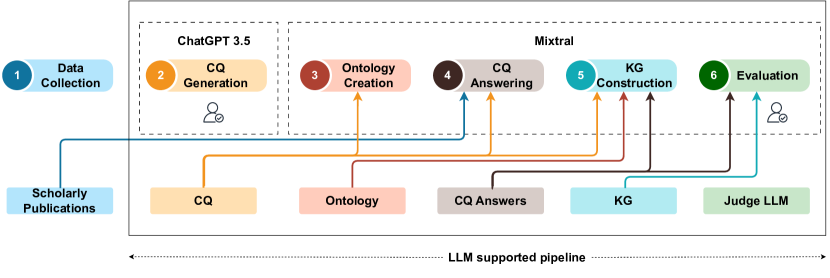
- 여섯 구성 요소 파이프라인: 데이터 수집, Competency Question(CQ) 생성, 온톨로지 생성, CQ 응답, KG 구축, 평가.
- 비교 후 선택된 Mixtral 8x7B를 사용하여 CQ 응답에 RAG를 활용한 제로샷 설정으로 오픈 소스 LLM을 사용한다.
- CQ와 Q/A로부터 온톨로지를 구성하고, PROV-O를 기초 온톨로지로 재활용하며 CQ 응답을 KG 개념에 매핑한다.
- 다섯 편의 생물다양성 출판물에서 CQ에 답하기 위해 Retrieval-Augmented Generation을 활용한다.
- 정답에 대해 ground truth를 기준으로 심판 LLM을 사용해 CQ 응답과 KG 개념을 평가했다; 다섯 편의 논문에 주석을 달았다.
- 재현성을 위해 GitHub를 통해 공개 코드와 데이터를 제공한다.
실험 결과
연구 질문
- RQ1오픈 소스 LLM이 CQ 생성, 온톨로지 생성, KG 구축을 인간의 개입 검증과 함께 반자동화할 수 있는가?
- RQ2ground truth와 비교 평가했을 때 LLM이 생성한 CQ 응답과 결과 KG의 품질은 어떠한가?
- RQ3프롬프트 설계와 RAG 구성이 결과 온톨로지와 KG에 어떤 영향을 미치는가?
- RQ4PROV-O가 이 반자동 워크플로우의 DL 파이프라인 원천 온톨로지로 적합한가?
- RQ5생물다양성 DL 방법을 위한 사용 가능한 KG를 생산하는 데 있어 자동화와 인간 노력을 통한 절충은 무엇인가?
주요 결과
- 40 competency questions were generated to cover the DL pipeline stages.
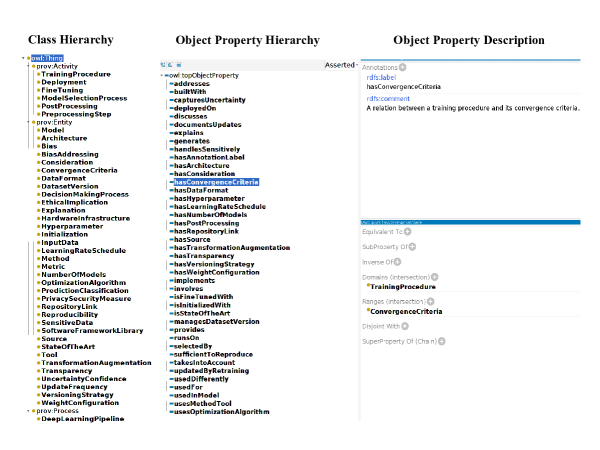
- The DLProv ontology was created with 45 classes, 41 relationships, and 365 axioms, reusing PROV-O.
- There were 42 disagreements between human annotator and the LLM Judge out of 200 evaluated CQ answers.
- Best KG performance (percentage of KG individuals aligned with CQ answers) varied by prompt/CQ answer combination across five publications.
- Across five publications, some prompt/CQ combinations produced meaningful KGs while others yielded no meaningful KG (denoted by x).
- A single pipeline achieved up to 91.53% alignment for one combination, with other combinations achieving 81.48%, 82.76%, 77.55%, 68.06%, and 66.67% in different cases.
이 논문 읽기
누빈트 뷰어에서 원문을 열고, 읽으면서 궁금한 곳을 바로 물어보세요.
누빈트에서 이 논문 읽기이 리뷰는 AI가 논문 원문을 바탕으로 만들었습니다. 인용하기 전에 원문을 확인해 주세요.