
[논문 리뷰] From Persona to Personalization: A Survey on Role-Playing Language Agents
LLMs로 구동되는 Role-Playing Language Agents (RPLAs)에 대한 포괄적 고찰로, 페르소나를 인구통계학적, 캐릭터, 개별화 유형으로 분류하고 구성, 평가, 위험 및 응용을 개괄한다.
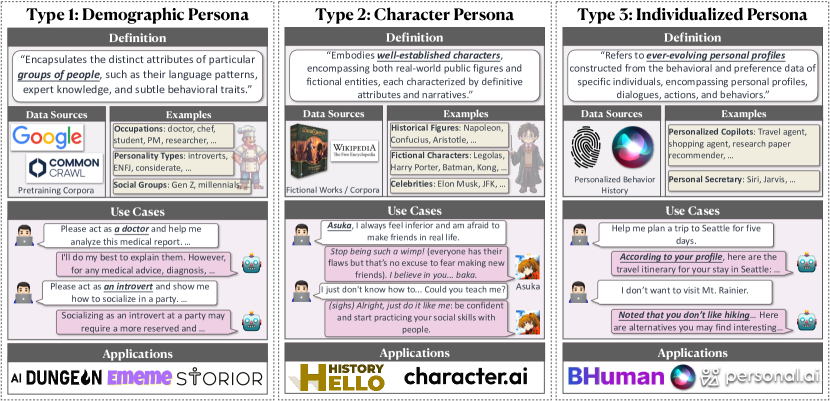
Recent advancements in large language models (LLMs) have significantly boosted the rise of Role-Playing Language Agents (RPLAs), i.e., specialized AI systems designed to simulate assigned personas. By harnessing multiple advanced abilities of LLMs, including in-context learning, instruction following, and social intelligence, RPLAs achieve a remarkable sense of human likeness and vivid role-playing performance. RPLAs can mimic a wide range of personas, ranging from historical figures and fictional characters to real-life individuals. Consequently, they have catalyzed numerous AI applications, such as emotional companions, interactive video games, personalized assistants and copilots, and digital clones. In this paper, we conduct a comprehensive survey of this field, illustrating the evolution and recent progress in RPLAs integrating with cutting-edge LLM technologies. We categorize personas into three types: 1) Demographic Persona, which leverages statistical stereotypes; 2) Character Persona, focused on well-established figures; and 3) Individualized Persona, customized through ongoing user interactions for personalized services. We begin by presenting a comprehensive overview of current methodologies for RPLAs, followed by the details for each persona type, covering corresponding data sourcing, agent construction, and evaluation. Afterward, we discuss the fundamental risks, existing limitations, and future prospects of RPLAs. Additionally, we provide a brief review of RPLAs in AI applications, which reflects practical user demands that shape and drive RPLA research. Through this work, we aim to establish a clear taxonomy of RPLA research and applications, and facilitate future research in this critical and ever-evolving field, and pave the way for a future where humans and RPLAs coexist in harmony.
연구 동기 및 목표
- RPLA 페르소나의 분류체계(인구통계학적, 캐릭터, 개별화)를 정의하고 RPLAs에서 개인화의 중요성을 동기화한다.
- 각 페르소나 유형에 대한 데이터 소스, 구성 방법 및 평가 기준을 고찰한다.
- 안전하고 효과적인 RPLA 연구 및 응용을 안내하기 위한 위험, 한계 및 향후 방향을 논의한다.
제안 방법
- 매개적 학습(parametric training) 및 비매개적 프롬프트(nonparametric prompting)를 포함한 RPLAs 구축을 위한 기존 방법론을 고찰한다.
- RPLAs에서 의인화된 행동을 가능하게 하는 기억(memory), 도구 사용(tool-usage), 계획(planning) 모듈을 설명한다.
- 각 페르소나 유형(인구통계학적, 캐릭터, 개별화)에 대한 데이터 소스와 구축 접근 방법을 요약한다.
- 역할 수행 능력과 페르소나 충실도에 대한 평가 기준을 개략한다.
- RPLA 연구와 응용을 분석할 수 있는 분류체계와 프레임워크를 제공한다.
실험 결과
연구 질문
- RQ1RPLAs가 인구통계학적, 캐릭터, 개별화 페르소나로 어떻게 분류되며 각 유형을 지원하는 데이터 소스는 무엇인가?
- RQ2RPLAs가 페르소나를 시뮬레이션하도록 하는 일반적인 구축 기법과 모듈(메모리, 도구, 계획)은 무엇인가?
- RQ3역할 수행 능력 및 할당된 페르소나에 대한 충실도 측면에서 RPLAs는 어떻게 평가되는가?
- RQ4각 페르소나 범주와 관련된 실용적 응용 및 위험은 무엇인가?
- RQ5안전하고 효과적인 RPLA 연구 및 배치를 위한 향후 방향과 격차는 무엇인가?
주요 결과
- RPLAs는 실질적으로 세 가지 진보적 페르소나 유형(인구통계학적, 캐릭터, 개별화)으로 구성되어 있다.
- 메모리, 도구 사용, 계획 모듈은 RPLAs에서 동적이고 맥락 인식적 역할 수행을 가능하게 하는 핵심 요소다.
- 매개적 학습은 인구통계학적 및 캐릭터 페르소나에 적합하고, 프롬프트 방법은 개인화에 일반적으로 사용된다.
- 평가는 역할 수행 능력과 특정 개인이나 인구통계학적 특성에 대한 페르소나 충실도를 구분한다.
- RPLAs는 디지털 클론과 동료에서 대화형 게임에 이르는 광범위한 응용을 제공하지만 독성, 편향, 환각, 프라이버시 문제와 같은 위험을 증가시킨다.
이 논문 읽기
누빈트 뷰어에서 원문을 열고, 읽으면서 궁금한 곳을 바로 물어보세요.
누빈트에서 이 논문 읽기이 리뷰는 AI가 논문 원문을 바탕으로 만들었습니다. 인용하기 전에 원문을 확인해 주세요.