
[논문 리뷰] From slides (through tiles) to pixels: an explainability framework for weakly supervised models in pre-clinical pathology
이 논문은 전임상 디지털 병리학에서 약한 감독 학습 딥 러닝 모델을 위한 문맥 기반 설명 가능한 인공지능(XAI) 프레임워크를 제안한다. 전체 슬라이드 이미지(WSIs)에 대해 슬라이드 수준의 레이블만을 사용하여 다중임계점 학습(MIL)을 적용하며, 병리의사의 주석과 세그멘테이션 모델 예측과 상관관계가 있는 픽셀 수준의 히트맵 설명을 생성한다. 이는 모델의 의사결정 과정을 조직 경계에서의 형태학적 특징 탐지로 통해 안정성과 정밀도를 보여준다.
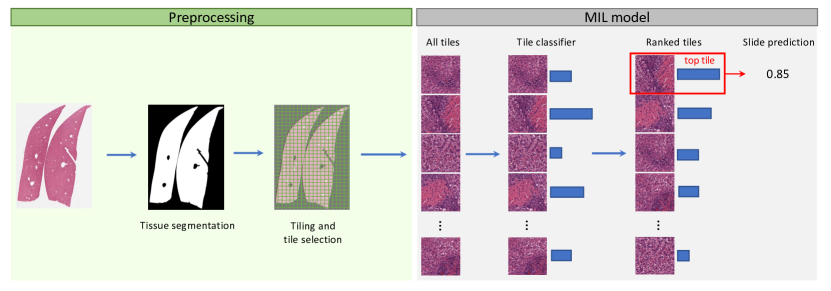
In pre-clinical pathology, there is a paradox between the abundance of raw data (whole slide images from many organs of many individual animals) and the lack of pixel-level slide annotations done by pathologists. Due to time constraints and requirements from regulatory authorities, diagnoses are instead stored as slide labels. Weakly supervised training is designed to take advantage of those data, and the trained models can be used by pathologists to rank slides by their probability of containing a given lesion of interest. In this work, we propose a novel contextualized eXplainable AI (XAI) framework and its application to deep learning models trained on Whole Slide Images (WSIs) in Digital Pathology. Specifically, we apply our methods to a multi-instance-learning (MIL) model, which is trained solely on slide-level labels, without the need for pixel-level annotations. We validate quantitatively our methods by quantifying the agreements of our explanations' heatmaps with pathologists' annotations, as well as with predictions from a segmentation model trained on such annotations. We demonstrate the stability of the explanations with respect to input shifts, and the fidelity with respect to increased model performance. We quantitatively evaluate the correlation between available pixel-wise annotations and explainability heatmaps. We show that the explanations on important tiles of the whole slide correlate with tissue changes between healthy regions and lesions, but do not exactly behave like a human annotator. This result is coherent with the model training strategy.
연구 동기 및 목표
- 전임상 병리학에서 픽셀 수준의 주석이 부족한 문제를 해결하기 위해, 약한 감독 모델에 대한 설명 가능한 인공지능을 가능하게 한다.
- 수동적인 픽셀 주석이 필요 없이 슬라이드 수준의 예측을 국소화된 픽셀 수준의 설명으로 향상시키는 프레임워크를 개발한다.
- 병리의사가 주석한 병변 경계와 세그멘테이션 모델 출력과의 관련성에서 설명의 정밀도와 안정성을 검증한다.
- 모델이 생성한 히트맵을 활용하여 병리의사가 고위험 슬라이드를 우선순위로 정리하고 생물학적으로 관련성이 높은 영역에 집중할 수 있도록 지원한다.
제안 방법
- 최근 개발된 XAI 기법을 슬라이드 수준 진단 레이블 전용으로 훈련된 다중임계점 학습(MIL) 모델에 적응한다.
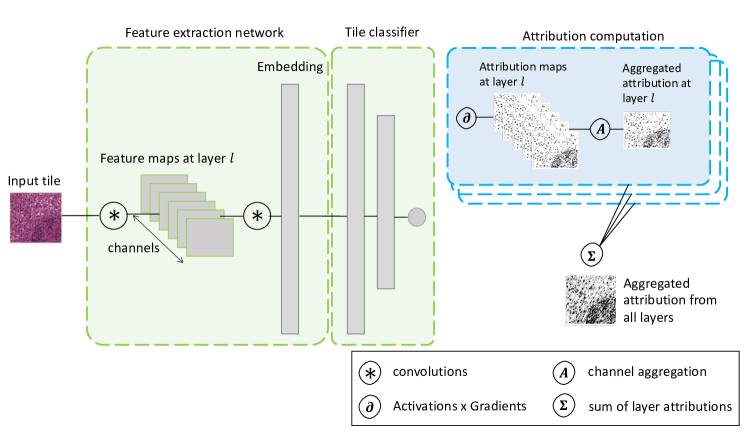
- 전체 슬라이드 이미지에서 추출한 패치에 대해 MIL 모델의 어텐션 맵을 분석하여 타일 수준에서 히트맵 설명을 생성한다.
- 고성능 타일을 고해상도로 국소화된 히트맵으로 개선하는 문맥 기반 설명 워크플로우를 적용하여 의사결정에 관련된 영역을 강조한다.
- 두 가지 골드 표준인 병리의사가 주석한 병변 경계와 픽셀 수준 주석을 기반으로 훈련된 완전 감독 세그멘테이션 모델의 예측 결과와 설명을 검증한다.
- 입력에 대한 흐트러짐(왜곡)에 대한 설명의 안정성과 모델 성능 향상과의 상관관계를 평가한다.
- Pado Visualize 패키지를 활용하여 임상 워크플로우에 프레임워크를 통합하고, 상호작용 가능한 슬라이드 우선순위 정렬 및 시각화를 지원한다.
실험 결과
연구 질문
- RQ1약한 감독 학습 MIL 모델에서 생성한 XAI 기반 히트맵이 병리의사가 주석한 병변 경계와 얼마나 잘 상관되는가?
- RQ2모델의 설명이 픽셀 수준 주석을 기반으로 훈련된 완전 감독 세그멘테이션 모델의 예측과 어느 정도 일치하는가?
- RQ3입력 슬라이드에 경미한 변형이나 이동이 가해질 경우 설명의 안정성은 어떻게 되는가?
- RQ4기초가 되는 MIL 모델의 성능 향상에 따라 설명의 정밀도는 어떻게 변화하는가?
- RQ5모델의 의사결정 과정을 탐지하는 데 있어, 히트맵은 랩터 간엽 슬라이드에서 괴사 검출에 대해 어떤 생물학적 통찰을 드러내는가?
주요 결과
- XAI로 생성된 히트맵은 병리의사가 주석한 병변 경계와 완전 감독 세그멘테이션 모델의 예측 결과와 모두 유의미한 정적 상관관계를 보였다.
- 입력 슬라이드의 경미한 변화나 전처리 방법의 변동에 대해 설명이 안정적이었으며, 이는 모델의 견고성을 시사한다.
- 모델 성능 향상에 따라 설명의 정밀도가 증가함에 따라, 진단 보조 도구로서의 신뢰성이 확인되었다.
- 히트맵은 건강한 조직과 괴사 조직 경계에서 색채, 질감, 세포 구조의 형태학적 변화를 강조하며 생물학적 관련성과 일치하였다.
- 모델의 설명은 인간의 주석을 정확히 재현하지는 않았으며, 이는 슬라이드 수준 진단과 픽셀 수준 세그멘테이션 작업 간의 근본적 차이를 반영한다.
- 이 프레임워크는 병리의사가 고위험 슬라이드를 우선순위로 정리하고 생물학적으로 관련성이 높은 영역에 집중할 수 있도록 하여 진단 효율성을 향상시켰다.
이 논문 읽기
누빈트 뷰어에서 원문을 열고, 읽으면서 궁금한 곳을 바로 물어보세요.
누빈트에서 이 논문 읽기이 리뷰는 AI가 논문 원문을 바탕으로 만들었습니다. 인용하기 전에 원문을 확인해 주세요.