
[논문 리뷰] Generating Faithful Synthetic Data with Large Language Models: A Case Study in Computational Social Science
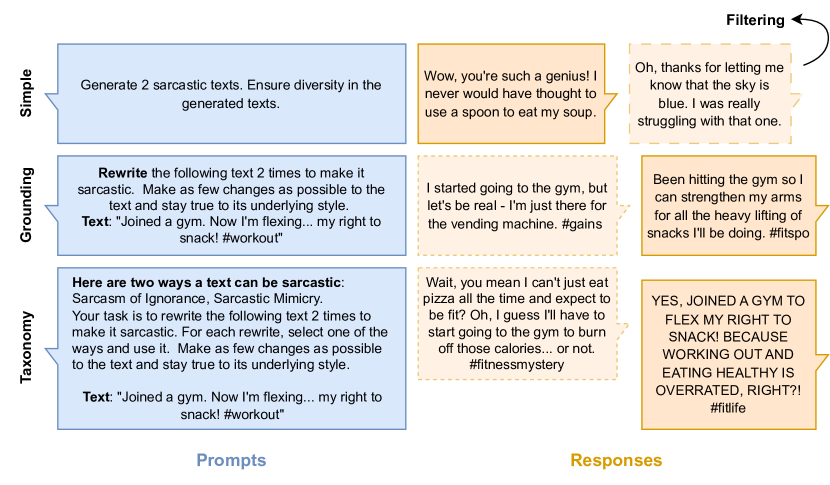
이 연구는 프롬프트 전략— grounding, taxonomy-based generation, and filtering — 를 테스트하여 대형 언어 모델로부터 생성된 합성 데이터가 sarcasm detection에 더 충실하도록 하며, baselines 및 실제 데이터와 비교한다.
Large Language Models (LLMs) have democratized synthetic data generation, which in turn has the potential to simplify and broaden a wide gamut of NLP tasks. Here, we tackle a pervasive problem in synthetic data generation: its generative distribution often differs from the distribution of real-world data researchers care about (in other words, it is unfaithful). In a case study on sarcasm detection, we study three strategies to increase the faithfulness of synthetic data: grounding, filtering, and taxonomy-based generation. We evaluate these strategies using the performance of classifiers trained with generated synthetic data on real-world data. While all three strategies improve the performance of classifiers, we find that grounding works best for the task at hand. As synthetic data generation plays an ever-increasing role in NLP research, we expect this work to be a stepping stone in improving its utility. We conclude this paper with some recommendations on how to generate high(er)-fidelity synthetic data for specific tasks.
연구 동기 및 목표
- LLMs와 함께 NLP에서 신뢰할 수 있는 합성 데이터의 필요성을 자극한다.
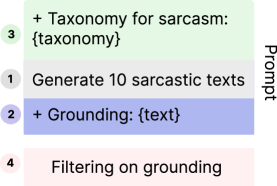
- 합성 데이터의 충실도를 높이기 위한 프롬프트 전략( grounding, taxonomy-based generation )을 제시한다.
- 합성 데이터로 분류기를 학습하고 실제 데이터에서 sarcasm 검출을 평가하여 전략을 평가한다.
- Grounding이 다른 전략보다 효과적인지 평가하고 실용적인 권고를 제공한다.
제안 방법
- 훈련 및 평가를 위해 SemEval-2022 Task 6 sarcasm 데이터를 사용한다.
- 다수의 프롬 prompting 전략 하에서 ChatGPT로 합성 데이터를 생성한다.
- 합성 데이터로 E5-base 모델을 미세조정하고 실제 테스트 세트에서 평가한다.
- 합성 데이터를 필터링하기 위한 판별기를 학습시키고 실제 데이터와 비교한다.
- 생성된 데이터에 대해 합성 대 실제 분류기를 비교 테스트하여 신뢰성을 평가한다.
실험 결과
연구 질문
- RQ1Grounding, taxonomy-based generation, and filtering이 sarcasm detection을 위한 LLM 생성 합성 데이터의 충실도를 향상시킬 수 있는가?
- RQ2이 전략들은 downstream 성능에서 단순 프롬프트 및 zero-shot ChatGPT와 어떻게 비교되는가?
- RQ3이 전략들이 실제 데이터로 평가될 때 분류기의 macro-F1 및 신뢰성에 미치는 영향은 무엇인가?
- RQ4Grounding이 토픽 다양성 및 관심 구성 요소를 포착하는 데 가장 효과적인 전략인가?
주요 결과
- Grounding-based prompts achieve the highest macro-F1 among synthetic-data-trained classifiers (0.55).
- Simple prompts perform worst (macro-F1 0.48) due to limited topical and construct diversity.
- Grounding + Taxonomy yields macro-F1 0.51, between grounding alone and simple prompts.
- Grounding + Filtering performs poorly (macro-F1 0.26) likely due to discriminator limitations.
- Zero-shot ChatGPT macro-F1 (0.60) exceeds macro-F1 of models trained on synthetic data from smaller prompts.
- Believability varies by method, with Grounding + Filtering achieving highest believability (0.56), while Groundtruth annotations reach 0.95 and Simple remains low (0.04).
이 논문 읽기
누빈트 뷰어에서 원문을 열고, 읽으면서 궁금한 곳을 바로 물어보세요.
누빈트에서 이 논문 읽기이 리뷰는 AI가 논문 원문을 바탕으로 만들었습니다. 인용하기 전에 원문을 확인해 주세요.