
[논문 리뷰] Generative models improve fairness of medical classifiers under distribution shifts
논문은 라벨 및 민감 속성에 조건화된 확산 기반 생성 모델이 훈련 데이터를 보강하여 분포 변화 하에서도 조직병리학, 흉부 방사선 사진, 피부과 영역의 의학 분류기의 견고성과 공정성을 향상시킨다는 것을 보여준다.
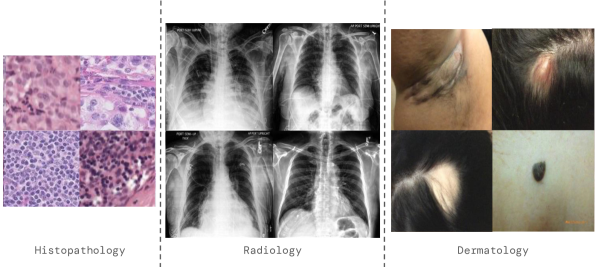
A ubiquitous challenge in machine learning is the problem of domain generalisation. This can exacerbate bias against groups or labels that are underrepresented in the datasets used for model development. Model bias can lead to unintended harms, especially in safety-critical applications like healthcare. Furthermore, the challenge is compounded by the difficulty of obtaining labelled data due to high cost or lack of readily available domain expertise. In our work, we show that learning realistic augmentations automatically from data is possible in a label-efficient manner using generative models. In particular, we leverage the higher abundance of unlabelled data to capture the underlying data distribution of different conditions and subgroups for an imaging modality. By conditioning generative models on appropriate labels, we can steer the distribution of synthetic examples according to specific requirements. We demonstrate that these learned augmentations can surpass heuristic ones by making models more robust and statistically fair in- and out-of-distribution. To evaluate the generality of our approach, we study 3 distinct medical imaging contexts of varying difficulty: (i) histopathology images from a publicly available generalisation benchmark, (ii) chest X-rays from publicly available clinical datasets, and (iii) dermatology images characterised by complex shifts and imaging conditions. Complementing real training samples with synthetic ones improves the robustness of models in all three medical tasks and increases fairness by improving the accuracy of diagnosis within underrepresented groups. This approach leads to stark improvements OOD across modalities: 7.7% prediction accuracy improvement in histopathology, 5.2% in chest radiology with 44.6% lower fairness gap and a striking 63.5% improvement in high-risk sensitivity for dermatology with a 7.5x reduction in fairness gap.
연구 동기 및 목표
- 의료 ML 모델의 분포 변화와 잠재적 편향을 동기 부여하고 해결한다.
- 하위 그룹의 데이터 분포를 모델링하기 위해 확산 모델을 활용한 레이블 효율적 증가 방법을 개발한다.
- 학습된 보강이 휴리스틱 보강보다 우수하고 정확도 손실 없이 공정성을 개선할 수 있음을 입증한다.
- 다양한 난이도와 해상도의 여러 이미징 모달리티에서 접근법의 일반화를 보인다.
제안 방법
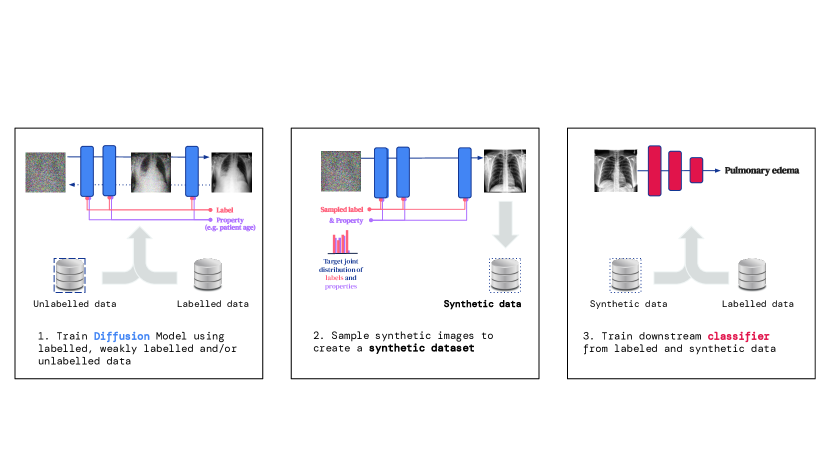
- 진단 라벨 또는 진단 라벨과 민감 속성을 조건으로 라벨링된 데이터와 비라벨링된 데이터에 대해 확산 모델을 학습한다.
- 확산 모델로부터 공정한 샘플링 전략에 따라 합성 이미지를 샘플링한다.
- 실제 라벨이 있는 데이터와 합성 데이터의 혼합으로 다운스트림 분류기를 학습하되, 혼합 비율을 하이퍼파라미터로 설정한다.
실험 결과
연구 질문
- RQ1라벨과 민감 속성에 조건화된 확산 모델 보강이 분포 변화 하에서 성능을 향상시키는가?
- RQ2학습된 보강이 조직병리학, 흉부 방사선학, 피부과에서 하위 그룹 간의 공정성 격차를 줄이는가?
- RQ3고해상도 및 높은 난이도 피부과 작업에서 방법이 다른 기준선과 비교하여 어떤 성능을 보이는가?
- RQ4합성 데이터와 색상 보강 또는 다른 휴리스틱을 결합하는 것이 정확도와 공정성에 미치는 영향은 무엇인가?
주요 결과
- 합성 데이터와 색상 보강으로 조직병리학에서 테스트 세트 정확도 7.7 포인트 향상.
- 44.6% 낮아진 공정성 격차와 함께 out-of-distribution 흉부 방사선학에서 평균 AUC 5.2 포인트 향상.
- 분포 변화 하에서 피부과에서 고위험 민감도 63.5% 향상 및 공정성 격차가 7.5배 감소.
- 확산 기반 보강은 기준선보다 우수하게 작동하며 모달리티 및 분포 변화 시나리오 전반에서 공정성 격차를 줄인다.
- 고해상도 피부과 결과에서 cascaded diffusion upsampling을 256x256으로 사용해 OOD 설정에서 뚜렷한 이득을 보였다.
이 논문 읽기
누빈트 뷰어에서 원문을 열고, 읽으면서 궁금한 곳을 바로 물어보세요.
누빈트에서 이 논문 읽기이 리뷰는 AI가 논문 원문을 바탕으로 만들었습니다. 인용하기 전에 원문을 확인해 주세요.