
[논문 리뷰] Generative Proxemics: A Prior for 3D Social Interaction from Images
이 논문은 SMPL-X 신체 파라미터를 사용하여 두 사람이 밀접하게 상호작용할 때의 사회적 거리(소셜 프록세믹스)를 3D 생성 사전으로 학습하는 디노이징 확산 모델인 BUDDI를 소개한다. 노이즈가 섞인 2D에서 3D 추정치에 조건을 주어, 접촉 애너테이션 없이도 단일 이미지에서 타당한 3D 인간 메시를 개선함으로써, 재구성 정확도와 현실성에서 최신 기법들을 능가한다.
Social interaction is a fundamental aspect of human behavior and communication. The way individuals position themselves in relation to others, also known as proxemics, conveys social cues and affects the dynamics of social interaction. Reconstructing such interaction from images presents challenges because of mutual occlusion and the limited availability of large training datasets. To address this, we present a novel approach that learns a prior over the 3D proxemics two people in close social interaction and demonstrate its use for single-view 3D reconstruction. We start by creating 3D training data of interacting people using image datasets with contact annotations. We then model the proxemics using a novel denoising diffusion model called BUDDI that learns the joint distribution over the poses of two people in close social interaction. Sampling from our generative proxemics model produces realistic 3D human interactions, which we validate through a perceptual study. We use BUDDI in reconstructing two people in close proximity from a single image without any contact annotation via an optimization approach that uses the diffusion model as a prior. Our approach recovers accurate and plausible 3D social interactions from noisy initial estimates, outperforming state-of-the-art methods. Our code, data, and model are availableat our project website at: muelea.github.io/buddi.
연구 동기 및 목표
- 이미지 데이터로부터 두 사람 간 3D 사회적 상호작용을 위한 데이터 기반 생성 사전을 학습하는 것.
- 서로의 가림과 접촉 애너테이션 부족으로 인해 성능이 저하되는 상황에서, 단일 이미지에서 타당한 3D 인간 자세와 형태를 재구성하는 과제를 해결하는 것.
- 지표가 없는 접촉 감시 없이도 확산 모델을 사전으로 활용하여 노이즈가 섞인 초기 3D 메시 추정치를 개선하는 방법을 개발하는 것.
- 인지 평가를 통해 생성된 샘플의 현실성을 검증하고, 하류 3D 재구성 작업에서 사전의 효과성을 입증하는 것.
- 이미지에서 사회적으로 타당한 인간 상호작용을 합성할 수 있는 기반을 마련하여, 디지털 인간 모델링과 사회적 행동 이해를 발전시키는 것.
제안 방법
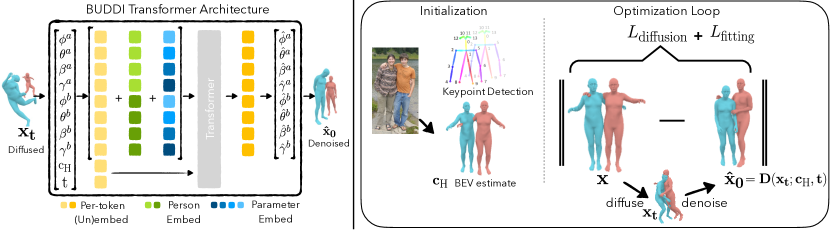
- 접촉 애너테이션이 있는 이미지 데이터셋과 MoCap 데이터에서 재구성된 3D 자세를 사용하여, 상호작용하는 사람들의 SMPL-X 신체 파라미터에 대해 디노이징 확산 모델(BUDDI)을 훈련한다.
- 토큰 차원에 따라 병합함으로써 다중 인물 메시 회귀기로부터 추정된 3D 신체 파라미터에 조건을 주어 개선를 이끌어내는 방식으로 BUDDI를 조건화한다.
- 점진적으로 더 타당한 사회적 상호작용으로 향하도록 3D 메시 추정치를 개선하기 위해 스코어-디스틸레이션 유사 손실을 사용한다.
- 초기 회귀기 출력에 조건이 붙은 BUDDI 샘플로 최적화를 초기화하고, 2D 관절 검출에 맞추어 SMPL-X 자세, 형태, 이동을 최적화한다.
- BUDDI의 생성 사전을 전체 목적 함수에 통합하여 재구성 과정에서 사회적 타당성을 강제한다.
- 모델이 무조건적인 현실적인 3D 사회적 상호작용 샘플을 생성할 수 있는 능력을 활용하여 인지 검증을 수행한다.
실험 결과
연구 질문
- RQ1확산 모델은 이미지 데이터로부터 두 사람이 상호작용할 때의 현실적이고 데이터 기반의 3D 사회적 프록세믹스 사전을 학습할 수 있는가?
- RQ2접촉 애너테이션이 없는 단일 이미지에서 3D 인간 메시 재구성에 있어 BUDDI는 얼마나 효과적인 생성 사전인가?
- RQ3BUDDI가 생성한 샘플은 얼마나 실제 사회적 상호작용과 인지적 현실성에서 유사한가?
- RQ4BUDDI 사전을 활용한 최적화 기반 재구성 파이프라인은 정확도와 타당성 면에서 최신 기법들을 능가하는가?
- RQ5관절 위치만을 사용하는 것보다 SMPL-X 파라미터를 사용함으로써 3D 상호작용에서 상호 접촉과 근접도를 더 잘 모델링할 수 있는가?
주요 결과
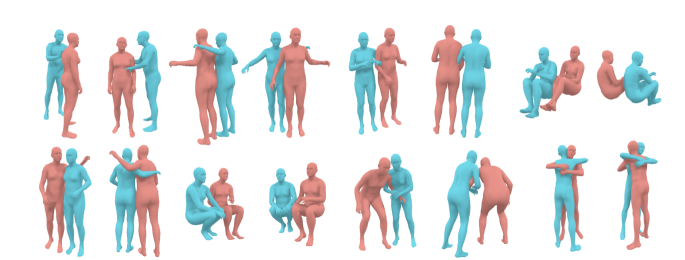
- BUDDI는 실제 샘플과의 비교에서 44.4%의 경우에 현실적으로 인식되며, 인간이 진짜인지 가짜인지 구분할 수 없는 50% 기준에 가까워지고 있다.
- 제안된 최적화 방법은 FlickrCI3D, CHI3D, Hi4D 데이터셋에서 기준 다중 인물 메시 회귀기 [67]의 성능을 정량적·정성적으로 크게 향상시켰다.
- 특히 가림 현상 처리와 사회적으로 타당한 구성 유지 면에서 단일 이미지에서의 3D 인간 메시 재구성에서 최신 기법들을 능가한다.
- SMPL-X 파라미터를 사용함으로써 관절만을 사용하는 표현보다 표면 수준의 상호작용과 근접도를 더 잘 모델링할 수 있었다.
- 스코어 기반 손실을 통해 노이즈가 섞인 초기 추정치를 개선하는 확산 모델의 능력은 더 정확하고 안정적인 3D 재구성을 이끌어냈다.
- 다양한 사회적 상호작용 유형—站着, 안기, 스포츠 플레이—에 걸쳐 일반화되어 있으며, 다양한 프록세믹 패턴에 대한 강건성을 입증했다.
이 논문 읽기
누빈트 뷰어에서 원문을 열고, 읽으면서 궁금한 곳을 바로 물어보세요.
누빈트에서 이 논문 읽기이 리뷰는 AI가 논문 원문을 바탕으로 만들었습니다. 인용하기 전에 원문을 확인해 주세요.