
[논문 리뷰] GLoRe: When, Where, and How to Improve LLM Reasoning via Global and Local Refinements
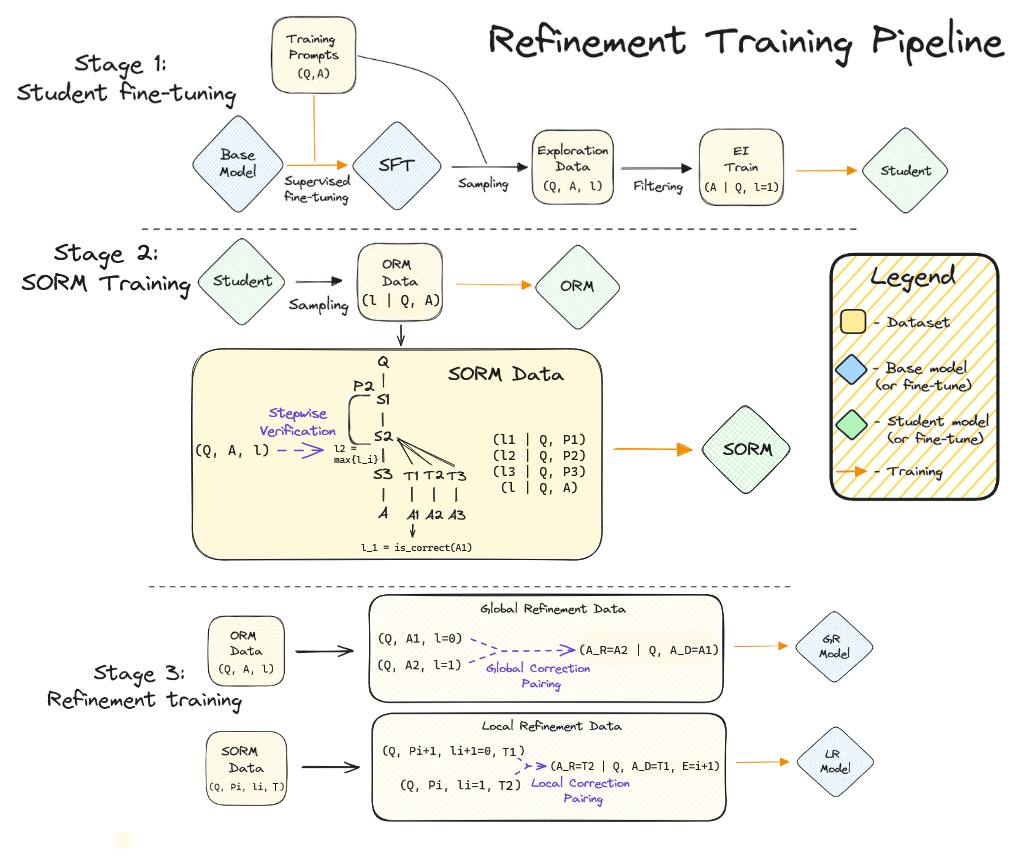
이 논문은 합성 데이터를 사용하여 보완을 언제, 어디서, 어떻게 할 것인지 분해함으로써 LLM 추론을 향상시키는 GLoRe 프레임워크를 제안한다. 표준 결과 보상 모델(ORMs)보다 중간 추론 단계의 오류를 더 잘 탐지할 수 있도록 단계별 결과 보상 모델(SORMs)을 도입하고, ORM 기반 재정렬과 함께 전역적이고 국소적인 보완을 결합하여 LLaMA-2 13B 모델을 사용할 때 GSM8K의 정확도를 53%에서 65%로 향상시킨다.
State-of-the-art language models can exhibit impressive reasoning refinement capabilities on math, science or coding tasks. However, recent work demonstrates that even the best models struggle to identify extit{when and where to refine} without access to external feedback. Outcome-based Reward Models ( extbf{ORMs}), trained to predict correctness of the final answer indicating when to refine, offer one convenient solution for deciding when to refine. Process Based Reward Models ( extbf{PRMs}), trained to predict correctness of intermediate steps, can then be used to indicate where to refine. But they are expensive to train, requiring extensive human annotations. In this paper, we propose Stepwise ORMs ( extbf{SORMs}) which are trained, only on synthetic data, to approximate the expected future reward of the optimal policy or $V^{\star}$. More specifically, SORMs are trained to predict the correctness of the final answer when sampling the current policy many times (rather than only once as in the case of ORMs). Our experiments show that SORMs can more accurately detect incorrect reasoning steps compared to ORMs, thus improving downstream accuracy when doing refinements. We then train extit{global} refinement models, which take only the question and a draft solution as input and predict a corrected solution, and extit{local} refinement models which also take as input a critique indicating the location of the first reasoning error. We generate training data for both models synthetically by reusing data used to train the SORM. We find combining global and local refinements, using the ORM as a reranker, significantly outperforms either one individually, as well as a best of three sample baseline. With this strategy we can improve the accuracy of a LLaMA-2 13B model (already fine-tuned with RL) on GSM8K from 53\% to 65\% when greedily sampled.
연구 동기 및 목표
- 외부 피드백 없이 LLM의 자가보완이 추론 작업에서 취약한 점을 해결하기 위해.
- 중간 단계의 추론 오류 탐지를 향상시키기 위해 중간 단계에 대한 보상 모델을 보완하기 위해.
- 정확한 중간 단계 보상 모델을 훈련하기 위한 확장 가능한, 합성 데이터 기반의 방법을 개발하기 위해.
- 보상 기반 재정렬을 사용하여 전역적이고 국소적 보완 전략을 결합하여 우수한 성능을 내기 위해.
- 인간 레이블링 없이도 베이스라인을 능가하는 모델을 효과적으로 훈련시킬 수 있는 합성 데이터의 가능성을 입증하기 위해.
제안 방법
- 각 중간 단계에서 정책을 여러 번 샘플링하여 최종 정답의 정확성을 추정함으로써 합성 데이터로 훈련된 단계별 결과 보상 모델(SORMs)을 도입한다.
- 기각 샘플링과 후처리를 사용하여 최적의 정책 π*를 근사하고 SORMs의 훈련 레이블을 생성한다.
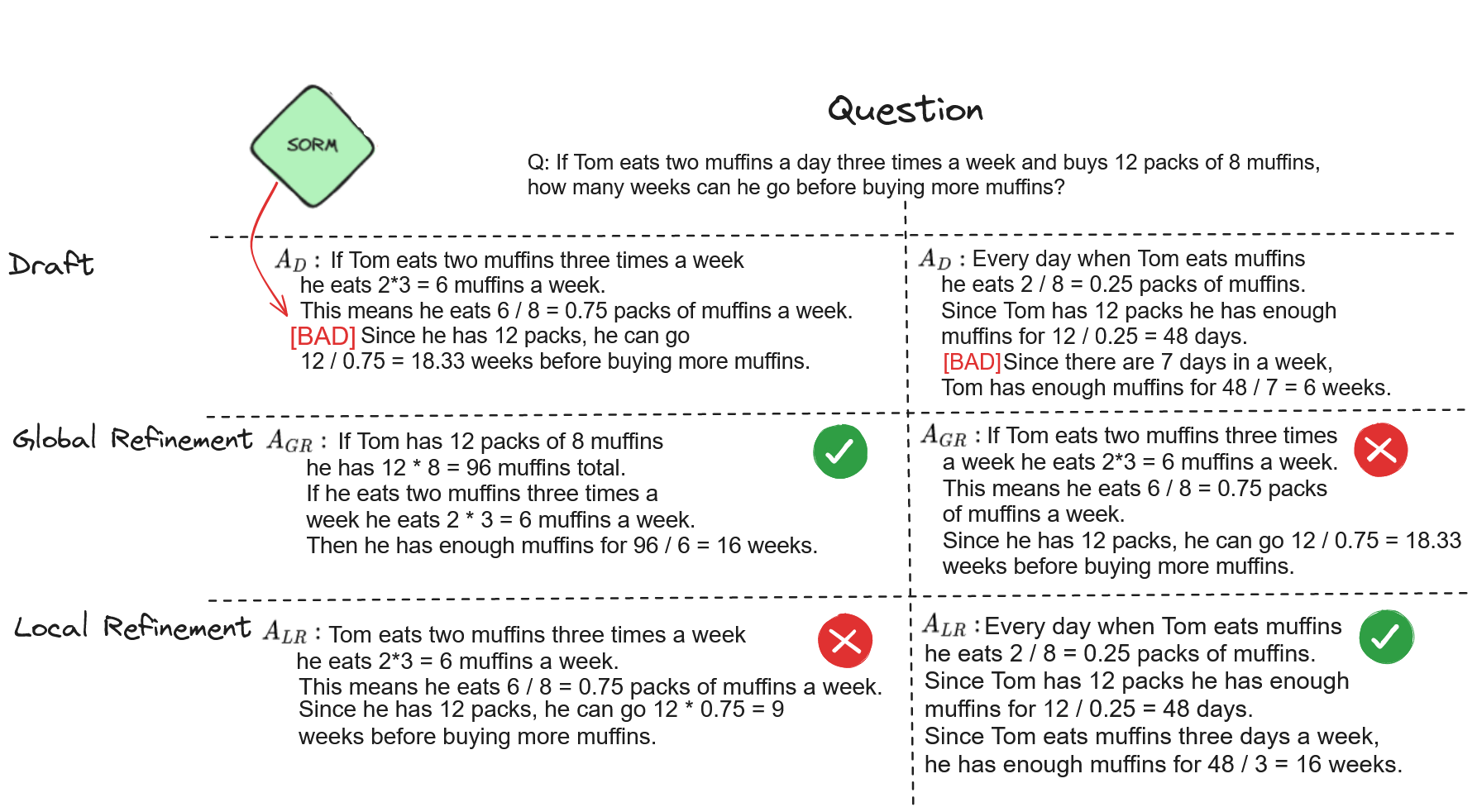
- 틀린 풀이와 올바른 풀이의 합성 쌍을 사용하여 전체 추론 흐름을 수정하는 전역 보완 모델을 훈련한다.
- SORM 피드백를 사용하여 첫 번째 잘못된 추론 단계를 식별하고 수정하는 국소 보완 모델을 훈련한다.
- 전역 및 국소 보완을 결합하고 ORM을 재정렬기로 사용하여 초안, 전역 및 국소 보완 중 최고의 출력을 선택한다.
- 모든 구성 요소에 대해 SORM 및 ORM 훈련 데이터를 재사용함으로써 인간의 레이블링 없이도 완전한 합성 데이터 훈련을 가능하게 한다.
실험 결과
연구 질문
- RQ1결과 기반 보상 모델(ORMs)은 LLM의 중간 추론 단계의 정확성을 신뢰성 있게 평가할 수 있는가?
- RQ2비용이 많이 드는 인간 레이블링 없이도 프로세스 기반 보상 모델(PRMs)을 위한 과정 기반 평가를 어떻게 향상시킬 수 있는가?
- RQ3합성 데이터를 사용하여 표준 ORMs보다 추론 체인의 오류를 더 잘 탐지할 수 있는 보상 모델을 훈련시킬 수 있는가?
- RQ4보상 기반 재정렬을 사용하여 전역적 및 국소적 보완 전략을 결합하면 전체 추론 정확도가 향상되는가?
- RQ5정책이 최적에서 멀리 떨어져 있을 때, SORMs가 ORMs보다 더 잘 일반화되는가?
주요 결과
- 정책이 최적에서 멀리 떨어져 있을수록 SORMs가 ORMs보다 잘못된 추론 단계를 더 잘 탐지한다.
- SORMs를 사용해 국소 보완을 이끌면 중간 단계의 정확도가 향상되어 ORMs보다 거짓 음성(false negatives)이 줄어든다.
- 전역 및 국소 보완 모델은 상당히 다른 문제 집합을 해결하므로 상호 보완적인 성질을 띤다.
- 전역 및 국소 보완을 ORM 기반 재정렬과 함께 사용하면 LLaMA-2 13B에서 GSM8K 정확도를 53%에서 65%로 향상시키며, 최고의 3개 선택 기반 베이스라인보다 8~13% 높은 성능을 기록한다.
- 전역 및 국소 보완이 모두 ORM에 의해 재정렬될 경우 최고의 성능을 달성하며, 기저 모델이 실패한 문제의 최대 41%를 복구할 수 있다.
이 논문 읽기
누빈트 뷰어에서 원문을 열고, 읽으면서 궁금한 곳을 바로 물어보세요.
누빈트에서 이 논문 읽기이 리뷰는 AI가 논문 원문을 바탕으로 만들었습니다. 인용하기 전에 원문을 확인해 주세요.