
[논문 리뷰] Guiding Large Language Models via Directional Stimulus Prompting
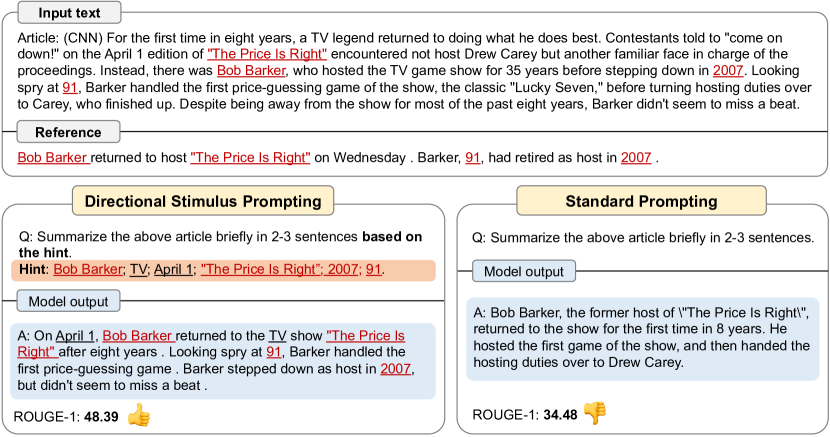
DSP는 소규모 조정 가능한 정책 모델을 사용하여 인스턴스별 방향 프롬프트를 생성하고 블랙박스 LLM이 원하는 출력으로 향하도록 도와줍니다. 한정된 라벨 데이터로 요약, 대화, 추론 작업에서 성능을 개선합니다.
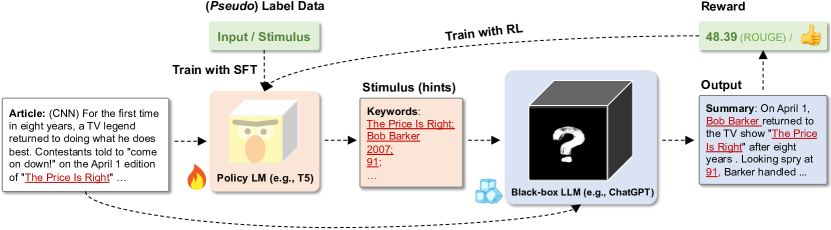
We introduce Directional Stimulus Prompting, a novel framework for guiding black-box large language models (LLMs) toward specific desired outputs. Instead of directly adjusting LLMs, our method employs a small tunable policy model (e.g., T5) to generate an auxiliary directional stimulus prompt for each input instance. These directional stimulus prompts act as nuanced, instance-specific hints and clues to guide LLMs in generating desired outcomes, such as including specific keywords in the generated summary. Our approach sidesteps the challenges of direct LLM tuning by optimizing the policy model to explore directional stimulus prompts that align LLMs with desired behaviors. The policy model can be optimized through 1) supervised fine-tuning using labeled data and 2) reinforcement learning from offline or online rewards based on the LLM's output. We assess our method across summarization, dialogue response generation, and chain-of-thought reasoning tasks. Our experiments demonstrate that the framework consistently improves LLMs' (e.g., ChatGPT, Codex, InstructGPT) performance on these supervised tasks using minimal labeled data. Notably, using just 80 dialogues on the MultiWOZ dataset, our approach enhances ChatGPT's performance by an impressive 41.4%, matching or surpassing some fully supervised start-of-the-art models. Additionally, the instance-specific chain-of-thought prompt generated by our approach improves InstructGPT's reasoning accuracy compared to human-crafted or automatically generated prompts. The code and data are publicly available at \url{https://github.com/Leezekun/Directional-Stimulus-Prompting}.
연구 동기 및 목표
- 파인 튜닝 없이 블랙박스 LLM을 조향하기 위한 경량 방법을 제안한다.
- 프롬프트에 인스턴스별 힌트를 제공하는 방향성 자극을 도입한다.
- 감독형 미세조정과 강화학습을 통해 소형 정책 모델을 최적화하는 방법을 보여준다.
- 요약, 대화 응답 생성, 사고 연쇄(chain-of-thought) 추론에서의 개선을 입증한다.
제안 방법
- 각 입력 x에 대해 방향성 자극 z를 생성하기 위한 작은 조정 가능한 정책 모델을 도입한다.
- 자극 z를 x와 연결해 파라미터에 접근할 수 없는 블랙박스 LLM용 프롬프트를 형성한다.
- x, z* 쌍에 대한 감독 학습 미세조정으로 정책 모델을 학습한 후, 필요에 따라 강화학습으로 하류 보상 R을 최적화한다.
- R을 LLM 출력의 관점에서 정의한다(예: 요약의 ROUGE, 대화의 작업 성공 지표, 사고 연쇄의 효율성).
- 큰 행동 공간을 다루기 위해 상위 확률(top-p) 마스킹이 있는 PPO( NLPO 변형 )를 사용하고 초기화에 가깝게 유지하기 위해 KL 발산 페널티를 적용한다.]
실험 결과
연구 질문
- RQ1작은 정책 모델이 인스턴스별 프롬프트를 생성하여 블랙박스 LLM을 원하는 출력으로 이끌 수 있는가?
- RQ2방향 자극의 RL 기반 최적화가 LLM 안내에서 감독 프롬프트보다 뛰어난가?
- RQ3제한된 라벨 데이터로 요약, 대화 시스템, 사고 연쇄 작업에서 이득이 지속적으로 나타나는가?
주요 결과
- DSP는 최소한의 라벨 데이터에도 불구하고 요약, 대화 및 추론 작업에서 LLM 성능을 향상시킨다.
- 요약의 경우 CNN/Daily Mail의 4,000개 라벨링 쌍에서 ChatGPT에 대해 ROUGE/BLEU가 4-13% 증가했다.
- MultiWOZ 대화에서 RL-유도 프롬프트를 80개 대화만으로 사용해 결합 지표에서 ChatGPT 점수를 최대 41.4%까지 올렸다.
- DSP로 생성된 인스턴스별 사고 연쇄 트리거는 InstructGPT용으로 인간이 제작하거나 자동 생성된 프롬프트를 능가했다.
- RL 미세조정은 SFT만으로는 얻기 어려운 이득을 지속적으로 제공하며, 특히 훈련 데이터 규모가 커질수록 그렇다.
이 논문 읽기
누빈트 뷰어에서 원문을 열고, 읽으면서 궁금한 곳을 바로 물어보세요.
누빈트에서 이 논문 읽기이 리뷰는 AI가 논문 원문을 바탕으로 만들었습니다. 인용하기 전에 원문을 확인해 주세요.