
[논문 리뷰] Health-LLM: Large Language Models for Health Prediction via Wearable Sensor Data
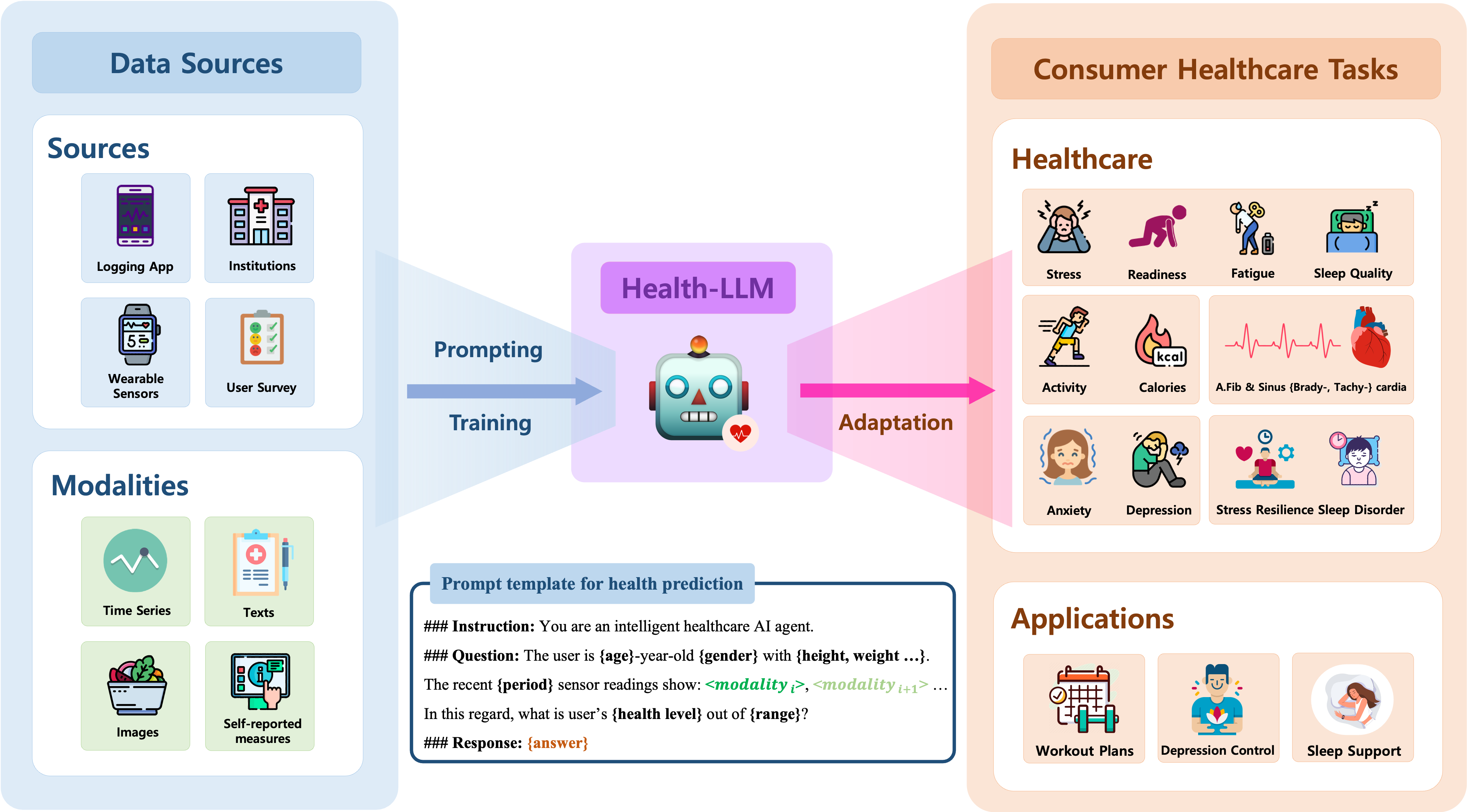
본 논문은 여섯 개의 공개 웨어러블 센서 데이터셋을 이용해 13개의 건강 예측 태스크에서 8개의 최첨단 LLM을 평가하고, 맥락 강화 프롬프트와 미세조정된 Health-Alpaca가 강력한 성능을 달성하며 때로는 GPT-4/3.5에 근접함을 보인다. 또한 프롷프트 맥락 유형과 데이터셋 일반화도 분석한다.
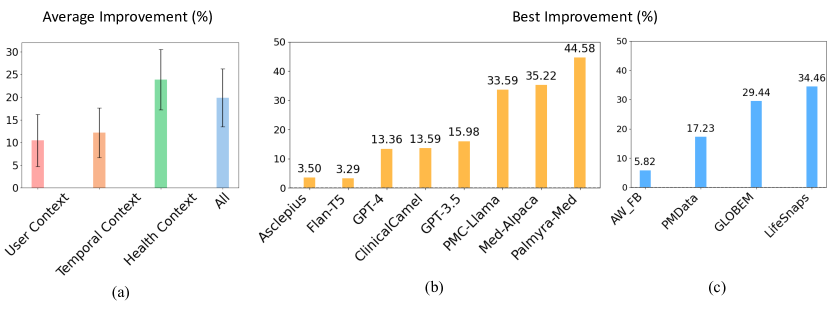
Large language models (LLMs) are capable of many natural language tasks, yet they are far from perfect. In health applications, grounding and interpreting domain-specific and non-linguistic data is crucial. This paper investigates the capacity of LLMs to make inferences about health based on contextual information (e.g. user demographics, health knowledge) and physiological data (e.g. resting heart rate, sleep minutes). We present a comprehensive evaluation of 12 state-of-the-art LLMs with prompting and fine-tuning techniques on four public health datasets (PMData, LifeSnaps, GLOBEM and AW_FB). Our experiments cover 10 consumer health prediction tasks in mental health, activity, metabolic, and sleep assessment. Our fine-tuned model, HealthAlpaca exhibits comparable performance to much larger models (GPT-3.5, GPT-4 and Gemini-Pro), achieving the best performance in 8 out of 10 tasks. Ablation studies highlight the effectiveness of context enhancement strategies. Notably, we observe that our context enhancement can yield up to 23.8% improvement in performance. While constructing contextually rich prompts (combining user context, health knowledge and temporal information) exhibits synergistic improvement, the inclusion of health knowledge context in prompts significantly enhances overall performance.
연구 동기 및 목표
- 다중 모달 웨어러블 센서 데이터를 사용하여 사전 학습된 LLM 지식과 소비자 건강 문제 사이의 간극을 좁히다.
- 13개의 건강 예측 태스크에 대한 제로샷, 파샷, 그리고 미세조정된 LLM 성능을 평가하다.
- 프롬프트 맥락(사용자 건강 지식, 시간적 맥락)이 모델 성능에 미치는 영향을 조사하다.
- 건강 도메인 응용을 위한 실용적 지침을 확립하기 위해 다양한 오픈 및 폐쇄 LLM을 비교하다.]
- method_underscore_removed
- method_indicator_removed
제안 방법
- 여덟 개 LLM(Med-Alpaca, PMC-Llama, Asclepius, ClinicalCamel, Flan-T5, Palmyra-Med, GPT-3.5, GPT-4)를 여섯 개 데이터세트의 13개 태스크에 대해 평가하다.
- 제로샷, CoT/SC를 활용한 파샷, 지시적 미세조정, PEFT 튜닝(LoRA) 방식 사용.
- 다음과 같은 맥락 강화 프롬프트를 도입: 1) 사용자 맥락, 2) 건강 지식 맥락, 3) 시간 맥락, 4) 이들의 조합.
- 건강 지향 모델 Health-Alpaca(및 Health-Alpaca-LoRa)를 미세조정하고 이를 더 큰 GPT 모델과 비교하다.
- 데이터셋 간 일반화와 미세조정을 위한 학습 크기 효과를 분석하다.
- 오픈소스 Health-LLM 프레임워크와 Health-Alpaca 모델을 제공하다.
실험 결과
연구 질문
- RQ1상용으로 바로 사용할 수 있는 LLM이 다중 모달 웨어러블 센서 데이터를 건강 예측 태스크에 근거를 둘 수 있는가?
- RQ2프롬프트 전략(제로샷 대 CoT/SC를 활용한 파샷)이 웨어러블을 이용한 건강 예측에서 성능에 어떤 영향을 주는가?
- RQ3지시형 미세조정이나 PEFT가 더 작은 모델이 건강 태스크에서 더 큰 LLM과 동등하거나 더 우수해지도록 하는가?
- RQ4건강 예측에서 맥락 강화 프롬프트(사용자, 건강 지식, 시간 맥락)의 이점은 무엇인가?
- RQ5미세조정된 Health-LLMs가 데이터세트 간 및 서로 다른 태스크 유형에 대해 얼마나 잘 일반화되는가?
주요 결과
- 제로샷 프롬프트는 특정 태스크의 기준선과 경쟁력 있는 결과를 보이는 태스크들이 있다.
- GPT-3.5/GPT-4를 사용한 파샷 프롬프트는 수치 시계열 기반 태스크에서 제로샷보다 현저한 개선을 보이며 일부 기준선을 능가한다.
- Health-Alpaca 모델(GPT-3.5/4보다 25배~250배 작음)이 완전 미세조정 시 13개 태스크 중 5개에서 최고 성능을 달성한다.
- 맥락 강화는 태스크, 데이터셋, 모델에 따라 최대 23.8%까지 성능을 높일 수 있으며, 건강 지식 맥락이 종종 가장 큰 이득을 제공한다.
- Health-Alpaca-LoRa 역시 많은 태스크에서 개선을 보여주며, 건강 태스크에 대한 파라미터 효율적 미세조정의 실행 가능성을 보여준다.
- 단일 데이터셋에 대한 미세조정은 종종 강한 결과를 내지만, 다중 데이터셋 Health-Alpaca는 태스크 간에 합리적인 일반화를 보여준다.
이 논문 읽기
누빈트 뷰어에서 원문을 열고, 읽으면서 궁금한 곳을 바로 물어보세요.
누빈트에서 이 논문 읽기이 리뷰는 AI가 논문 원문을 바탕으로 만들었습니다. 인용하기 전에 원문을 확인해 주세요.