
[논문 리뷰] How AI Ideas Affect the Creativity, Diversity, and Evolution of Human Ideas: Evidence From a Large, Dynamic Experiment
본 연구는 AI가 생성한 아이디어에 노출되는 것이 공개 여부와 무관하게, 동적이고 군중과 유사한 브레인스토밍 설정에서 800명 이상, 40개국 이상 참가자에 걸쳐 개인 창의성과 집단적 다양성에 어떤 영향을 미치는지 조사한다.
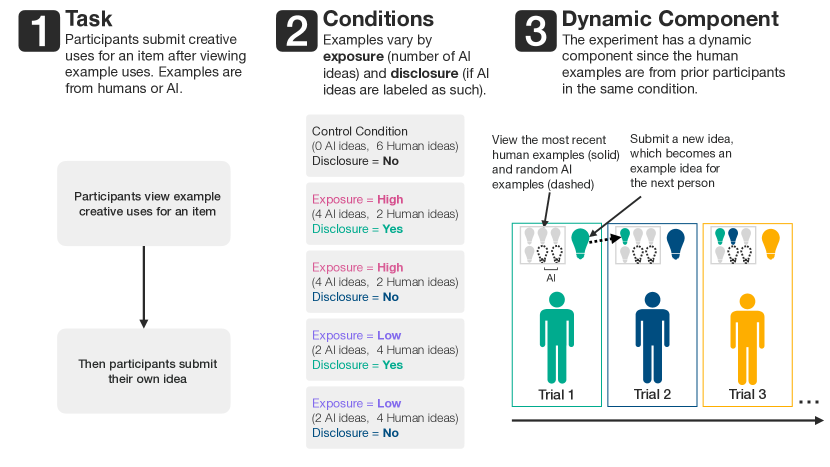
Exposure to large language model output is rapidly increasing. How will seeing AI-generated ideas affect human ideas? We conducted an experiment (800+ participants, 40+ countries) where participants viewed creative ideas that were from ChatGPT or prior experimental participants and then brainstormed their own idea. We varied the number of AI-generated examples (none, low, or high exposure) and if the examples were labeled as 'AI' (disclosure). Our dynamic experiment design -- ideas from prior participants in an experimental condition are used as stimuli for future participants in the same experimental condition -- speaks to the interdependent process of cultural creation: creative ideas are built upon prior ideas. Hence, we capture the compounding effects of having LLMs 'in the culture loop'. We find that high AI exposure (but not low AI exposure) did not affect the creativity of individual ideas but did increase the average amount and rate of change of collective idea diversity. AI made ideas different, not better. There were no main effects of disclosure. We also found that self-reported creative people were less influenced by knowing an idea was from AI and that participants may knowingly adopt AI ideas when the task is difficult. Our findings suggest that introducing AI ideas may increase collective diversity but not individual creativity.
연구 동기 및 목표
- 동적 문화 루프 맥락에서 AI 생성 아이디어에의 노출이 인간의 창의성에 미치는 영향을 조사한다.
- AI 공개가 창의성과 다양성에 미치는 영향을 조정하는지 판단한다.
- 참가자들의 연속 세대에 걸쳐 아이디어 다양성의 진화에 AI 아이디어가 어떠한 영향을 미치는지 평가한다.
제안 방법
- 참가자들이 자신만의 아이디어를 생성하기 전에 AI 및/또는 인간 아이디어를 보게 하는 Alternate Uses Task (AUT)의 변형을 사용한다.
- 동적 순방향 설계에서 AI 노출 수준(없음, 낮음, 높음)과 AI 공개(라벨링 vs. 비라벨링)를 조작한다.
- 아이디어를 임베딩(SBERT)으로 표현하여 아이디어 다양성과 AI 모방을 AI 예시와의 코사인 유사도를 통해 측정한다.
- 개인의 창의성을 인간 평가와 상관된 GPT-3 기반 오리지널리티 분류기로 추정한다(전반적으로 r=0.81).
- 동일 조건 내에서 아이디어가 향후 참가자에게 피드포워드되도록 하여 시간적 다이내믹스를 추적한다.
실험 결과
연구 질문
- RQ1높은 AI 노출이 개인 창의성이나 군중 수준의 다양성을 증가시키는가?
- RQ2AI 생성 아이디어의 라벨링(공개)이 창의성이나 AI 아이디어의 채택에 영향을 미치는가?
- RQ3AI 노출이 시간에 따른 집단 아이디어 다양성 변화율에 어떤 영향을 미치는가?
- RQ4스스로 창의적이라고 식별하는 개인이 AI 공개 아이디어에 더 다르게 반응하는가, 창의적으로 식별하지 않는 이들과 비교할 때?
주요 결과
- 높은 AI 노출은 집단 아이디어 다양성을 증가시키지만 개인 창의성을 향상시키지 않는다.
- AI 노출은 시간이 지남에 따라 아이디어 다양성이 발전하는 속도를 가속화한다.
- 자신을 창의적이라고 식별한 참가자들은 AI 아이디어를 채택할 때 AI 공개의 영향이 덜하다.
- 과제가 어려울수록, 특히 공개하였을 때 참가자들은 AI 아이디어를 채택할 가능성이 더 커진다.
- 전체 샘플에서 창의성이나 다양성에 대한 공개의 주효과는 없다.

이 논문 읽기
누빈트 뷰어에서 원문을 열고, 읽으면서 궁금한 곳을 바로 물어보세요.
누빈트에서 이 논문 읽기이 리뷰는 AI가 논문 원문을 바탕으로 만들었습니다. 인용하기 전에 원문을 확인해 주세요.