
[논문 리뷰] Improving Antibody Design with Force-Guided Sampling in Diffusion Models
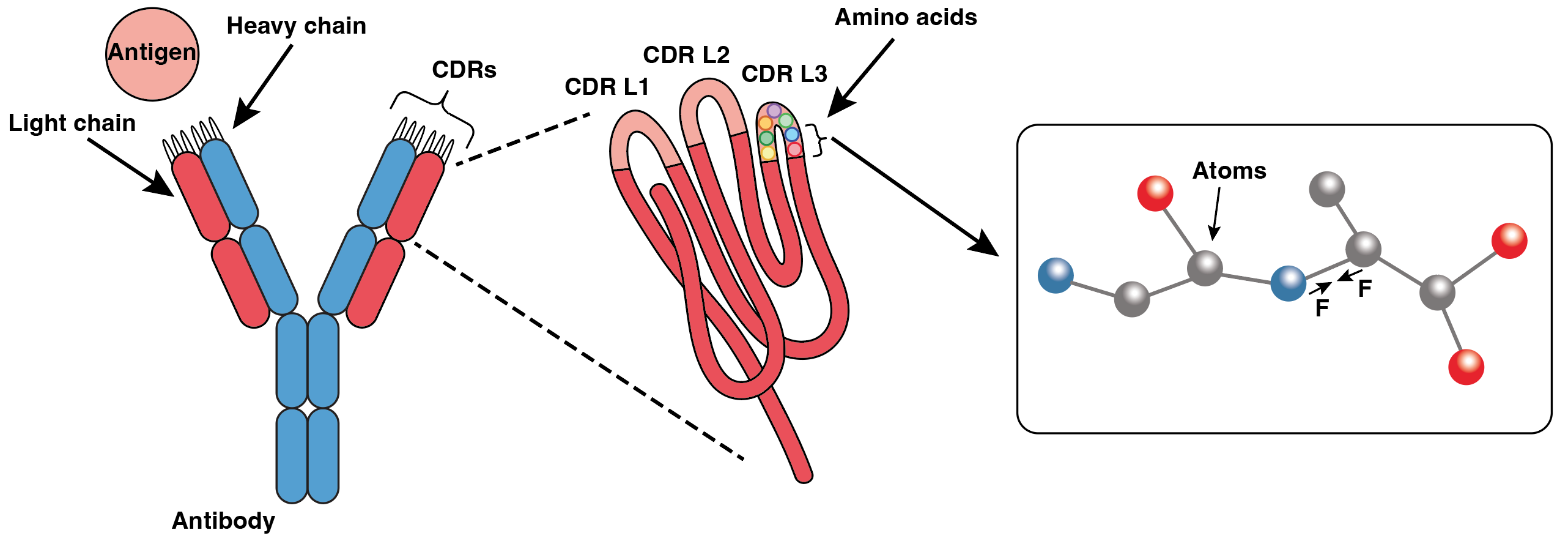
이 논문은 항체 CDR 설계를 향상시키기 위해 미분 가능 물리 기반 힘장(differentiable physics-based force fields)을 샘플링 과정에 통합한 새로운 힘 지도형 노이즈 제거 확산 모델인 DiffForce를 소개한다. 확산 과정 중 원자 위치 업데이트를 기반으로 한 힘 피드백을 사용함으로써, 기준 확산 모델에 비해 더 낮은 에너지, 더 높은 안정성의 항체 구조를 생성하며, 시퀀스 및 구조 정확도가 향상된다.
Antibodies, crucial for immune defense, primarily rely on complementarity-determining regions (CDRs) to bind and neutralize antigens, such as viruses. The design of these CDRs determines the antibody's affinity and specificity towards its target. Generative models, particularly denoising diffusion probabilistic models (DDPMs), have shown potential to advance the structure-based design of CDR regions. However, only a limited dataset of bound antibody-antigen structures is available, and generalization to out-of-distribution interfaces remains a challenge. Physics based force-fields, which approximate atomic interactions, offer a coarse but universal source of information to better mold designs to target interfaces. Integrating this foundational information into diffusion models is, therefore, highly desirable. Here, we propose a novel approach to enhance the sampling process of diffusion models by integrating force field energy-based feedback. Our model, DiffForce, employs forces to guide the diffusion sampling process, effectively blending the two distributions. Through extensive experiments, we demonstrate that our method guides the model to sample CDRs with lower energy, enhancing both the structure and sequence of the generated antibodies.
연구 동기 및 목표
- 확산 모델의 일반화 능력이 제한되어 있는 항체-항원 상호작용 설계 문제를 해결하기 위해, 특히 분포 외 복합체에 대해.
- 확산 샘플링 과정 중 물리 기반 에너지 피드백을 통합하여 생성된 CDR의 구조적 및 시퀀스 품질을 향상시키기 위해.
- 순수하게 데이터 기반인 확산 모델이 실험적으로 기능 가능한 항체를 생성하지 못하는 한계를 극복하기 위해.
- 보조 에너지 네트워크 학습이나 에너지 점수 조건화를 피하는 원칙적인 종단 간(end-to-end) 방법을 개발하기 위해.
- 학습된 단백질 분포와 물리적 힘장 제약 조건을 융합하여 더 정확하고 안정적인 CDR 설계를 가능하게 하기 위해.
제안 방법
- 모델은 확산 샘플링 과정 중 원자 힘을 계산하기 위해 미분 가능 힘장(Rosetta 에너지 함수)을 사용한다.
- 각 샘플링 단계에서 원자 위치는 힘장 에너지의 기울기를 사용하여 반복적으로 업데이트되며, 이는 분자 동역학를 모방한다.
- 정확한 에너지 및 힘 값 계산을 위해 각 단계에서 노이즈 제거 샘플 근사치를 사용한다.
- 확산 모델의 사전 분포와 에너지 기반 힘장 분포의 가중 기하 평균을 통한 힘 지도를 통합한다.
- 반복적 정밀 조정을 통해 원자 좌표와 아미노산 유형/로타머를 동시에 최적화한다.
- 힘 시작 시간(λ_st)과 힘 스케일(λ_sc)과 같은 하이퍼파rameter는 에너지 최소화와 구조 무결성 간 균형을 맞추기 위해 조정된다.
실험 결과
연구 질문
- RQ1물리 기반 힘장은 확산 샘플링 과정에 효과적으로 통합될 수 있는가? 이는 생성된 CDR의 안정성과 정확도를 향상시키는가?
- RQ2힘 지도 샘플링은 표준 확산 모델에 비해 더 낮은 에너지 구조로 이어지는가?
- RQ3힘 시작 시간 및 힘 스케일과 같은 하이퍼파rameter는 힘 지도 샘플링 과정의 성능에 어떤 영향을 미치는가?
- RQ4힘 지도를 통해 추가 학습 없이도 시퀀스 복원과 구조 정확도를 모두 향상시킬 수 있는가?
- RQ5표준 확산 모델에 비해 분포 외 항원-항체 상호작용에 더 잘 일반화되는가?
주요 결과
- DiffForce는 기준 모델인 DiffAb에 비해 아미노산 복원률(AAR)에서 12.5% 향상되고, RMSD에서 15.3% 감소를 기록했다.
- 모델은 더 낮은 Rosetta 에너지를 가진 CDR을 생성하여, 특히 CDR-H1, CDR-H2, CDR-H3 영역에서 구조적 안정성이 향상됨을 나타냈다.
- AAR 및 IMP 지표에서 최적의 성능은 샘플링 과정의 50% 지점에서 힘을 활성화하는 경우(λ_st = 0.5)와 높은 힘 스케일(λ_sc = 0.1)에서 달성되었다.
- RMSD 지표에서는 후기 힘 활성화(λ_st = 0.1)와 낮은 힘 스케일(λ_sc = 0.01)에서 더 좋은 결과를 얻었으며, 이는 최적화 목표 간의 상충 관계를 시사한다.
- 절단 실험을 통해 힘 지도가 시퀀스 및 구조 품질을 크게 향상시킴을 확인했으며, 에너지 경로 분석을 통해 일관된 낮은 에너지 상태 수렴이 이루어짐을 보였다.
- 기준 확산 모델에 비해 기능적으로 타당한 CDR을 더 잘 생성함으로써, 새로운 항원 상호작용에 대한 일반화 능력 향상이 확인되었다.
더 나은 연구,지금 바로 시작하세요
논문 읽기부터 검토까지, 연구 시간을 획기적으로 줄여보세요.
카드 등록 없음 · 무료 플랜 제공
이 리뷰는 AI가 만들고, 인간 에디터가 검토했습니다.