
[논문 리뷰] Improving Retrieval-Augmented Generation in Medicine with Iterative Follow-up Questions
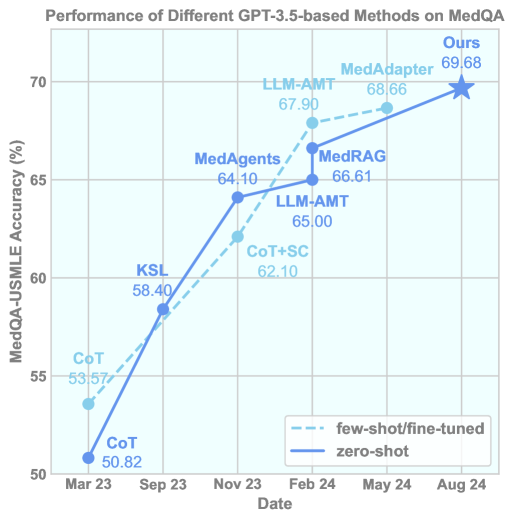
이 논문은 대규모 언어 모델(Large Language Models, LLMs)이 반복적으로 후속 질문을 생성하여 의료 질문 응답 성능을 향상시키는 데 기여하는 i-MedRAG을 제안한다. RAG를 통해 다중 라운드에 걸쳐 질의를 정교화함으로써, GPT-3.5를 사용하여 MedQA 데이터셋에서 새로운 SOTA(최고 성능)로 간주되는 69.68%의 제로샷 정확도를 달성하였으며, 이는 이전의 프롬프트 엔지니어링 및 희석 방법들을 모두 능가한다.
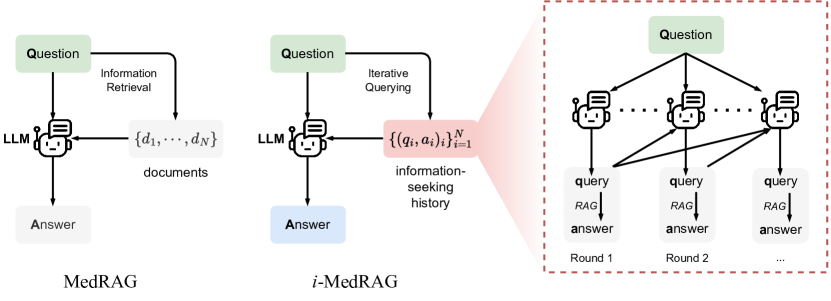
The emergent abilities of large language models (LLMs) have demonstrated great potential in solving medical questions. They can possess considerable medical knowledge, but may still hallucinate and are inflexible in the knowledge updates. While Retrieval-Augmented Generation (RAG) has been proposed to enhance the medical question-answering capabilities of LLMs with external knowledge bases, it may still fail in complex cases where multiple rounds of information-seeking are required. To address such an issue, we propose iterative RAG for medicine (i-MedRAG), where LLMs can iteratively ask follow-up queries based on previous information-seeking attempts. In each iteration of i-MedRAG, the follow-up queries will be answered by a conventional RAG system and they will be further used to guide the query generation in the next iteration. Our experiments show the improved performance of various LLMs brought by i-MedRAG compared with conventional RAG on complex questions from clinical vignettes in the United States Medical Licensing Examination (USMLE), as well as various knowledge tests in the Massive Multitask Language Understanding (MMLU) dataset. Notably, our zero-shot i-MedRAG outperforms all existing prompt engineering and fine-tuning methods on GPT-3.5, achieving an accuracy of 69.68% on the MedQA dataset. In addition, we characterize the scaling properties of i-MedRAG with different iterations of follow-up queries and different numbers of queries per iteration. Our case studies show that i-MedRAG can flexibly ask follow-up queries to form reasoning chains, providing an in-depth analysis of medical questions. To the best of our knowledge, this is the first-of-its-kind study on incorporating follow-up queries into medical RAG. The implementation of i-MedRAG is available at https://github.com/Teddy-XiongGZ/MedRAG.
연구 동기 및 목표
- 의료 분야의 복잡하고 다단계적인 임상 추론 과제를 다루는 데 있어 일반적인 RAG의 한계를 해결하기 위해.
- 후속 질문을 통한 반복적 정보 탐색을 통해 LLM의 환각 현상과 지식의 노후화 문제를 줄이기 위해.
- 모델 희석 없이도 의료 질문 응답 과제에서 LLM 성능을 향상시킬 수 있는 일반화 가능한 제로샷 프레임워크를 개발하기 위해.
- 반복적 질의 생성의 스케일링 행동을 반복 횟수와 각 반복에서의 질의 수 측면에서 분석하기 위해.
- 사례 연구를 통해 반복적 추론 체인의 효과성을 입증하고 복잡한 임상 사례를 해결하는 데 기여하기 위해.
제안 방법
- 프레임워크는 이전 검색 결과와 답변 기록을 바탕으로 LLM이 후속 질문을 생성하도록 유도한다.
- 각 후속 질문은 일반적인 RAG 시스템을 통해 처리되어 관련 문서를 검색하고 답변을 생성한다.
- 검색된 답변은 다음 반복의 질의 생성을 정교화하는 데 사용되며, 이는 추론 체인을 형성한다.
- 이 과정은 다중 반복을 거쳐 진행되며, 각 단계에서 구체성과 관련성 있는 정보 탐색이 향상된다.
- 최종 답변은 검색된 정보와 추론 단계의 전 과정을 기반으로 LLM이 생성한다.
- 이 방법은 희석 없이도 적용되며, 태스크 특화 프롬프트 엔지니어링이 필요하지 않다.
실험 결과
연구 질문
- RQ1반복적인 후속 질문 생성이 복잡한 의료 질문 응답 과제에서 LLM의 성능 향상에 기여할 수 있는가?
- RQ2반복 횟수와 각 반복에서의 질의 수가 검색 보강 추론 과정의 성능에 어떤 영향을 미치는가?
- RQ3모델 희석 없이도 i-MedRAG이 기존의 프롬프트 엔지니어링 및 희석 방법들을 능가할 수 있는가?
- RQ4다양한 의료 데이터셋에서 다양한 LLMs(GPT-3.5, Llama-3.1-8B 등)이 i-MedRAG를 통해 어떤 성능을 보이는가?
- RQ5반복적 질의를 사용할 때 LLM이 형성하는 추론 체인의 유형은 무엇이며, 이는 정답 정확도 향상에 어떻게 기여하는가?
주요 결과
- GPT-3.5를 사용하여 MedQA 데이터셋에서 i-MedRAG는 69.68%의 새로운 제로샷 정확도를 달성하였으며, 이는 이전의 모든 프롬프트 엔지니어링 및 희석 방법들을 능가한다.
- 프레임워크는 MedQA의 USMLE 서브셋에서 복잡한 임상 질문과 MMLU-Med 데이터셋에서의 성능을 크게 향상시켰다.
- 성능은 반복 횟수와 각 반복에서의 질의 수에 따라 향상되며, 특정 지점 이후에는 수익 감소 현상이 관찰되었다.
- 사례 연구에서는 i-MedRAG가 타겟된 질문을 통해 진단 및 치료를 점차 좁혀나가는 방식으로 일관된 추론 체인을 형성하도록 도와주는 것으로 나타났다.
- 다중 검색 라운드 동안 검색된 증거에 기반하여 답변를 고정함으로써 환각 현상을 효과적으로 줄였다.
- i-MedRAG는 닫힌 소스(GPT-3.5)와 개방 소스(Llama-3.1-8B) LLM 모두에 대해 다양한 의료 질문 응답 벤치마크에서 일반화 능력을 보였다.
이 논문 읽기
누빈트 뷰어에서 원문을 열고, 읽으면서 궁금한 곳을 바로 물어보세요.
누빈트에서 이 논문 읽기이 리뷰는 AI가 논문 원문을 바탕으로 만들었습니다. 인용하기 전에 원문을 확인해 주세요.