
[논문 리뷰] Improving the Model Consistency of Decentralized Federated Learning
본 논문은 DFedSAM과 DFedSAM-MGS를 제안하며, Sharpness Aware Minimization과 다중 Gossip 스텝을 분산 연합학습에 통합하여 지역 모델 간의 불일치를 감소시키고 이론적 수렴 보장과 중앙집중형 FL에 비해 경쟁력 있는 실험적 결과를 보여준다.
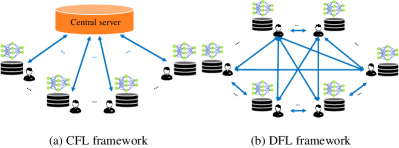
To mitigate the privacy leakages and communication burdens of Federated Learning (FL), decentralized FL (DFL) discards the central server and each client only communicates with its neighbors in a decentralized communication network. However, existing DFL suffers from high inconsistency among local clients, which results in severe distribution shift and inferior performance compared with centralized FL (CFL), especially on heterogeneous data or sparse communication topology. To alleviate this issue, we propose two DFL algorithms named DFedSAM and DFedSAM-MGS to improve the performance of DFL. Specifically, DFedSAM leverages gradient perturbation to generate local flat models via Sharpness Aware Minimization (SAM), which searches for models with uniformly low loss values. DFedSAM-MGS further boosts DFedSAM by adopting Multiple Gossip Steps (MGS) for better model consistency, which accelerates the aggregation of local flat models and better balances communication complexity and generalization. Theoretically, we present improved convergence rates $\small \mathcal{O}\big(\frac{1}{\sqrt{KT}}+\frac{1}{T}+\frac{1}{K^{1/2}T^{3/2}(1-λ)^2}\big)$ and $\small \mathcal{O}\big(\frac{1}{\sqrt{KT}}+\frac{1}{T}+\frac{λ^Q+1}{K^{1/2}T^{3/2}(1-λ^Q)^2}\big)$ in non-convex setting for DFedSAM and DFedSAM-MGS, respectively, where $1-λ$ is the spectral gap of gossip matrix and $Q$ is the number of MGS. Empirically, our methods can achieve competitive performance compared with CFL methods and outperform existing DFL methods.
연구 동기 및 목표
- 분산 연합학습(DFL)에서 지역 모델 간의 높은 불일치를 동기부여하고 해결한다.
- Sharpness Aware Minimization(SAM)을 통해 로컬 flat 모델을 생성하기 위해 DFedSAM을 제안한다.
- DFedSAM-MGS에서 다중 Gossip 스텝(MGS)을 도입하여 합의와 통신-일반화 간의 균형을 개선한다.
- 토폴로지(스펙트럼 간격), 데이터 이질성, SAM 교란 및 MGS의 영향을 포착하는 비 볼록 수렴 보장을 제공한다.
- IID 및 비 IID 파티션에서 CFL과 비교하여 제안된 방법들이 경쟁력 있는 성능을 달성하고 기존의 DFL 벤치마크를 CIFAR-10/100에서 능가함을 실험적으로 입증한다.
제안 방법
- 연결 그래프에서 이웃 간의 통신만으로 DFL 목표를 정의한다.
- SAM 기반 로컬 업데이트를 적용: y^{t,k+1}(i)=y^{t,k}(i) - η ∇F_i(y^{t,k}(i) + δ(y^{t,k}); ξ) with δ(y)=ρ g/||g||_2.
- 통신 전에 K번의 로컬 내부 반복을 수행하여 z^{t}(i)를 얻고 합산: x^{t+1}(i) = ∑_{l∈N(i)} w_{i,l} z^{t}(l).
- DFedSAM-MGS의 경우 라운드당 Q개의 Gossip 스텝을 도입하고 x^{t,q+1}(i)=∑_{l∈N(i)} w_{i,l} z^{t,q}(l) 및 z^{t,q+1}(i)=x^{t,q+1}(i) for q=0,...,Q-1.
- 비볼록 설정에서 이론적 수렴 경계 제공: O(1/√(KT) + 1/T + (1−λ)와 Q에 의존하는 항들).
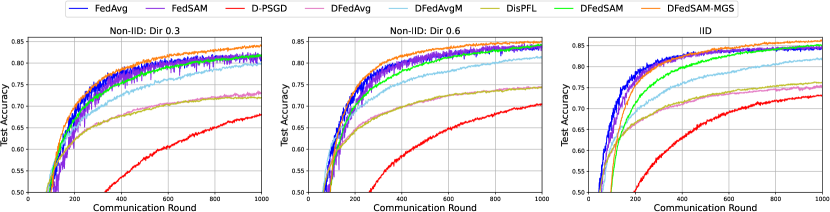
- 실험을 통해 CIFAR-10/100에서 IID 및 비 IID 파티션 하에 FedAvg, FedSAM, D-PSGD, DFedAvg, DisPFL 등의 베이스라인과 비교한다.
실험 결과
연구 질문
- RQ1 SAM이 분산 FL에서 로컬 모델의 과적합을 줄이고 일반화에 기여할 수 있는가?
- RQ2 Gossip 스텝(MGS)을 증가시키면 토폴로지 전반에서 모델 합의가 개선되고 CFL 대비 격차를 좁히는가?
- RQ3 확률적 비볼록 분산 설정에서 DFedSAM 및 DFedSAM-MGS의 수렴 보장은 있는가?
- RQ4 데이터 이질성과 토폴로지(스펙트럼 간격)가 성능에 어떤 영향을 미치며 제안된 방법이 이를 완화하는가?
- RQ5 DFedSAM 및 DFedSAM-MGS가 CFL 및 기존 DFL 벤치마크 대비 표준 데이터세트에서 경쟁력 있거나 우수한 성능을 달성하는가?
주요 결과
- DFedSAM은 CIFAR-10/100에서 IID 및 비 IID 설정에서 중앙집중형 FedSAM과 경쟁력 있는 성능을 달성하며, DFedSAM-MGS가 특히 토폴로지 로버스트니스를 지속적으로 개선한다.
- DFedSAM-MGS는 링, 격자, 지수적, 완전 연결 네트워크 전반에서 다른 DFL 벤치마크에 비해 성능이 향상된 토폴로지 강인성을 일관되게 보여준다.
- 제안된 방법은 일반화 오차를 감소시키고 더 부드러운 손실 지형을 만들어 클라이언트 간 모델 일관성이 개선됨을 시사한다.
- 이론적 수렴 속도는 토폴로지(스펙트럼 간격), MGS 스텝 수 Q, 교란 반경 ρ에 따라 개선되며 실험 결과와 일치한다.
- 실험 결과는 더 큰 Q(다중 Gossip 스텝)가 합의를 개선하고 토폴로지로 인한 악화를 완화함을 보여주며, DFedSAM-MGS가 종종 DFedSAM 및 다른 벤치마크를 능가한다.
이 논문 읽기
누빈트 뷰어에서 원문을 열고, 읽으면서 궁금한 곳을 바로 물어보세요.
누빈트에서 이 논문 읽기이 리뷰는 AI가 논문 원문을 바탕으로 만들었습니다. 인용하기 전에 원문을 확인해 주세요.