
[논문 리뷰] Jailbreak Attacks and Defenses Against Large Language Models: A Survey
대형 언어 모델(LLM)에 대한 탈출(jailbreak) 공격 및 방어 방법의 포괄적인 분류체계로, 화이트박스/블랙박스 공격, 프롬프트/모델 방어, 평가 접근 방법을 상세히 다루고, 공격-방어 관계 및 벤치마크에 대한 통찰을 제공합니다.
Large Language Models (LLMs) have performed exceptionally in various text-generative tasks, including question answering, translation, code completion, etc. However, the over-assistance of LLMs has raised the challenge of "jailbreaking", which induces the model to generate malicious responses against the usage policy and society by designing adversarial prompts. With the emergence of jailbreak attack methods exploiting different vulnerabilities in LLMs, the corresponding safety alignment measures are also evolving. In this paper, we propose a comprehensive and detailed taxonomy of jailbreak attack and defense methods. For instance, the attack methods are divided into black-box and white-box attacks based on the transparency of the target model. Meanwhile, we classify defense methods into prompt-level and model-level defenses. Additionally, we further subdivide these attack and defense methods into distinct sub-classes and present a coherent diagram illustrating their relationships. We also conduct an investigation into the current evaluation methods and compare them from different perspectives. Our findings aim to inspire future research and practical implementations in safeguarding LLMs against adversarial attacks. Above all, although jailbreak remains a significant concern within the community, we believe that our work enhances the understanding of this domain and provides a foundation for developing more secure LLMs.
연구 동기 및 목표
- 화이트박스와 블랙박스를 포함한 탈출 공격 방법과 프롬프트 수준 및 모델 수준의 방어 방법에 대한 체계적 분류체계를 제시한다.
- 공격 기법과 방어 기법 간의 관계를 도식화하고 방어의 크로스 어플리케이션 가능성을 식별한다.
- 탈출 연구에 사용되는 현재의 평가 지표, 벤치마크 및 데이터셋을 요약한다.
- LLM의 안전성과 보안을 개선하기 위한 취약점과 향후 방향을 강조한다.
제안 방법
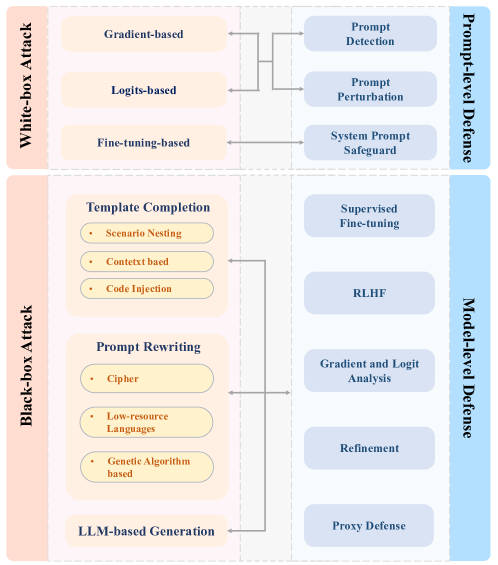
- 공격 방법을 화이트박스(그래디언트 기반, 로짓 기반, 미세 조정 기반)와 블랙박스(템플릿 완성, 프롬프트 재작성, LLM 기반 생성)로 분류한다.
- 방어 방법을 프롬프트 수준(탐지, 섭동, 시스템 프롬프트)와 모델 수준(감독 학습 파인튜닝, RLHF, 그래디언트/로짓 분석, 프록시 방어)으로 분류한다.
- 관계의 일관된 도식(그림 1)과 탈출 공격의 분류체계(그림 2)를 제공한다.
- 대표 연구를 포함한 다양한 하위 클래스들을 조사하고 핵심 아이디어와 결과를 개략한다.
- 탈출 연구에 사용된 평가 방법, 지표 및 벤치마크를 요약한다.
실험 결과
연구 질문
- RQ1LLM에 대한 탈출 공격 방법의 주요 범주와 하위 범주는 무엇인가?
- RQ2프롬프트 수준과 모델 수준에서 어떤 방어가 존재하며, 이것들이 특정 공격과 어떻게 연관되는가?
- RQ3현재의 평가 접근법은 탈출 효과성과 안전성 강건성을 어떻게 평가하는가?
- RQ4공격 유형 전반의 주요 취약점은 무엇이며, 방어는 공격 간에 어떻게 일반화될 수 있는가?
- RQ5탈출에 대한 LLM의 안전성을 강화할 수 있는 향후 방향은 무엇인가?
주요 결과
- 탈출 방법은 화이트박스와 블랙박스 범주로 효과적으로 조직되며, 그래디언트, 로짓, 미세 조정, 템플릿 완성, 프롬프트 재작성, LLM 기반 생성에 걸친 다수의 하위 분류가 있다.
- 방어는 프롬프트 수준(탐지, 교란, 시스템 프롬프트)과 모델 수준(감독 학습 파인튜닝, RLHF, 그래디언트/로짓 분석, 프록시 방어)에서 작동하며 교차 공격 효과를 보인다.
- 신규 공격은 가독성과 효율적인 적대 프롬프트(AutoDAN, ARCA)에 중점을 두고 있으며, 디코딩, 다국어 및 코드 관련 취약점을 악용해 방지책을 우회한다.
- 미세 조정 기반 공격은 비교적 소량의 악의적 데이터로도 안전 정렬을 크게 약화시켜 긴급한 방어 필요성을 제기한다.
- 맥락화 및 맥락 내 탈출(시나리오 중첩, 컨텍스트 내 공격)과 코드 주입 방식은 직접 프롬프트 조작을 넘어 진화하는 공격 표면을 보여준다.
- 암호화 문자, ASCII 아트 등 비자연어 프롬프트 형식은 비영어권 입력이나 인코딩된 입력에 대한 현재 안전 정렬의 간극을 드러낸다.
이 논문 읽기
누빈트 뷰어에서 원문을 열고, 읽으면서 궁금한 곳을 바로 물어보세요.
누빈트에서 이 논문 읽기이 리뷰는 AI가 논문 원문을 바탕으로 만들었습니다. 인용하기 전에 원문을 확인해 주세요.