
[논문 리뷰] Language Agent Tree Search Unifies Reasoning Acting and Planning in Language Models
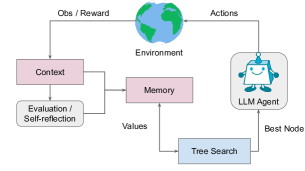
LATS는 언어 모델에서 계획, 행동, 추론을 통합합니다. LM 구성요소를 에이전트, 가치 함수, 최적화기로 간주하고 몬테카를로 트리 탐색(MCTS) 프레임워크 내에서 이를 수행하며, 외부 피드백과 자기 성찰을 활용해 다양한 작업에서 의사결정을 개선합니다.
While language models (LMs) have shown potential across a range of decision-making tasks, their reliance on simple acting processes limits their broad deployment as autonomous agents. In this paper, we introduce Language Agent Tree Search (LATS) -- the first general framework that synergizes the capabilities of LMs in reasoning, acting, and planning. By leveraging the in-context learning ability of LMs, we integrate Monte Carlo Tree Search into LATS to enable LMs as agents, along with LM-powered value functions and self-reflections for proficient exploration and enhanced decision-making. A key feature of our approach is the incorporation of an environment for external feedback, which offers a more deliberate and adaptive problem-solving mechanism that surpasses the constraints of existing techniques. Our experimental evaluation across diverse domains, including programming, interactive question-answering (QA), web navigation, and math, validates the effectiveness and generality of LATS in decision-making while maintaining competitive or improved reasoning performance. Notably, LATS achieves state-of-the-art pass@1 accuracy (92.7%) for programming on HumanEval with GPT-4 and demonstrates gradient-free performance (average score of 75.9) comparable to gradient-based fine-tuning for web navigation on WebShop with GPT-3.5. Code can be found at https://github.com/lapisrocks/LanguageAgentTreeSearch
연구 동기 및 목표
- 외부 환경에서 계획하고, 행동하며, 추론할 수 있는 자율적인 LM 에이전트의 필요성을 동기 부여한다.
- 환경 피드백과 자기 성찰을 활용하는 일반적인 LM 기반 몬테카를로 트리 탐색 프레임워크인 LATS를 제안한다.
- 다양한 도메인(프로그래밍, 오픈 도메인 QA, 웹 내비게이션)에서 LATS를 시연하여 광범위한 적용 가능성을 보여준다.
- 외부 피드백과 통합된 추론-행동-계획 루프가 이전 프롬프트 방법들보다 성능을 향상시킨다는 것을 보인다.
제안 방법
- 사전 학습된 LM을 MCTS 유사 탐색 내에서 LM 에이전트, 가치 함수, 최적화기로 재목적화한다.
- 노드를 [x, a1..i, o1..i]로 정의하고, LM 프롬프트가 행동 및 가치 추정을 안내하도록 하며 표준 MCTS 연산(선택, 확장, 평가, 시뮬레이션, 역전파)을 수행한다.
- 확장 시에 LM이 n개의 행동을 생성하고 잎 노드를 가치 함수로 점수화하여 의도적 궤적 구성을 가능하게 한다.
- 환경 관찰을 통한 외부 피드백과 실패한 궤적을 주석하고 맥락 학습에 저장되는 자기 성찰 모듈을 도입한다.
- 향후 시도에 의미적 지침을 보강해 보상 신호를 확대하고 확장하는 성찰 단계를 포함하여 스칼라 보상 신호를 풍부하게 한다.
- 리액트(ReAct)처럼 외부 도구나 API와의 상호작용을 행동 집합 내에서 허용하여 현실 세계 환경에서 추론과 행동을 연결한다.
- 프로그래밍(HumanEval with GPT-4), HotPotQA, 및 WebShop에서 LATS를 평가하여 다재다능성과 성능 향상을 보여준다.
실험 결과
연구 질문
- RQ1LM 기반 몬테카를로 트리 탐색 프레임워크가 의사결정 과제를 위해 추론, 계획 및 행동을 통합할 수 있는가?
- RQ2외부 환경 피드백과 LM이 생성한 성찰을 활용하면 ReAct, CoT, ToT, RAP 등 이전 프롬프트 방법들보다 성능이 향상되는가?
- RQ3프로그래밍, 다중 추론 QA, 웹 탐색이 필요한 도메인에서 LATS의 성능은 어떠한가?
- RQ4확장 폭(n)과 궤적 샘플(k)을 다르게 하는 것이 성능과 계산에 어떤 영향을 미치는가?
- RQ5LM 주도 계획 및 행동에서 자가 성찰이 성능 향상에 어느 정도 기여하는가?
주요 결과
- LATS는 GPT-4를 사용한 HumanEval 프로그래밍에서 94.4% Pass@1을 달성하며 해당 설정에서 최첨단을 수립한다.
- GPT-3.5를 사용한 WebShop에서 LATS는 평균 점수 75.9를 달성하고 베이스라인 대비 우수한 탐색 기반 계획을 보여준다.
- HotPotQA에서 LATS는 평가된 방법들 중 가장 높은 행동 기반 EM(0.61)을 달성했고 추론에서도 경쟁력이 있다(0.61 대 베이스라인의 0.60–0.64 범위).
- LATS는 HotPotQA에서 샘플링 예산 전반에 걸쳐 ReAct를 능가하며, 더 큰 노드 확장(n)이 일관된 이득을 준다.
- 자기 성찰은 성능에 다소 기여하며(일부 차단 실험에서 약 0.05점 상승), 의미적 피드백이 스칼라 역전파를 넘어 보완적 가치를 제공함을 시사한다.
- 구간 제거 실험은 구성 요소(LM 휴리스틱, 성찰, DFS 구성)을 제거하면 성능이 저하됨을 보여주며, 전체 LATS 설계의 중요성을 강조한다.
이 논문 읽기
누빈트 뷰어에서 원문을 열고, 읽으면서 궁금한 곳을 바로 물어보세요.
누빈트에서 이 논문 읽기이 리뷰는 AI가 논문 원문을 바탕으로 만들었습니다. 인용하기 전에 원문을 확인해 주세요.