
[논문 리뷰] Late Breaking Results: Fortifying Neural Networks: Safeguarding Against Adversarial Attacks with Stochastic Computing
논문은 추론 단계에서 특히 초깃단 컨볼루션 계층에서 확률적 컴퓨팅(SC)을 사용해 적대적 공격에 대한 신경망의 강인성을 개선하는 것을 제안했으며, LeNet-5 (MNIST) 및 ResNet-20 (CIFAR-10)에서 L2/Carlini-Wagner 공격으로 시연했다.
In neural network (NN) security, safeguarding model integrity and resilience against adversarial attacks has become paramount. This study investigates the application of stochastic computing (SC) as a novel mechanism to fortify NN models. The primary objective is to assess the efficacy of SC to mitigate the deleterious impact of attacks on NN results. Through a series of rigorous experiments and evaluations, we explore the resilience of NNs employing SC when subjected to adversarial attacks. Our findings reveal that SC introduces a robust layer of defense, significantly reducing the susceptibility of networks to attack-induced alterations in their outcomes. This research contributes novel insights into the development of more secure and reliable NN systems, essential for applications in sensitive domains where data integrity is of utmost concern.
연구 동기 및 목표
- SC(확률적 컴퓨팅)가 신경망의 적대적 공격에 대한 탄력성을 강화할 수 있는지 평가한다.
- SC에서 어떤 계층과 비트스트림 구성이 강인성에 가장 기여하는지 식별한다.
- 간단한 구조(LeNet-5/MNIST)와 복잡한 구조(ResNet-20/CIFAR-10) 모두에서 SC 기반 방어를 평가한다.
제안 방법
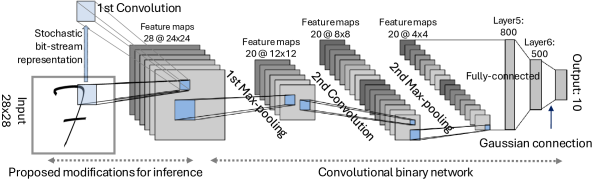
- 대상 컨볼루션 계층의 곱셈을 비트-와이즈 AND 연산을 사용하는 SC 기반 비트스트림 곱셈기로 대체한다.
- 입력과 가중치를 준 난수 Sobol 시퀀스로 생성된 확률적 비트스트림으로 인코딩한다.
- 정확도를 유지하면서 복잡성을 줄이기 위해 SC 적용을 첫 번째 컨볼루션 계층에 집중한다.
- 추론 전용 수정으로 사용한다; 학습 단계는 변경되지 않는다.
- MNIST 및 CIFAR-10 데이터세트에 대해 White-box L2(Carlini-Wagner) 적대적 공격에 대한 방어를 평가한다.
실험 결과
연구 질문
- RQ1초기 계층에 SC를 도입하면 재학습 없이 적대적 교란에 대한 탄력성이 향상되는가?
- RQ2공격 하에서 어떤 계층과 비트스트림 길이가 강인성-정확도 트레이드오프를 최적화하는가?
- RQ3SC 기반 추론이 CIFAR-10의 복잡한 네트워크(ResNet-20)를 L2 적대자에 대해 방어할 수 있는가?
- RQ4공격하에서 오분류율 측면에서 SC 기반 방어가 기존 방어 기법과 비교하여 어떠한가?
주요 결과
- 첫 번째 컨볼루션 계층에서의 SC가 강인성을 크게 향상시키며, 두 번째 계층에서만의 SC은 작은 비트스트림에 대해 덜 유익하다.
- MNIST의 LeNet-5는 공격 전 거의 원래 정확도(≈99%)를 유지하고, SC 방어 하에서 특정 구성에서 공격 후 정확도가 최대 79%까지 증가한다.
- CIFAR-10의 ResNet-20은 더 긴 비트스트림(N=256 등)으로 강인성 증가를 보이고 일반적인 정확도 수준에 도달하며, 일부 구성에서 공격 후 정확도가 최대 85%까지 된다.
- 공격하에 보호된 모델은 잘못 분류하는 비율이 현저히 낮아(예: 10% 오분류) 보고된 최첨단 벤치마크에 비해 낮다.
- 이 접근법은 재학습을 피하고 단순한 네트워크와 복잡한 네트워크 모두에 적용 가능하여 보안 강화 AI 시스템에 실용적 방어를 제공한다.
- 본 연구는 추론 중 적대적 조작이 있어도 확률적 처리로 정확도를 유지하거나 회복할 수 있음을 입증한다.
이 논문 읽기
누빈트 뷰어에서 원문을 열고, 읽으면서 궁금한 곳을 바로 물어보세요.
누빈트에서 이 논문 읽기이 리뷰는 AI가 논문 원문을 바탕으로 만들었습니다. 인용하기 전에 원문을 확인해 주세요.