
[논문 리뷰] Latent Stochastic Differential Equations for Modeling Quasar Variability and Inferring Black Hole Properties
이 논문은 불규칙한 샘플링과 장기간 간격이 있는 상황에서도 블랙홀 질량, 기울기 각도, 온도 경향성과 같은 물리적 특성을 추론할 수 있도록 다중 대역 quasar 광선 곡선을 동시에 재구성하는 잠재적 확률 미분 방정식(SDE) 모델을 소개한다. 시뮬레이션된 LSST 데이터로 훈련된 이 모델은 재구성 정확도에서 다중 출력 가우시안 프로세스 회귀보다 뛰어나며, 확률적 변동성으로부터 물리적 매개변수를 안정적으로 추론할 수 있다.
Quasars are bright and unobscured active galactic nuclei (AGN) thought to be powered by the accretion of matter around supermassive black holes at the centers of galaxies. The temporal variability of a quasar's brightness contains valuable information about its physical properties. The UV/optical variability is thought to be a stochastic process, often represented as a damped random walk described by a stochastic differential equation (SDE). Upcoming wide-field telescopes such as the Rubin Observatory Legacy Survey of Space and Time (LSST) are expected to observe tens of millions of AGN in multiple filters over a ten year period, so there is a need for efficient and automated modeling techniques that can handle the large volume of data. Latent SDEs are machine learning models well suited for modeling quasar variability, as they can explicitly capture the underlying stochastic dynamics. In this work, we adapt latent SDEs to jointly reconstruct multivariate quasar light curves and infer their physical properties such as the black hole mass, inclination angle, and temperature slope. Our model is trained on realistic simulations of LSST ten year quasar light curves, and we demonstrate its ability to reconstruct quasar light curves even in the presence of long seasonal gaps and irregular sampling across different bands, outperforming a multioutput Gaussian process regression baseline. Our method has the potential to provide a deeper understanding of the physical properties of quasars and is applicable to a wide range of other multivariate time series with missing data and irregular sampling.
연구 동기 및 목표
- 불규칙한 샘플링과 장기간 간격이 있는 다변량 quasar 광선 곡선을 위한 확장 가능하고 미분 가능한 모델을 개발하기 위해.
- 관측된 광선 곡선과 블랙홀 질량, 기울기 각도, 온도 경향성과 같은 내재된 물리적 매개변수를 동시에 재구성하기 위해.
- LSST와 같은 대규모 조사에서 인구 수준의 quasar 매개변수 분포를 계층적으로 추론할 수 있도록 하기 위해.
- 관측 도전 과제 상황에서 광선 곡선과 구조 함수 재구성에서 기존의 가우시안 프로세스 회귀 기준선을 향상시키기 위해.
- 누락된 자료가 있는 확률적 천체 물리학적 시간 시리즈에서 잠재적 SDE를 사용한 물리적 추론의 가능성을 입증하기 위해.
제안 방법
- 모델은 quasar 빛의 강도 변동성의 잠재적 확률적 역학을 연속 시간 확산 과정으로 표현하기 위해 잠재적 SDE 프레임워크를 사용한다.
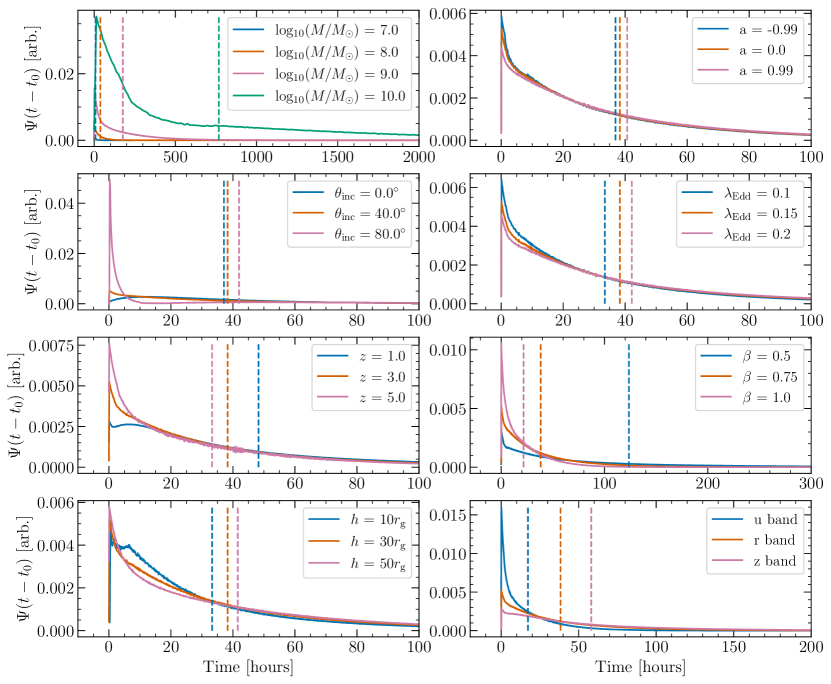
- 다중 대역 광선 곡선은 공통된 잠재 과정의 관측치로 간주되며, 파장에 따라 다른 시간 지연을 모델링하기 위해 대역별 전이 함수를 포함한다.
- 모델은 10년 기준, 불규칙한 캐드런스와 계절적 간격을 포함한 현실적인 LSST 시뮬레이션 광선 곡선을 엔드 투 엔드로 훈련한다.
- 신경망은 SDE의 드리프트 및 확산 함수를 매개변수화하여 복잡한 변동성을 유연하고 데이터 기반으로 모델링할 수 있다.
- 불확실성 정량화와 사후 추정을 가능하게 하기 위해 확률적 경량 샘플링을 사용한 변분 추론을 수행한다.
- 이 프레임워크는 광선 곡선의 공동 재구성과 물리적 매개변수 추론(인구 분포의 계층적 모델링 포함)을 지원한다.
실험 결과
연구 질문
- RQ1잠재적 SDE 모델은 불규칙한 샘플링과 장기간 간격이 있는 다중 대역 quasar 광선 곡선을 정확히 재구성할 수 있는가?
- RQ2잠재적 SDE는 블랙홀 질량, 기울기 각도, 온도 경향성과 같은 물리적 매개변수를 확률적 변동성으로부터 어느 정도 정확하게 추론할 수 있는가?
- RQ3잠재적 SDE의 성능은 불규칙한 샘플링과 구조 함수 복원 상황에서 다중 출력 가우시안 프로세스 회귀와 비교해 어떻게 되는가?
- RQ4이 모델은 quasar 매개변수의 인구 수준 분포를 안정적으로 계층적으로 추론할 수 있는가?
- RQ5캐드런스와 간격과 같은 관측 효과가 물리적 매개변수 복원 가능성에 어떤 영향을 미치는가?
주요 결과
- 잠재적 SDE 모델은 불규칙한 샘플링과 장기간 계절적 간격이 있는 상황에서 다중 출력 가우시안 프로세스 회귀보다 quasar 광선 곡선 재구성에서 뛰어난 성능을 보였다.
- 모델은 시뮬레이션된 quasar 광선 곡선의 진짜 구조 함수를 성공적으로 복원하였으며, 평균 예측치가 진짜 값과 매우 유사하였다.
- 블랙홀 질량, 기울기 각도, 온도 경향성과 같은 물리적 매개변수는 중앙값 예측치가 진짜 값에 가깝고, 95%의 테스트 케이스에서 진짜 값이 1σ 불확실성 범위에 포함되었다.
- 모델은 계층적 추론을 가능하게 하여, 원추형 디스크 및 풍속 모델을 제약할 수 있는 온도 경향성과 같은 매개변수의 인구 수준 분포 추정이 가능했다.
- 잠재적 SDE 프레임워크는 누락된 자료 및 불규칙한 캐드런스와 같은 관측 과제에 대해 강건함을 보였으며, 이는 LSST 규모의 조사에 적합하다.
- 시간 지연 또는 변동 폭이 시간 분할보다 충분히 큰 경우에만 매개변수 복원이 가능하며, 12시간 이하의 영향을 갖는 매개변수는 회복하기 어려울 수 있다.
이 논문 읽기
누빈트 뷰어에서 원문을 열고, 읽으면서 궁금한 곳을 바로 물어보세요.
누빈트에서 이 논문 읽기이 리뷰는 AI가 논문 원문을 바탕으로 만들었습니다. 인용하기 전에 원문을 확인해 주세요.