
[논문 리뷰] Learning to Predict Mutation Effects of Protein-Protein Interactions by Microenvironment-aware Hierarchical Prompt Learning
이 논문은 사전 훈련된 프롬프트 코드북을 통해 다중 척도 구조적 종속성을 모델링함으로써 단백질-단백질 상호작용의 돌연변이 효과를 효율적으로 예측하는 마이크로환경 인식형 계층적 프롬프트 학습 프레임워크인 Prompt-DDG를 제안한다. 이는 전처리 비용을 크게 줄이며 ΔΔG 예측 및 항체 최적화에서 최신 기술 수준의 성능을 달성한다.
Protein-protein bindings play a key role in a variety of fundamental biological processes, and thus predicting the effects of amino acid mutations on protein-protein binding is crucial. To tackle the scarcity of annotated mutation data, pre-training with massive unlabeled data has emerged as a promising solution. However, this process faces a series of challenges: (1) complex higher-order dependencies among multiple (more than paired) structural scales have not yet been fully captured; (2) it is rarely explored how mutations alter the local conformation of the surrounding microenvironment; (3) pre-training is costly, both in data size and computational burden. In this paper, we first construct a hierarchical prompt codebook to record common microenvironmental patterns at different structural scales independently. Then, we develop a novel codebook pre-training task, namely masked microenvironment modeling, to model the joint distribution of each mutation with their residue types, angular statistics, and local conformational changes in the microenvironment. With the constructed prompt codebook, we encode the microenvironment around each mutation into multiple hierarchical prompts and combine them to flexibly provide information to wild-type and mutated protein complexes about their microenvironmental differences. Such a hierarchical prompt learning framework has demonstrated superior performance and training efficiency over state-of-the-art pre-training-based methods in mutation effect prediction and a case study of optimizing human antibodies against SARS-CoV-2.
연구 동기 및 목표
- 단백질-단백질 상호작용 연구에서의 표본화된 실험적 돌연변이 데이터 부족 문제를 해결한다.
- 다양한 구조적 척도를 통해 복잡한 고차원 종속성을 모델링하지 못하는 기존 사전 훈련 방법의 한계를 극복한다.
- 변형된 복합체의 구조를 명시적으로 예측하지 않고도 돌연변이에 의해 유도되는 국소 마이크로환경 변화를 포착한다.
- 높은 예측 성능를 유지하면서도 전처리 비용을 줄인다.
- 특히 SARS-CoV-2 중화 항체에 대한 효과적인 가상 스크리닝 및 기능적 부위 탐색을 가능하게 한다.
제안 방법
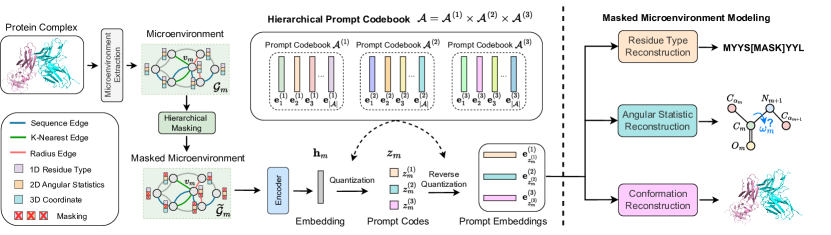
- 다양한 구조적 척도(예: 아미노산, 이황각, 국소 구조)에서 공통적인 마이크로환경 패턴을 별도로 인코딩하기 위해 계층적 프롬프트 코드북을 구축한다.
- 각 돌연변이 주변의 잔기 유형, 각도 통계, 국소 구조적 변화를 동시에 모델링하는 마스크된 마이크로환경 모델링 사전 훈련 작업을 설계한다.
- 코드북에서 추출한 계층적 프롬프트를 조합하여 각 돌연변이에 대한 마이크로환경 인식형 프롬프트를 생성함으로써, 원형 및 돌연변이 복합체 간의 차이를 포착한다.
- 학습된 프롬프트를 인라인 표현으로 사용하여 후행 작업인 ΔΔG 예측을 유도함으로써, 고비용의 엔드 투 엔드 미세조정을 피한다.
- 모델을 각 새로운 돌연변이에 대해 재훈련하지 않고도 구조적 맥락을 영리하게 다중 척도로 인코딩할 수 있도록 프롬프트 코드북을 활용한다.
- 원형 및 돌연변이 마이크로환경 표현 간의 정렬을 목표로 하는 대비 학습 목표를 사용하여 프레임워크를 종합적으로 훈련한다.
실험 결과
연구 질문
- RQ1계층적 프롬프트 코드북은 돌연변이 주변 단백질 마이크로환경의 다중 척도 구조적 종속성을 효과적으로 모델링할 수 있는가?
- RQ2표준 사전 훈련 작업과 비교해 마스크된 마이크로환경 모델링 사전 훈련이 후행 ΔΔG 예측 성능을 향상시키는가?
- RQ3ΔΔG 예측에서 엔드 투 엔드 사전 훈련 대비 프롬프트 기반 표현 학습이 뛰어난 정확도와 효율성을 달성할 수 있는가?
- RQ4모델은 SARS-CoV-2에 대한 항체 최적화와 같은 실제 응용에 얼마나 잘 일반화되는가?
- RQ5정확도와 훈련 효율성 측면에서 모델의 성능가 최신 기술 수준의 방법들과 비교해 어떻게 되는가?
주요 결과
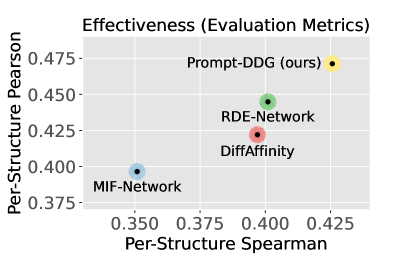
- Prompt-DDG는 SKEMPI v2.0 벤치마크에서 구조별 피어슨 상관계수(0.6557)와 스피어만 상관계수(0.5691)로 최고 성능을 기록하여 모든 기준선을 초월했다.
- RDE-Network 및 DiffAffinity와 비교해 전처리 시간을 50% 이상 단축시키면서도 뛰어난 성능을 유지했다.
- SARS-CoV-2 항체 최적화 사례 연구에서, Prompt-DDG는 알려진 다섯 가지 유리한 돌연변이를 상위 40% 내에 모두 순위 매기며, 평균 순위 10.69%를 기록했으며, RDE-Network(18.26%) 및 DiffAffinity(24.49%)를 크게 앞섰다.
- 오직 Prompt-DDG만이 상위 10% 내에서 다섯 개의 핵심 중화 돌연변이 중 네 개를 성공적으로 식별하여 강력한 일반화 능력과 정밀도를 입증했다.
- 제거 실험 결과, 마스크된 마이크로환경 모델링 작업에서 최적의 마스크 비율은 0.10이었으며, 이는 피어슨 및 스피어만 상관계수 양면에서 최고의 성능를 보였다.
- 계층적 프롬프트 코드북은 다중 척도 마이크로환경 특징의 효과적인 모델링을 가능하게 하여 돌연변이 효과의 개선된 일반화 및 해석 가능성에 기여했다.
더 나은 연구,지금 바로 시작하세요
논문 읽기부터 검토까지, 연구 시간을 획기적으로 줄여보세요.
카드 등록 없음 · 무료 플랜 제공
이 리뷰는 AI가 만들고, 인간 에디터가 검토했습니다.