
[논문 리뷰] Les Houches Lectures on Community Ecology: From Niche Theory to Statistical Mechanics
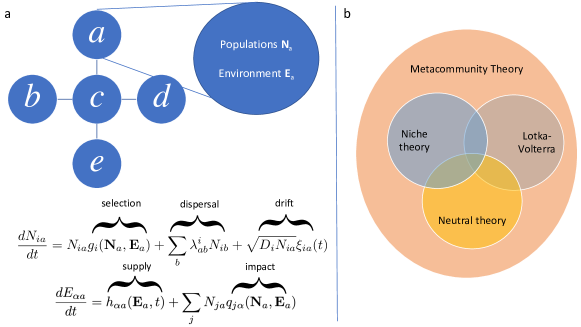
니치 이론과 통계물리학을 커뮤니티 생태학에 연결하는 고찰로, Consumer Resource Models와 Generalized Lotka-Volterra 모델을 상세히 다루고, cavity methods와 random matrix theory를 이용한 고차원 분석을 탐구한다.
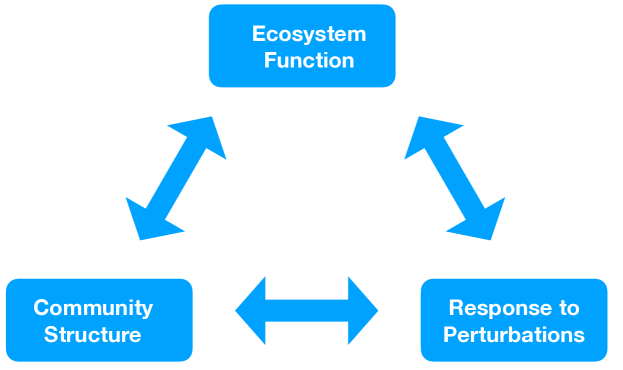
Ecosystems are among the most interesting and well-studied examples of self-organized complex systems. Community ecology, the study of how species interact with each other and the environment, has a rich tradition. Over the last few years, there has been a growing theoretical and experimental interest in these problems from the physics and quantitative biology communities. Here, we give an overview of community ecology, highlighting the deep connections between ecology and statistical physics. We start by introducing the two classes of mathematical models that have served as the workhorses of community ecology: Consumer Resource Models (CRM) and the generalized Lotka-Volterra models (GLV). We place a special emphasis on graphical methods and general principles. We then review recent works showing a deep and surprising connection between ecological dynamics and constrained optimization. We then shift our focus by analyzing these same models in "high-dimensions" (i.e. in the limit where the number of species and resources in the ecosystem becomes large) and discuss how such complex ecosystems can be analyzed using methods from the statistical physics of disordered systems such as the cavity method and Random Matrix Theory.
연구 동기 및 목표
- 커뮤니티 생태학의 핵심 원리와 커뮤니티 형성에서 니치 이론의 역할을 소개한다.
- 두 가지 주된 모델링 프레임워크인 Consumer Resource Models (CRMs)와 Generalized Lotka-Volterra (GLV) 모델을 제시하고 대조한다.
- 생태 역학이 제약 최적화와 고차원 통계물리 방법과 연결되는 방식을 설명한다.
- 공존, 안정성, 자원-소비자 상호작용의 기하학을 다루는 그래픽 방법을 논의한다.
- 고차원 분석과 무질서 계(system) 기법이 생태계 거동을 어떻게 밝히는지 강조한다.
제안 방법
- CRMs와 GLVs를 커뮤니티 생태학의 기본 모델로서 설명하고 분석한다.
- 제로 순증가율 등가선(ZNGIs) 및 공존 원추(cones)와 같은 그래픽 표현을 사용해 공존성과 안정성 기준을 도출한다.
- 고정점 주변의 선형 응답 전개를 통해 탄력성 유사성(elasticity analogies)을 이용하여 GLV 방정식을 도출한다.
- 일반화된 MacArthur 자원 모델과 본질적/대체 불가능한 자원에 대한 공급 벡터 및 영향 벡터를 다룬다.
- 랜덤 행렬 이론의 개념과 cavity 방법을 통해 고차원 분석을 소개한다.
실험 결과
연구 질문
- RQ1CRMs와 GLVs가 커뮤니티 구성에서 생태학적 상호작용과 환경 매개를 어떻게 암호화하는가?
- RQ2CRMs와 GLV 프레임워크에서 다수 종이 안정적으로 공존하는 기하학적·동역학적 조건은 무엇인가?
- RQ3고차원 한계(종 및 자원의 대수 증가)가 니치 이론 하에서 안정성 및 다양성에 어떻게 영향을 미치는가?
- RQ4생태 역학에서 니치 이론과 최적화 원칙 간의 관계는 무엇인가?
- RQ5 cavity 방법, Random Matrix Theory와 같은 통계물리학 기법을 대형 생태 네트워크 분석에 어떻게 적용할 수 있는가?
주요 결과
- CRMs와 GLVs는 보완적 관점을 제공한다: CRMs는 환경 매개 상호작용을 강조하고, GLVs는 종-종 간 상호작용을 포착한다.
- CRMs에서의 공존은 ZNGIs, 공급점, 음의 영향 벡터로 형성된 원추를 통해 기하학적으로 이해될 수 있으며, 경쟁 배제 원칙은 안정적 공존을 자원의 수로 제한한다.
- 외부적으로 공급되는 자원은 원추 기하를 수정하여 고차원에서 고정점 공존 영역을 축소하고 경쟁 배제 경계의 포화에 영향을 준다.
- 본질적 자원(대체 불가 자원)은 지수적 ZNGI를 이끌 수 있으며 자원의 생물량 스토이키오메트리에 따라 잠재적으로 불안정한 고정점을 만들 수 있어 단순 공존을 넘어선 복잡한 동역학을 허용한다.
- 생태 역학으로부터 GLV를 도출하면 종간 상호작용은 환경 매개에 의존하고 자원 기반 모델에서 도출될 때 더 높은 차수 효과를 포함할 수 있음을 시사한다.
- 고차원 설정에서 랜덤 행렬 이론과 cavity 방법의 도구들은 복잡한 생태계의 안정성과 다양성을 분석하는 프레임워크를 제공한다.
이 논문 읽기
누빈트 뷰어에서 원문을 열고, 읽으면서 궁금한 곳을 바로 물어보세요.
누빈트에서 이 논문 읽기이 리뷰는 AI가 논문 원문을 바탕으로 만들었습니다. 인용하기 전에 원문을 확인해 주세요.