
[논문 리뷰] LHC Dark Matter Working Group: Next-generation spin-0 dark matter models
이 논문은 이론적으로 일관되며 다음 세대의 스핀-0 암흑물질 프레임워크인 2HDM+a 모델을 제안한다. 이는 게이지 불변이고 재정규화 가능한 이중 히iggs 듀렛트 모델에 추가로 편소수 보손 매개체를 더한 간소화된 편소수 암흑물질 모델의 확장이다. 다양한 LHC 서명에서 풍부한 미니멀리즘-엑스 현상학을 보이며, LHC, 직접 탐지, 간접 탐지, 잔여 밀도 제약 조건과의 비교를 위한 벤치마크 스캔을 제공한다. 이로써 LHC는 이미 암흑물질 질량이 $ m_\chi \simeq M_a/2 $ 에서 정확한 잔여 밀도가 달성되는 지점에서 탐지 능력을 지닌다.
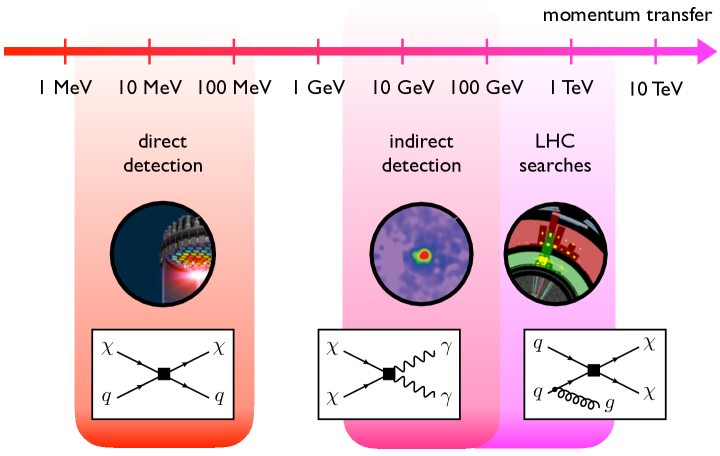
Dark matter (DM) simplified models are by now commonly used by the ATLAS and CMS Collaborations to interpret searches for missing transverse energy ($E_T^\mathrm{miss}$). The coherent use of these models sharpened the LHC DM search program, especially in the presentation of its results and their comparison to DM direct-detection (DD) and indirect-detection (ID) experiments. However, the community has been aware of the limitations of the DM simplified models, in particular the lack of theoretical consistency of some of them and their restricted phenomenology leading to the relevance of only a small subset of $E_T^\mathrm{miss}$ signatures. This document from the LHC Dark Matter Working Group identifies an example of a next-generation DM model, called $ extrm{2HDM+a}$, that provides the simplest theoretically consistent extension of the DM pseudoscalar simplified model. A comprehensive study of the phenomenology of the $ extrm{2HDM+a}$ model is presented, including a discussion of the rich and intricate pattern of mono-$X$ signatures and the relevance of other DM as well as non-DM experiments. Based on our discussions, a set of recommended scans are proposed to explore the parameter space of the $ extrm{2HDM+a}$ model through LHC searches. The exclusion limits obtained from the proposed scans can be consistently compared to the constraints on the $ extrm{2HDM+a}$ model that derive from DD, ID and the DM relic density.
연구 동기 및 목표
- 기존 LHC 암흑물질 간소화 모델의 이론적 모순과 제한된 현상학을 해결하기 위해.
- 간소화된 편소수 암흑물질 모델의 다음 세대, 게이지 불변이며 재정규화 가능한 확장 모델을 제안하기 위해.
- 풍부한 미니멀리즘-엑스 서명과 LHC, 직접/간접 탐지, 잔여 밀도로부터의 교차 실험 제약 조건을 갖춘 모델을 식별하기 위해.
- LHC 탐색을 위한 일관된 비교가 가능한 추천 파라미터 스캔을 제공하기 위해.
제안 방법
- 2HDM+a 모델은 암흑물질 상호작용을 매개하는 추가적인 싱게트 편소수 보손을 가진 이중 히iggs 듀렛트 모델로 구성된다.
- 효율적인 이벤트 생성을 위해 5-플레버 스킴(5FS)에 통합되었으며, 이는 MadGraph5_aMC@NLO를 사용하고, 파arton 쇼워링에는 PYTHIA 8.2를 사용한다.
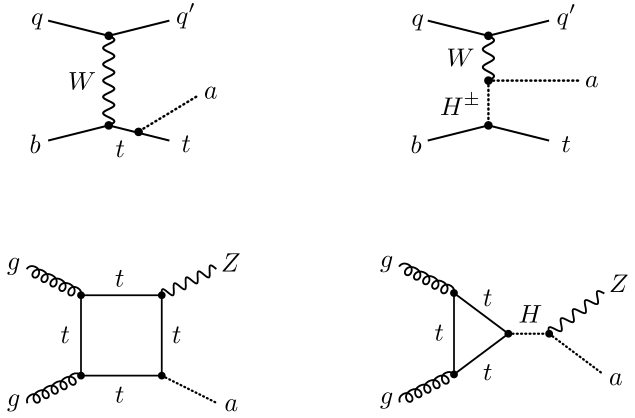
- 글루온 융합 및 쿼크-반쿼크 융합 과정을 통해 미니멀리즘-젯, 미니멀리즘-히그스 (b\bar{b}), 그리고 미니멀리즘-Z (l+l-) 서명이 생성된다.
- 히그스 및 플레이버 물리, 전자기력 정밀 측정, 진공 안정성, 그리고 추가 스핀-0 상태에 대한 LHC 탐색 제약 조건이 체계적으로 평가된다.
- 이론적 일관성과 현상학적 관련성을 바탕으로 벤치마크 포인트가 선정되었으며, 최적의 감도를 위해 $ \sin\theta \approx 0.35 $ 에 중점을 두었다.
- 감도 추정치는 기존 LHC 제약 조건(예: [160])에서 유도된 $ E_T^{\text{miss}} $ 분할 및 오차를 사용하여 계산되었다.
실험 결과
연구 질문
- RQ1기존의 단순화된 모델의 단점을 피하면서도 이론적으로 일관되고 재정규화 가능한 간소화된 편소수 암흑물질 모델의 확장은 구현 가능한가?
- RQ22HDM+a 모델은 다양한 미니멀리즘-엑스 서명에서 얼마나 풍부한 현상학을 보이며, 어떤 LHC 탐색 채널이 가장 민감한가?
- RQ3직접 탐지, 간접 탐지, 관측된 암흑물질 잔여 밀도와 LHC 배제 한계는 2HDM+a 모델의 파라미터 공간에서 어떻게 비교되는가?
- RQ4어느 암흑물질 질량에서 LHC는 정확한 잔여 밀도를 재현하는 모델에 대해 감도를 가지는가?
- RQ52HDM+a 모델에서 향후 LHC 탐색과 교차 실험 비교에 가장 적합한 벤치마크 파라미터 포인트는 무엇인가?
주요 결과
- 2HDM+a 모델은 간소화된 편소수 암흑물질 모델의 게이지 불변이며 재정규화 가능한 확장으로 이론적 일관성을 달성한다.
- 모델은 미니멀리즘-젯, 미니멀리즘-히그스 (b\bar{b}), 그리고 미니멀리즘-Z (l+l-)를 포함한 풍부한 미니멀리즘-엑스 서명 패tern을 보이며, 여러 채널에서 뚜렷한 감도를 보인다.
- LHC 탐색은 암흑물질 질량까지 $ m_\chi \simeq 125\,\text{GeV} $ 에서 감도를 가지며, 이는 정확한 잔여 밀도가 자연스럽게 달성되는 $ m_\chi \simeq M_a/2 $ 와 일치한다.
- 비교적 $ \sin\theta = 0.15 $ 또는 $ 0.7 $ 에 비해 $ \sin\theta = 0.35 $ 는 미니멀리즘-히그스 탐색에서 향상된 감도를 제공하므로 LHC 연구에 최적의 조건을 제공한다.
- 모델의 파라미터 공간은 히그스 및 플레이버 물리, 전자기력 정밀 측정, 진공 안정성으로 인해 제약을 받으며, $ M_a \sim 200-350\,\text{GeV} $ 에서 유효한 영역이 존재한다.
- 제안된 벤치마크 스캔은 LHC 결과와 직접 탐지, 간접 탐지, 관측된 암흑물질 잔여 밀도 $ \Omega h^2 $ 의 제약 조건 간 일관된 비교를 가능하게 한다.
더 나은 연구,지금 바로 시작하세요
논문 읽기부터 검토까지, 연구 시간을 획기적으로 줄여보세요.
카드 등록 없음 · 무료 플랜 제공
이 리뷰는 AI가 만들고, 인간 에디터가 검토했습니다.