
[논문 리뷰] LiDAR-NeRF: Novel LiDAR View Synthesis via Neural Radiance Fields
LiDAR-NeRF는 LiDAR 거리, 강도, 레이 드롭 확률을 인코딩하는 신경 방사장(NeRF) 필드를 학습하여 새로운 LiDAR 뷰를 렌더링하는 differentiable end-to-end 프레임워크를 제시하며, 구조적 정규화와 새로운 객체 중심 데이터셋 NeRF-MVL을 포함합니다.
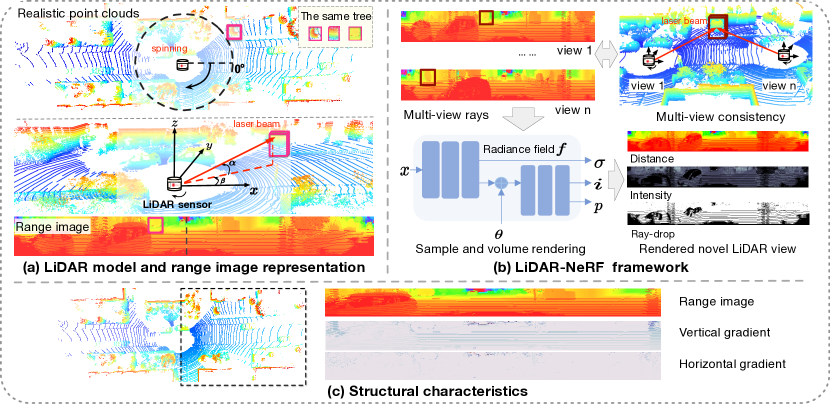
We introduce a new task, novel view synthesis for LiDAR sensors. While traditional model-based LiDAR simulators with style-transfer neural networks can be applied to render novel views, they fall short of producing accurate and realistic LiDAR patterns because the renderers rely on explicit 3D reconstruction and exploit game engines, that ignore important attributes of LiDAR points. We address this challenge by formulating, to the best of our knowledge, the first differentiable end-to-end LiDAR rendering framework, LiDAR-NeRF, leveraging a neural radiance field (NeRF) to facilitate the joint learning of geometry and the attributes of 3D points. However, simply employing NeRF cannot achieve satisfactory results, as it only focuses on learning individual pixels while ignoring local information, especially at low texture areas, resulting in poor geometry. To this end, we have taken steps to address this issue by introducing a structural regularization method to preserve local structural details. To evaluate the effectiveness of our approach, we establish an object-centric multi-view LiDAR dataset, dubbed NeRF-MVL. It contains observations of objects from 9 categories seen from 360-degree viewpoints captured with multiple LiDAR sensors. Our extensive experiments on the scene-level KITTI-360 dataset, and on our object-level NeRF-MVL show that our LiDAR-NeRF surpasses the model-based algorithms significantly.
연구 동기 및 목표
- 새로운 LiDAR 뷰 합성의 동기를 제시하고 과제를 정의하며, 기존 LiDAR 시뮬레이터가 현실적인 LiDAR 패턴을 생성하지 못하는 격차를 해결한다.
- 명시적 3D 재구성 없이 NeRF에서 영감을 받은 프레임워크를 통해 기하학과 각 의사 픽셀당 LiDAR 속성(거리, 강도, ray-drop)을 공동으로 학습한다.
- 저-텍스처 영역에서 국부 기하학적 세부 정보를 보존하기 위한 구조적 정규화 전략을 도입한다.
- 여러 객체와 시점에 대한 LiDAR 뷰 합성 평가를 가능하게 하기 위해 NeRF-MVL 객체 중심 LiDAR 데이터셋을 생성·배포한다.
제안 방법
- LiDAR 포인트 클라우드를 뷰당 범위 의사 이미지로 변환하며, 각 의사 픽셀은 LiDAR 빔에 대응한다.
- 2개의 MLP로 구성된 NeRF 스타일의 방사장장을 사용하여 의사 픽셀당 속성(깊이 관련 밀도)과 강도 및 ray-drop 확률에 대한 2채널 특징 맵을 예측하고, 광선에 따라 뷰당 깊이, 강도, ray-drop을 적분하여 계산한다.
- 저-텍스처 영역에서 주로 지역 구조의 차이를 벌칙하는 구조 정규화 항을 도입하여 기하를 향상시킨다.
- 깊이 차이, 강도, ray-drop 및 구조 정규화 항을 결합한 다중 작업 손실으로 학습한다.

실험 결과
연구 질문
- RQ1엔드-투-엔드로 학습 가능한 차별화 가능한 LiDAR 렌더러가 새 관점에서 현실적인 LiDAR 뷰를 합성하도록 학습될 수 있는가?
- RQ2LiDAR 고유 속성(강도와 ray-drop)을 신경 방사장 프레임워크 내에서 어떻게 모델링할 수 있는가?
- RQ3저-텍스처 영역에서 특히 LiDARNeRF의 기하 정합성을 개선하는 구조 정규화 전략이 실제로 효과가 있는가?
- RQ4모델 기반 렌더러와 비교하여 LiDAR-NeRF가 씬 수준 및 객체 수준의 새로운 LiDAR 뷰 합성에서 어떻게 성능을 보이는가?
주요 결과
- LiDAR-NeRF가 KITTI-360 및 NeRF-MVL에서 씬 및 객체 수준 작업 전반에 걸쳐 기본 LiDAR 렌더러(LiDARsim, PCGen)보다 우수하다.
- KITTI-360의 경우, iNGP 기반 아키텍처와 구조적 정규화를 결합한 LiDAR-NeRF가 테스트된 변형들 중 최상의 지표(C-D, F-score, RMSE, δ1/δ2/δ3, SSIM, MAE)를 달성한다.
- NeRF-MVL 객체 수준 데이터에서 iNGP를 사용하는 LiDAR-NeRF가 기본값 대비 우수한 C-D, RMSE, δ1/δ2/δ3, SSIM 및 MAE를 달성한다.
- 구성요소 제거 실험은 구조 정규화와 iNGP 아키텍처 선택이 기하학 및 LiDAR 패턴 현실감을 크게 향상시킴을 시사한다.
이 논문 읽기
누빈트 뷰어에서 원문을 열고, 읽으면서 궁금한 곳을 바로 물어보세요.
누빈트에서 이 논문 읽기이 리뷰는 AI가 논문 원문을 바탕으로 만들었습니다. 인용하기 전에 원문을 확인해 주세요.