
[논문 리뷰] ManyDG: Many-domain Generalization for Healthcare Applications
이 논문은 의료 AI에서 환자별 공변량에 기인한 일반화 문제를 해결하기 위해 각 환자를 별도의 도메인으로 간주하는 새로운 도메인 일반화 방법 ManyDG를 제안한다. 환자별 특징을 레이블에 영향을 주지 않는 표현에서 분리하기 위해 상호 재구성과 직교 투영을 사용함으로써 ManyDG는 저자료 및 지속적 학습 환경에서도 최신 기술 수준의 성능을 달성하였으며, MIMIC 약물 추천 과제에서 Jaccard 점수 3.7% 향상 효과를 보였다.
The vast amount of health data has been continuously collected for each patient, providing opportunities to support diverse healthcare predictive tasks such as seizure detection and hospitalization prediction. Existing models are mostly trained on other patients data and evaluated on new patients. Many of them might suffer from poor generalizability. One key reason can be overfitting due to the unique information related to patient identities and their data collection environments, referred to as patient covariates in the paper. These patient covariates usually do not contribute to predicting the targets but are often difficult to remove. As a result, they can bias the model training process and impede generalization. In healthcare applications, most existing domain generalization methods assume a small number of domains. In this paper, considering the diversity of patient covariates, we propose a new setting by treating each patient as a separate domain (leading to many domains). We develop a new domain generalization method ManyDG, that can scale to such many-domain problems. Our method identifies the patient domain covariates by mutual reconstruction and removes them via an orthogonal projection step. Extensive experiments show that ManyDG can boost the generalization performance on multiple real-world healthcare tasks (e.g., 3.7% Jaccard improvements on MIMIC drug recommendation) and support realistic but challenging settings such as insufficient data and continuous learning.
연구 동기 및 목표
- 데이터 수집 환경과 신원 등 환자별 공변량으로 인한 모델 일반화 부족 문제를 해결하기 위해.
- 각 환자를 개별 도메인으로 간주하는 새로운 다도메인 일반화 설정을 제안하여 확장 가능하고 현실적인 일반화를 가능하게 하기 위해.
- 환자별 특징을 명시적으로 제거하면서도 레이블에 영향을 주지 않는 표현을 유지함으로써 일반화 성능을 향상시키기 위해.
- 제한된 레이블 데이터와 지속적 학습과 같은 실제 임상 환경에서의 성능 평가를 위해.
제안 방법
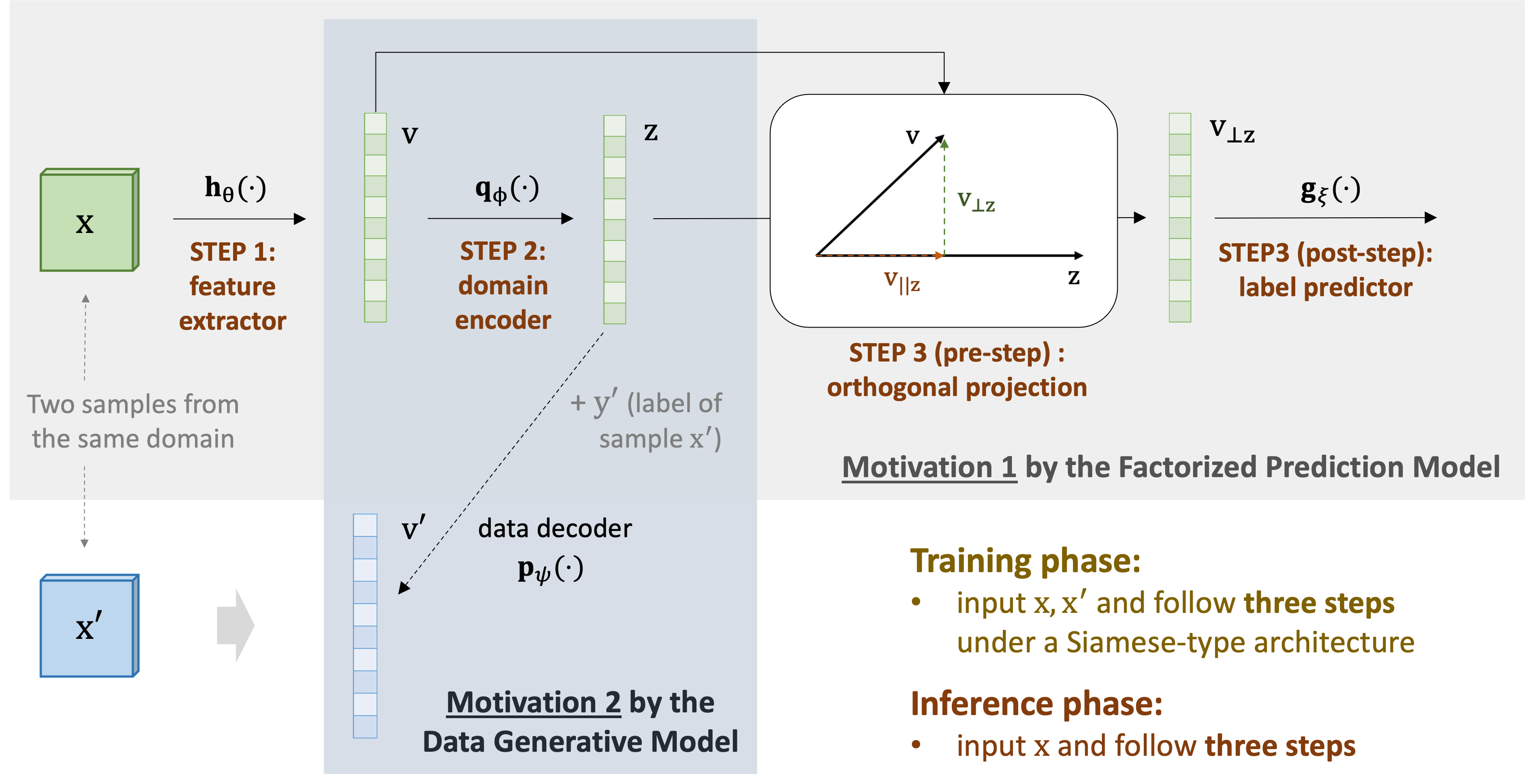
- 모델은 동일한 환자에서 온 쌍체 샘플을 학습하기 위해 시아미즈 아키텍처를 사용하여 환자별 데이터 간의 공동 최적화를 가능하게 한다.
- 상호 재구성 기법을 통해 별도의 도메인(z) 및 레이블(u) 표현으로부터 입력 특징 벡터를 재구성함으로써 다양한 시각 간 일관성 확보.
- 직교 투영을 적용하여 도메인(z) 표현과 레이블(u) 표현 간의 직교성을 강제함으로써 분리도 향상.
- 모델은 네 가지 손실 구성 요소로 훈련된다: 레이블 예측에 대한 지도 학습 손실, 재구성 손실, 동일 환자 내에서의 z 유사도 최대화를 위한 도메인 유사도 손실, 직교성 손실.
- 분해 가능한 예측 모델을 통해 도메인 및 레이블 정보에 대한 별도의 인코더를 사용하며, 이는 엔드 투 엔드 학습을 가능하게 한다.
- 본 방법은 간질 탐지, 수면 단계 분류, 약물 추천, 재입원 예측 등 다양한 과제를 수행하는 네 개의 실제 의료 데이터셋에서 평가되었다.
실험 결과
연구 질문
- RQ1각 환자를 별도의 도메인으로 간주하는 것이 의료 응용 분야에서 모델의 일반화 성능 향상에 기여하는가?
- RQ2상호 재구성과 직교 투영이 레이블에 영향을 주지 않는 표현에서 환자별 공변량을 얼마나 효과적으로 분리하는가?
- RQ3저자료 및 지속적 학습 환경에서 일반적으로 발생하는 임상 설정에서 본 방법이 잘 일반화되는가?
- RQ4성능 및 강건성 측면에서 기존의 도메인 일반화 기준 방법들과 비교해 볼 때 본 방법은 어떠한가?
주요 결과
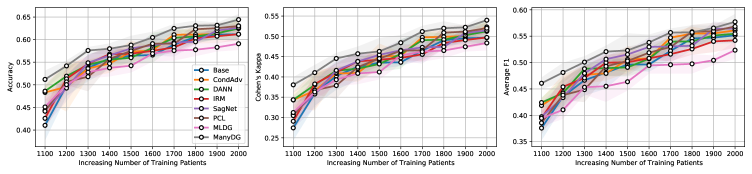
- ManyDG는 MIMIC 약물 추천 벤치마크에서 최고의 기준 방법 대비 Jaccard 점수 3.7% 향상되었다.
- 간질 탐지 과제에서 ManyDG는 정확도 0.6754(±0.0079)를 기록하여 SimD1(0.5954)과 SimD2(0.6499)를 모두 능가했다.
- 수면 단계 분류 과제에서 ManyDG는 정확도 0.9055(±0.0054)를 달성하여 SimD1(0.8862)과 SimD2(0.9017)를 초월했다.
- 오픈 EHR 약물 추천 과제에서 ManyDG는 Jaccard 점수 0.5175(±0.0130)를 기록하여 SimD1(0.4894)과 SimD2(0.4901)보다 유의미하게 높았다.
- 모든 평가 과제에서 일관된 성능 향상이 나타났으며, 재입원 예측 및 수면 단계 분류 과제 모두 표준 설정과 도전적인 설정에서 모두 성능 향상이 있었다.
- 제거 실험 결과, 재구성 및 도메인 유사도에 대해 코사인 유사도를 사용한 SimD2가 MSE를 사용한 SimD1보다 더 나은 스케일링된 손실 목표 덕분에 성능이 뛰어났다.
이 논문 읽기
누빈트 뷰어에서 원문을 열고, 읽으면서 궁금한 곳을 바로 물어보세요.
누빈트에서 이 논문 읽기이 리뷰는 AI가 논문 원문을 바탕으로 만들었습니다. 인용하기 전에 원문을 확인해 주세요.