
[논문 리뷰] MathVista: Evaluating Mathematical Reasoning of Foundation Models in Visual Contexts
MathVista 벤치마크는 시각 맥락에서의 수학적 추론을 6,141개 예제에서 28개의 기존 다중모달 데이터셋과 3개의 신규 데이터셋으로 평가하고, 12개의 기초 모델을 평가하여 인간 성능과의 상당한 차이를 드러낸다.
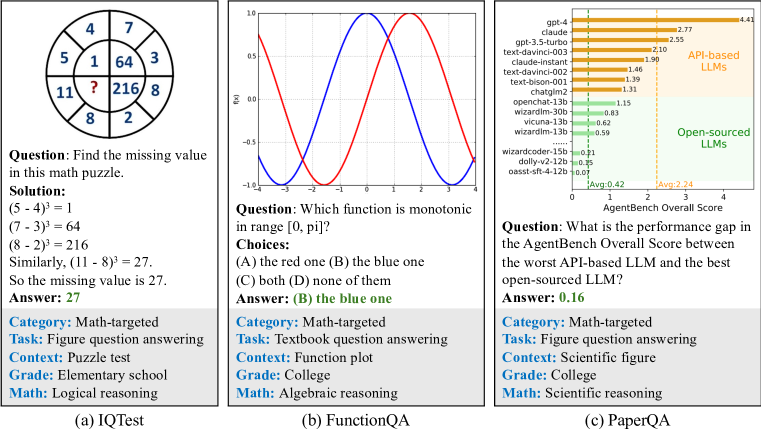
Large Language Models (LLMs) and Large Multimodal Models (LMMs) exhibit impressive problem-solving skills in many tasks and domains, but their ability in mathematical reasoning in visual contexts has not been systematically studied. To bridge this gap, we present MathVista, a benchmark designed to combine challenges from diverse mathematical and visual tasks. It consists of 6,141 examples, derived from 28 existing multimodal datasets involving mathematics and 3 newly created datasets (i.e., IQTest, FunctionQA, and PaperQA). Completing these tasks requires fine-grained, deep visual understanding and compositional reasoning, which all state-of-the-art foundation models find challenging. With MathVista, we have conducted a comprehensive, quantitative evaluation of 12 prominent foundation models. The best-performing GPT-4V model achieves an overall accuracy of 49.9%, substantially outperforming Bard, the second-best performer, by 15.1%. Our in-depth analysis reveals that the superiority of GPT-4V is mainly attributed to its enhanced visual perception and mathematical reasoning. However, GPT-4V still falls short of human performance by 10.4%, as it often struggles to understand complex figures and perform rigorous reasoning. This significant gap underscores the critical role that MathVista will play in the development of general-purpose AI agents capable of tackling mathematically intensive and visually rich real-world tasks. We further explore the new ability of self-verification, the application of self-consistency, and the interactive chatbot capabilities of GPT-4V, highlighting its promising potential for future research. The project is available at https://mathvista.github.io/.
연구 동기 및 목표
- 시각적으로 풍부한 맥락에서의 수학적 추론에 대한 통합 벤치마크를 정의한다.
- 다양한 수학 및 시각 작업에서 12개의 주요 기초 모델을 평가한다.
- 추론 유형의 격차를 메우기 위해 새로운 데이터셋(IQTest, FunctionQA, PaperQA)을 만든다.
- 모델의 강점과 실패를 진단하기 위한 세밀한 메타데이터와 분석을 제공한다.
제안 방법
- 28개의 기존 다중모달 데이터셋과 3개의 신규 데이터셋을 합쳐 총 6,141개의 예제로 MathVista를 구성한다.
- 질문 유형, 답변 유형, 작업, 학년 수준, 시각 맥락, 추론 기술 등을 포함한 메타데이터로 예제를 주석화한다.
- 반응 생성, 정답 추출, 점수 계산의 세 단계 파이프라인으로 모델을 평가한다.
- 객관식 및 자유형 문제 전반에 대해 결정론적 평가를 위한 정확도(정답 일치)를 사용한다.
- 텍스트 전용 LLM, 시각적 신호를 추가한 보강 LLM, 오픈소스/독점 LMM을 제로샷, 소수샷, 프롐핑(CoT, PoT) 변형 하에서 비교한다.
실험 결과
연구 질문
- RQ1문제가 시각적 맥락으로 제시될 때 현행 LLM과 LMM의 수학적 추론 역량은 어느 정도인가?
- RQ2MathVista 과제에서 텍스트만 사용하는 모델과 다중모달 모델의 상대적 강점과 실패 모드는 무엇인가?
- RQ3외부 시각 보조 도구(캡션, OCR)가 수학 추론에서 다중모달 모델의 성능을 얼마나 향상시키는가?
- RQ4새로운 데이터셋(IQTest, FunctionQA, PaperQA)이 기존 수학 혹은 VQA 벤치마크에서 다루지 않는 격차를 드러낼 수 있는가?
- RQ5이 벤치마크에서 인간 성능에 비해 모델 성능의 상한은 어느 정도인가?
주요 결과
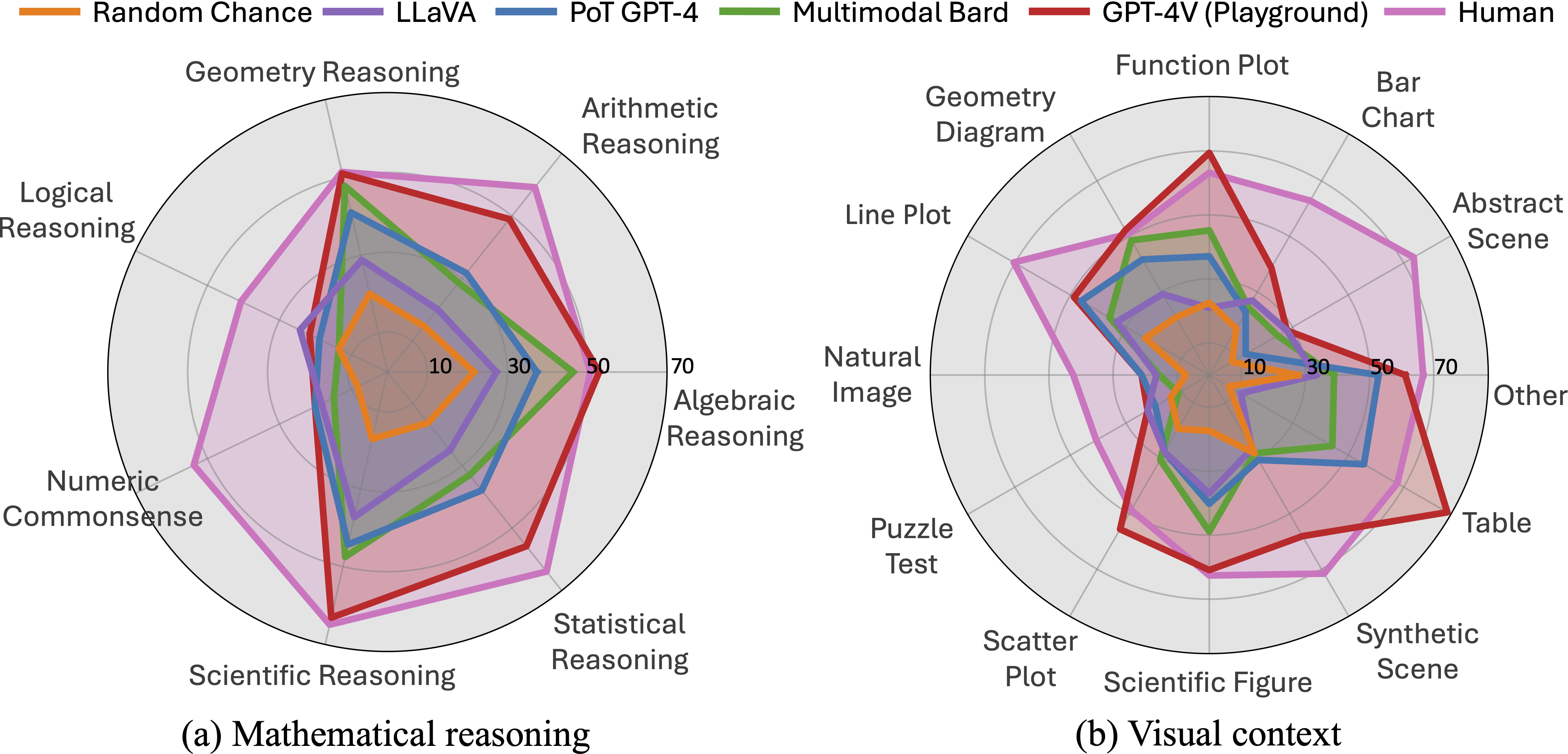
- GPT-4V가 전체 정확도 49.9%로 최고를 기록하지만 인간 성능보다 여전히 10.4% 낮다.
- 캡션과 OCR를 포함한 보강된 LLM은 33.9%에 도달하며(포트와 함께 하는 GPT-4), 텍스트 전용 기준선에 비해 제한된 향상을 보인다.
- 다중모달 Bard는 34.8%의 정확도에 그쳐 GPT-4V 및 인간보다 훨씬 떨어지며, 주요 허위 진술 및 계산 오류가 두드러진다.
- 오픈소스 LMM은 폐쇄형 모델에 비해 성능이 떨어지며, 수학 추론, OCR 및 차트 이해의 격차를 나타낸다.
- GPT-4V는 강한 시각 지각과 추론을 보이며, 다중 턴 대화를 가능하게 하는 자가 검증 및 자기 일관성의 특징이 부상한다.
- MathVista에서의 인간 성능은 전체 60.3%로, 대학 및 과학 수준의 시각 수학 과제에서 현 모델과의 큰 격차를 시사한다.
이 논문 읽기
누빈트 뷰어에서 원문을 열고, 읽으면서 궁금한 곳을 바로 물어보세요.
누빈트에서 이 논문 읽기이 리뷰는 AI가 논문 원문을 바탕으로 만들었습니다. 인용하기 전에 원문을 확인해 주세요.