
[논문 리뷰] Measurement-efficient quantum Krylov subspace diagonalisation
이 논문은 실시간 진동수의 적분을 통해 해밀토니안-거듭제곱-가우시안 함수를 표현함으로써 통계적 오차를 최소화하는 측정 효율적인 양자 크릴로프 부분공간 대각화 알고리즘을 제안한다. 이는 지수적 오차 억제를 가능하게 하며, 특히 기본 상태 투영을 위한 효율적인 프로젝터 구축을 통해 기존 방법 대비 측정 비용을 10⁴에서 10¹²배 감소시킨다.
The Krylov subspace methods, being one category of the most important classical numerical methods for linear algebra problems, can be much more powerful when generalised to quantum computing. However, quantum Krylov subspace algorithms are prone to errors due to inevitable statistical fluctuations in quantum measurements. To address this problem, we develop a general theoretical framework to analyse the statistical error and measurement cost. Based on the framework, we propose a quantum algorithm to construct the Hamiltonian-power Krylov subspace that can minimise the measurement cost. In our algorithm, the product of power and Gaussian functions of the Hamiltonian is expressed as an integral of the real-time evolution, such that it can be evaluated on a quantum computer. We compare our algorithm with other established quantum Krylov subspace algorithms in solving two prominent examples. To achieve an error comparable to that of the classical Lanczos algorithm at the same subspace dimension, our algorithm typically requires orders of magnitude fewer measurements than others. Such an improvement can be attributed to the reduced cost of composing projectors onto the ground state. These results show that our algorithm is exceptionally robust to statistical fluctuations and promising for practical applications.
연구 동기 및 목표
- 통계적 변동으로 인한 높은 측정 비용 문제를 해결하기 위해 양자 크릴로프 부분공간 대각화(KSD)에서 발생하는 높은 측정 비용을 해결한다.
- 양자 KSD 알고리즘에서 통계적 오차와 측정 비용을 분석하기 위한 일반적인 이론적 프레임워크를 개발한다.
- 기본 상태 에너지 추정을 위한 해밀토니안-거듭제곱 크릴로프 부분공간을 구성할 때 측정 오버헤드를 최소화한다.
- 근접한 양자 장치에서 통계적 노이즈에 민감하지 않게 하여 강건하고 실용적인 양자 시뮬레이션을 가능하게 한다.
제안 방법
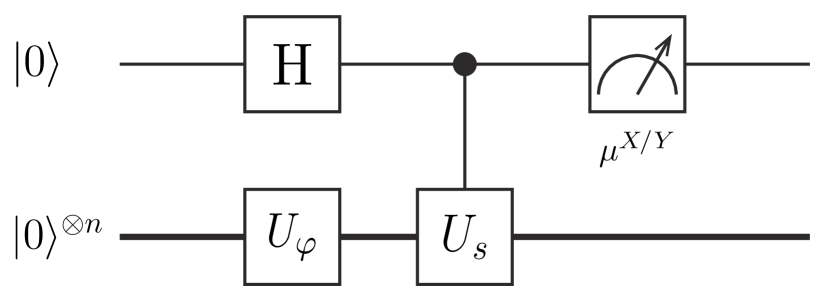
- 실시간 진동수 연산자의 적분을 통해 해밀토니안 거듭제곱과 가우시안 함수의 곱을 표현함으로써 양자 회로를 통한 시간 진동수 회로를 통한 평가를 가능하게 한다.
- 체비셰프 다항식을 사용하여 기본 상태를 분리하고 [-1, 1] 구간 내에서 Excited 상태를 억제하는 프로젝터를 구성한다.
- 체비셰프 프로젝터를 해밀토니안 거듭제곱 (H - E₀)^(k-1)의 선형 조합으로 전개함으로써 효율적인 양자 회로 구현을 가능하게 한다.
- 다항식 전개의 계수에 대한 상한을 유도하여 오버헤드를 제어하고 측정 효율성을 보장한다.
- 대표적인 양자 다체 모델(반자성 헤이젠베르크 모형 및 허버드 모형)을 다양한 격자에서 벤치마킹하여 측정 비용을 비교한다.
- 스펙트럼 분해와 체비셰프 다항식의 성질을 활용하여 다항식 차수 증가에 따라 Excited 상태 기여가 지수적으로 억제됨을 보장한다.
![Figure 1: Empirical distribution of the measurement overhead $\gamma$ for algorithms listed in Table 1 . In the Gaussian-power algorithm, we take a random $E_{0}$ in the interval $[E_{g}-0.1\|H\|_{2},E_{g}+0.1\|H\|_{2}]$ , i.e. we assume that we have a preliminary estimation of the ground-state ener](https://ar5iv.labs.arxiv.org/html/2301.13353/assets/x1.png)
실험 결과
연구 질문
- RQ1실제 측정 제약 조건 하에서 양자 크릴로프 부분공간 대각화의 통계적 오차를 엄밀하게 경계하고 최소화할 수 있는가?
- RQ2주어진 정확도를 확보하기 위해 필요한 측정 횟수의 이론적 상한은 무엇인가?
- RQ3실시간 진동수 적분을 사용하여 측정 비용을 줄인 해밀토니안-거듭제곱 크릴로프 부분공간을 효율적으로 구성할 수 있는가?
- RQ4제안된 알고리즘의 측정 비용은 대표적인 양자 다체 모델에서 기존의 양자 KSD 방법과 비교해 어떻게 되는가?
- RQ5체비셰프 다항식 기반 프로젝터는 기본 상태 에너지 추정에서 효과적인 측정 오버헤드를 어느 정도 감소시킬 수 있는가?
주요 결과
- 제안된 알고리즘은 기존의 양자 크릴로프 부분공간 대각화 방법 대비 측정 비용을 10⁴에서 10¹²배 감소시킨다.
- 체비셰프 다항식을 통한 Excited 상태 기여의 지수적 억제 덕분에 다항식 차수 증가에 따라 통계적 오차가 지수적으로 감소한다.
- 이 프레임워크는 모든 양자 KSD 알고리즘에 적용 가능한 일반적인 측정 횟수 상한을 제공하여 체계적인 비용 비교를 가능하게 한다.
- 알고리즘의 통계적 변동에 대한 강건성은 실시간 진동수 적분을 통한 기본 상태에 대한 프로젝터 효율적 구성에서 기인한다.
- 반자성 헤이젠베르크 모형 및 허버드 모형에 대한 벤치마킹 결과, 다양한 격자 크기에서 본 방법의 확장성과 우수성을 확인할 수 있다.
- 다항식 전개에서 오버헤드 인자 γ는 기하급수 급수로 유계이므로, 시스템 크기 증가에 따라 자원 스케일링이 제어 가능하다.
더 나은 연구,지금 바로 시작하세요
논문 읽기부터 검토까지, 연구 시간을 획기적으로 줄여보세요.
카드 등록 없음 · 무료 플랜 제공
이 리뷰는 AI가 만들고, 인간 에디터가 검토했습니다.