
[논문 리뷰] Mitigating Accuracy-Robustness Trade-off via Balanced Multi-Teacher Adversarial Distillation
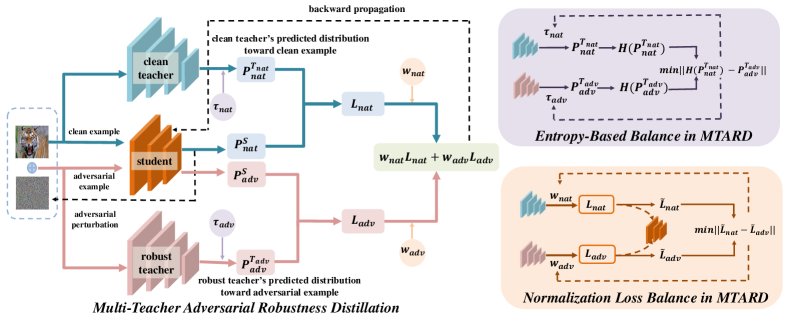
이 논문은 깨끗한 교사와 강건한 교사를 동시에 사용하여 모델 정확도와 적대적 공격에 대한 강건성을 동시에 향상시키는 새로운 지식 증류 프레임워크인 Multi-Teacher Adversarial Robustness Distillation (MTARD)를 제안한다. 엔트로피 기반 온도 보정 및 정규화 손실 가중치 기법을 도입함으로써 MTARD는 정확도-강건성 상충 문제를 완화하고, 다양한 적대적 공격 하에서 CIFAR-10, CIFAR-100, 그리고 Tiny-ImageNet에서 최신 기술 수준의 성능을 달성한다.
Adversarial Training is a practical approach for improving the robustness of deep neural networks against adversarial attacks. Although bringing reliable robustness, the performance towards clean examples is negatively affected after Adversarial Training, which means a trade-off exists between accuracy and robustness. Recently, some studies have tried to use knowledge distillation methods in Adversarial Training, achieving competitive performance in improving the robustness but the accuracy for clean samples is still limited. In this paper, to mitigate the accuracy-robustness trade-off, we introduce the Balanced Multi-Teacher Adversarial Robustness Distillation (B-MTARD) to guide the model's Adversarial Training process by applying a strong clean teacher and a strong robust teacher to handle the clean examples and adversarial examples, respectively. During the optimization process, to ensure that different teachers show similar knowledge scales, we design the Entropy-Based Balance algorithm to adjust the teacher's temperature and keep the teachers' information entropy consistent. Besides, to ensure that the student has a relatively consistent learning speed from multiple teachers, we propose the Normalization Loss Balance algorithm to adjust the learning weights of different types of knowledge. A series of experiments conducted on three public datasets demonstrate that B-MTARD outperforms the state-of-the-art methods against various adversarial attacks.
연구 동기 및 목표
- 적대적 훈련에서 빈번히 발생하는 정확도-강건성 상충 문제를 해결하라. 이는 강건성이 향상될수록 깨끗한 데이터의 정확도가 떨어지는 경향이 있기 때문이다.
- 단일 교사 기반 지식 증류의 한계를 극복하라. 이는 본질적인 모델 상충로 인해 깨끗한 정확도와 강건성을 동시에 최적화할 수 없기 때문이다.
- 깨끗한 예제와 적대적 예제에 대한 지침을 분리함으로써 균형 잡힌 학습을 가능하게 하는 다중 교사 증류 프레임워크를 개발하라.
- 다양한 교사 간 지식 척도와 학습 난이도의 본질적 격차를 해결함으로써 다수의 교사로부터 균형 잡힌 지식 전이를 보장하라.
- 다양한 적대적 공격 하에서 여러 벤치마크 데이터셋에서 깨끗한 정확도와 강건성 양면에서 최신 기술 수준의 성능을 달성하라.
제안 방법
- 깨끗한 데이터에서 높은 정확도를 보이는 깨끗한 교사와 적대적 예제에서 높은 강건성을 보이는 강건한 교사를 사용하는 이중 교사 프레임워크를 도입한다.
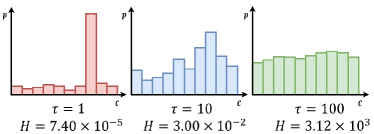
- 각 교사의 소프트 레이블 온도를 동적으로 조정함으로써 정보 엔트로피를 균형 있게 유지하는 엔트로피 기반 보정 알고리즘을 제안한다. 이는 지식 척도를 균형 있게 유지한다.
- 각 교사로부터의 증류 손실의 가중치를 동적으로 조정함으로써 학생이 두 유형의 지식을 균형 있게 학습할 수 있도록 하는 정규화 손실 보정 알고리즘을 설계한다.
- 적대적 훈련과 지식 증류를 융합한 방법을 적용한다. 이는 학생이 깨끗한 입력에서는 깨끗한 교사를, 적대적 입력에서는 강건한 교사를 모방하도록 훈련한다.
- 깨끗한 데이터에 대한 교차 엔트로피 손실, 적대적 손실, 그리고 두 교사로부터의 증류 손실을 조합한 복합 손실 함수를 사용하며, 가중치를 적응적으로 조정하여 한 교사의 영향력이 지배적이지 않도록 한다.
- 기울기 추정 및 AutoAttack(PGD 및 Square Attack 포함)를 적용하여 강건성을 평가하고, '왜곡된 기울기' 현상(방어 평가에서 흔한 잘못된 긍정 결과)에 취약하지 않음을 확인한다.
실험 결과
연구 질문
- RQ1다중 교사 기반 증류 프레임워크는 적대적 훈련에서 정확도-강건성 상충 문제를 효과적으로 완화할 수 있는가?
- RQ2깨끗한 교사와 강건한 교사의 지식을 어떻게 균형 있게 조정할 수 있는가? 이는 한 교사가 학생의 학습 과정을 지배하는 것을 방지하기 위함이다.
- RQ3깨끗한 예제와 적대적 예제의 지식 전이를 분리함으로써 단일 교사 기반 증류보다 깨끗한 정확도와 강건성 양면에서 더 나은 성능을 달성할 수 있는가?
- RQ4엔트로피 기반 온도 스케일링은 본질적으로 다른 성능 프로파일을 가진 두 교사의 지식 척도를 효과적으로 일치시킬 수 있는가?
- RQ5제안된 방법은 강력한 블랙박스 및 WHITELIST 적대적 공격, 특히 기울기 추정 공격에 대해서도 강건한가?
주요 결과
- MTARD는 ResNet-18에서 최신 기술 수준의 강건한 정확도를 달성하며, 다양한 공격 하에서 기존의 적대적 훈련 및 증류 방법을 초월한다. 이는 CIFAR-10, CIFAR-100, Tiny-ImageNet에서 성과를 내었다.
- MobileNet-v2에서 MTARD는 기준 방법 대비 CIFAR-10에서 5.56% 향상된 깨끗한 정확도, CIFAR-100에서 4.78%, Tiny-ImageNet에서 3.31% 향상된 정확도를 기록했다.
- 강력한 적대적 공격에 저항한다: AutoAttack(PGD 및 Square Attack 포함) 하에서 CIFAR-10의 강건한 정확도는 60% 이상, CIFAR-100에서는 30% 이상을 기록하여 뛰어난 일반화 능력을 보였다.
- MTARD 보호를 받은 ResNet-18에 대해 기울기 추정 공격(GE)을 적용한 결과, CIFAR-10에서 60.34%의 강건한 정확도를 기록하여 '왜곡된 기울기' 공격에 취약하지 않음을 확인했다.
- 놀랍게도, 더 작은 교사 모델들(예: ResNet-56 및 WideResNet-34-10)이 더 큰 모델들(예: WideResNet-70-16)보다 학생을 더 잘 이끌었다. 이는 모델 크기가 증류 효과의 유일한 결정 요소가 아니라는 것을 시사한다.
- 학생의 성능가 교사의 파rameter 수나 원래 성능에 엄격히 묶이지 않으며, 효과적인 증류는 작은 크기이지만 잘 선택된 교사 모델을 통해 가능하다는 점을 보여준다.
이 논문 읽기
누빈트 뷰어에서 원문을 열고, 읽으면서 궁금한 곳을 바로 물어보세요.
누빈트에서 이 논문 읽기이 리뷰는 AI가 논문 원문을 바탕으로 만들었습니다. 인용하기 전에 원문을 확인해 주세요.