
[논문 리뷰] MixPro: Data Augmentation with MaskMix and Progressive Attention Labeling for Vision Transformer
MixPro는 전역적 구조를 유지하면서 이미지 혼합을 위한 새로운 데이터 증강 방법인 MaskMix를 제안한다. 이는 조정 가능한 패치 크기의 마스크를 사용하여 이미지를 혼합하며, 신뢰할 수 없는 초기 훈련 단계의 어텐션 맵으로 인한 노이즈를 줄이기 위해 동적으로 어텐션 기반 레이블 신뢰도를 재가중하는 프로그레시브 어텐션 레이블링(Progressive Attention Labeling, PAL)을 도입한다. 이 방법은 DeiT-T를 사용하여 ImageNet에서 73.8%의 top-1 정확도를 달성하며, 여러 벤치마크에서 TransMix를 능가하고, 세분화 및 검출과 같은 후행 작업으로의 전이 능력을 향상시킨다.
The recently proposed data augmentation TransMix employs attention labels to help visual transformers (ViT) achieve better robustness and performance. However, TransMix is deficient in two aspects: 1) The image cropping method of TransMix may not be suitable for ViTs. 2) At the early stage of training, the model produces unreliable attention maps. TransMix uses unreliable attention maps to compute mixed attention labels that can affect the model. To address the aforementioned issues, we propose MaskMix and Progressive Attention Labeling (PAL) in image and label space, respectively. In detail, from the perspective of image space, we design MaskMix, which mixes two images based on a patch-like grid mask. In particular, the size of each mask patch is adjustable and is a multiple of the image patch size, which ensures each image patch comes from only one image and contains more global contents. From the perspective of label space, we design PAL, which utilizes a progressive factor to dynamically re-weight the attention weights of the mixed attention label. Finally, we combine MaskMix and Progressive Attention Labeling as our new data augmentation method, named MixPro. The experimental results show that our method can improve various ViT-based models at scales on ImageNet classification (73.8\% top-1 accuracy based on DeiT-T for 300 epochs). After being pre-trained with MixPro on ImageNet, the ViT-based models also demonstrate better transferability to semantic segmentation, object detection, and instance segmentation. Furthermore, compared to TransMix, MixPro also shows stronger robustness on several benchmarks. The code is available at https://github.com/fistyee/MixPro.
연구 동기 및 목표
- TransMix는 영역 수준의 자르기를 사용하여 전역적 구조를 손상시키고 초기 훈련 단계에서 신뢰할 수 없는 어텐션 맵에 의존하는 한계를 해결하기 위해.
- 더 효과적인 데이터 증강을 통해 비전 트랜스포머(ViT)의 일반화 및 강건성을 향상시키기 위해.
- 전역적 이미지 구조를 유지하고 초기 훈련 단계에서 혼합 레이블의 노이즈를 줄이는 데이터 증강 전략을 설계하기 위해.
- 세분화, 객체 검출, 인스턴스 세분화와 같은 후행 작업에서 ViT 기반 모델의 전이 학습 성능을 향상시키기 위해.
제안 방법
- MaskMix는 입력 이미지 패치 크기의 배수인 패치 기반 그리드 마스크를 사용하여 혼합 이미지를 생성하며, 각 출력 패치가 오직 하나의 원본 이미지에서 온다는 것을 보장한다.
- 마스크 크기는 조정 가능하며, 이미지 간 패치 수준 혼합을 방지함으로써 전역적 이미지 구조를 유지하도록 설계되어 있다.
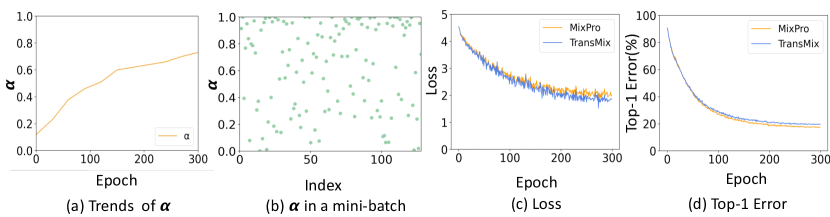
- 프로그레시브 어텐션 레이블링(Progressive Attention Labeling, PAL)은 프로그레시브 인자 α를 사용하여 어텐션 기반 레이블 신뢰도를 동적으로 재가중하여 초기 훈련 단계에서 신뢰도가 떨어지는 어텐션 맵에 대한 의존도를 줄인다.
- 프로그레시브 인자 α는 훈련 중에 점차 증가하여 어텐션 맵이 신뢰도가 높아지면서 모델이 그에 더 의존할 수 있도록 한다.
- MixPro는 MaskMix와 PAL을 통합한 데이터 증강 파이프라인으로, 이미지 수준과 레이블 수준 혼합을 모두 향상시킨다.
- 이 방법은 ImageNet에서의 사전 훈련 기간에 적용되며, 분류, 검출, 세분화, 강건성 벤치마크에서 평가된다.

실험 결과
연구 질문
- RQ1MaskMix는 TransMix의 영역 기반 자르기 방식과 비교해 비전 트랜스포머의 이미지 혼합을 어떻게 향상시키는가?
- RQ2신뢰도가 떨어지는 초기 훈련 단계에서 어텐션 맵으로 인한 혼합 레이블의 노이즈를 프로그레시브 어텐션 레이블링이 줄일 수 있는가?
- RQ3MixPro는 ViT 기반 모델의 ImageNet 및 후행 작업에서의 일반화와 강건성을 향상시키는가?
- RQ4정확도, 가림막에 대한 강건성, 분포 외 탐지 측면에서 MixPro는 TransMix보다 어떻게 비교되는가?
- RQ5성능을 극대화하기 위해 최적의 마스크 패치 크기와 프로그레시브 인자 전략은 무엇인가?
주요 결과
- MixPro는 300 에포크 동안 DeiT-T를 사용하여 ImageNet에서 73.8%의 top-1 정확도를 달성하며, TransMix와 순수 ViT를 모두 능가한다.
- DeiT-S에서 MixPro는 ImageNet-A 자연적 위협에 대해 top-1 정확도를 1.3% 향상시켜 22.4%를 기록하며, TransMix의 21.1%를 초월한다.
- ImageNet-A에서 MixPro는 32.4%의 AURRAC을 달성하여 TransMix-DeiT-S 대비 3.6% 향상되었으며, 더 나은 불확실성 추정 능력을 보여준다.
- ImageNet-O에서 분포 외 탐지에 대해 MixPro-DeiT-S는 23.1%의 AUPRC를 기록하여 TransMix-DeiT-S 대비 1.2% 높고, 순수 DeiT-S 대비 2.2% 높다.
- MixPro로 훈련된 모델은 후행 작업, 즉 세분화, 객체 검출, 인스턴스 세분화에서 더 뛰어난 성능을 보이며, 전이 능력이 뛰어나다.
- 제거 실험을 통해 MaskMix와 PAL이 성능 향상에 크게 기여하며, 최적의 마스크 패치 크기와 프로그레시브 인자 전략이 강건성과 정확도를 향상시킨다는 것이 확인되었다.
이 논문 읽기
누빈트 뷰어에서 원문을 열고, 읽으면서 궁금한 곳을 바로 물어보세요.
누빈트에서 이 논문 읽기이 리뷰는 AI가 논문 원문을 바탕으로 만들었습니다. 인용하기 전에 원문을 확인해 주세요.