
[논문 리뷰] MusicRL: Aligning Music Generation to Human Preferences
MusicRL은 인간 피드백을 통한 강화학습(RLHF)을 통해 미세조정된 첫 번째 텍스트-음악 생성 모델로, 인간의 선호도와의 일치도를 향상시킨다. 음성 품질, 텍스트 준거성, 사용자 선호도를 고려한 보상 신호를 결합하며, 300,000개의 쌍대 비교 데이터로부터 수집된 정보를 바탕으로, 인간 평가에서 베이스라인 및 이전 RL 미세조정 버전을 모두 능가하는 모델(MusicRL-RU)을 도출한다.
We propose MusicRL, the first music generation system finetuned from human feedback. Appreciation of text-to-music models is particularly subjective since the concept of musicality as well as the specific intention behind a caption are user-dependent (e.g. a caption such as "upbeat work-out music" can map to a retro guitar solo or a techno pop beat). Not only this makes supervised training of such models challenging, but it also calls for integrating continuous human feedback in their post-deployment finetuning. MusicRL is a pretrained autoregressive MusicLM (Agostinelli et al., 2023) model of discrete audio tokens finetuned with reinforcement learning to maximise sequence-level rewards. We design reward functions related specifically to text-adherence and audio quality with the help from selected raters, and use those to finetune MusicLM into MusicRL-R. We deploy MusicLM to users and collect a substantial dataset comprising 300,000 pairwise preferences. Using Reinforcement Learning from Human Feedback (RLHF), we train MusicRL-U, the first text-to-music model that incorporates human feedback at scale. Human evaluations show that both MusicRL-R and MusicRL-U are preferred to the baseline. Ultimately, MusicRL-RU combines the two approaches and results in the best model according to human raters. Ablation studies shed light on the musical attributes influencing human preferences, indicating that text adherence and quality only account for a part of it. This underscores the prevalence of subjectivity in musical appreciation and calls for further involvement of human listeners in the finetuning of music generation models.
연구 동기 및 목표
- 음악적 감상의 주관성으로 인해 텍스트-음악 모델의 지도학습이 제한되는 문제를 해결하기 위해.
- 자기연쇄적 음성 생성에서 음악성 편향의 부족을 극복하기 위해 인간 피드백을 통합함으로써.
- 강화학습을 활용해 인간 선호도와의 일치도를 높일 수 있는 확장 가능한 방법을 개발하기 위해.
- 사용자 피드백이 텍스트 준거성과 음질 초과하는 신호를 포함하는지 조사하기 위해.
- 배포 후에도 지속적인 인간 피드백을 통해 음악 생성을 향상시키는 시스템을 구축하기 위해.
제안 방법
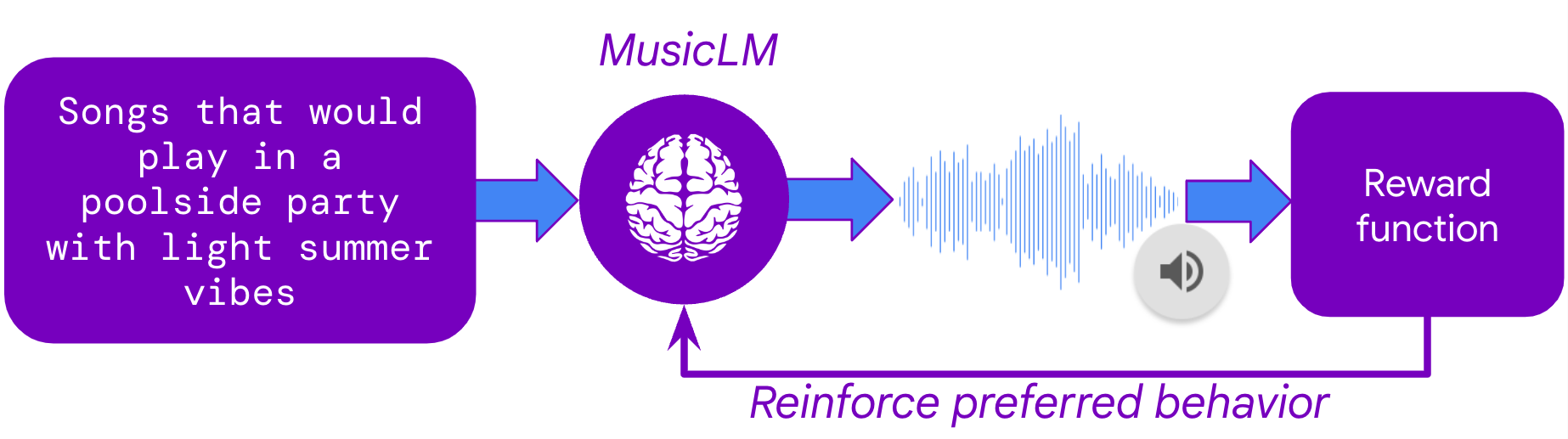
- 시퀀스 수준의 보상 최대화를 위해 강화학습을 사용해 미리 훈련된 자기연쇄적 MusicLM 모델을 미세조정함.
- 선택된 평가자로부터의 피드백을 기반으로 텍스트 준거성(예: MuLan 사이클 일관성)과 음질(예: Fréchet Audio Distance)을 고려한 보상 함수 설계.
- MusicLM을 사용자에게 배포하고 웹 인터페이스를 통해 300,000개의 사용자 생성 캡션-오디오 쌍과 쌍대 비교 선호도 애너테이션을 수집함.
- 수집된 사용자 선호도 데이터를 기반으로 보상 모델을 훈련하여 향후 RL 미세조정을 안내함.
- 사용자 선호도 보상 모델을 사용해 MusicRL-U를 훈련하고, 이를 이전 보상 신호들과 함께 결합하여 MusicRL-RU를 구성함.
- 향후 반복에서 온정책 데이터 수집을 통해 피드백과 배포 간의 분포 간격을 줄임.
실험 결과
연구 질문
- RQ1인간 피드백에서의 강화학습(RLHF)이 자동 평가 지표를 초월해 텍스트-음악 생성을 효과적으로 향상시킬 수 있는가?
- RQ2음악 생성에서 사용자 선호도가 텍스트 준거성과 음질과 같은 객관적 지표와 얼마나 일치하는가?
- RQ3텍스트 준거성, 음질, 사용자 선호도의 다중 보상 신호를 결합할 경우 모델 성능에 어떤 영향을 미치는가?
- RQ4텍스트 준거성과 음질을 초월해 인간 선호도에 영향을 미치는 음악적 특성은 무엇인가?
- RQ5실세계에서 수집된 대규모 사용자 피드백을 효과적으로 활용해 음악 생성을 위한 강력한 보상 모델을 훈련시킬 수 있는가?
주요 결과
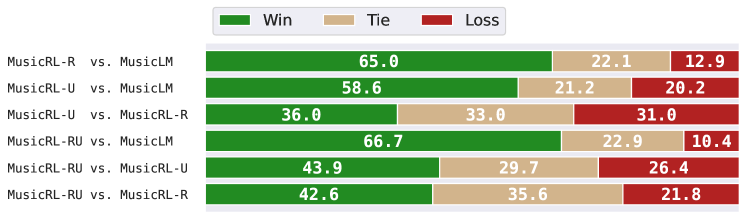
- 음질, 텍스트 준거성, 사용자 선호도 보상 신호를 모두 통합한 MusicRL-RU는 인간 평가에서 MusicRL-R 및 MusicRL-U보다 선호됨.
- 300,000건의 사용자 쌍대 비교 선호도 데이터를 기반으로 훈련된 MusicRL-U는 미리 훈련된 MusicLM 베이스라인을 크게 능가함.
- 음질 예측기는 어느 클립이 더 선호되었는지를 53.3%의 정확도로 예측함으로써, 인간 선호도에서 음질이 중간 정도의 신호이지만 주요 요소는 아님을 시사함.
- 사용자 선호도는 텍스트 준거성과 음질을 초월한 정보를 포함하고 있으며, 이는 음악성의 주관적이고 복잡한 특성이 있음을 시사함.
- 제거 실험 결과, 텍스트 준거성과 음질은 성능 향상에 기여하지만 인간 선호도를 완전히 설명하지 못함을 확인하여, 주관적인 음악성의 역할을 강조함.
- 사용자 피드백을 기반으로 훈련된 모델(MusicRL-U)은 음질 점수에서 약간의 향상을 보였으며, 이는 사용자 피드백이 선호도의 추가적이고 비트리비얼한 측면을 포괄하고 있음을 시사함.
이 논문 읽기
누빈트 뷰어에서 원문을 열고, 읽으면서 궁금한 곳을 바로 물어보세요.
누빈트에서 이 논문 읽기이 리뷰는 AI가 논문 원문을 바탕으로 만들었습니다. 인용하기 전에 원문을 확인해 주세요.