
[논문 리뷰] NeRO: Neural Geometry and BRDF Reconstruction of Reflective Objects from Multiview Images
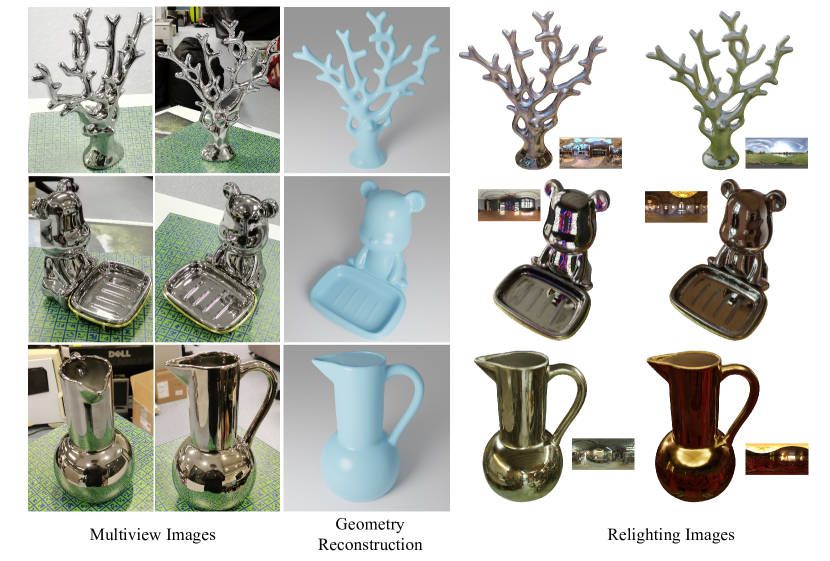
NeRO는 환경 조명이나 물체 마스크를 사전에 알지 못하는 다중 시점 RGB 이미지로부터 고반사 물체의 3D 기하구조와 BRDF를 복원하기 위한 이단계 신경 렌더링 방법을 제안한다. 렌더링 방정식을 분할합 근사와 방향 인코딩을 통해 통합함으로써 초기 기하구조 추정을 수행한 후, 몬테카를로 기반의 BRDF 및 조명 보정을 통해 반사 표면에서 최신 기술 수준의 복원 품질을 달성한다. 이는 정확한 알베도, 금속성, 거칠기 분해를 포함한다.
We present a neural rendering-based method called NeRO for reconstructing the geometry and the BRDF of reflective objects from multiview images captured in an unknown environment. Multiview reconstruction of reflective objects is extremely challenging because specular reflections are view-dependent and thus violate the multiview consistency, which is the cornerstone for most multiview reconstruction methods. Recent neural rendering techniques can model the interaction between environment lights and the object surfaces to fit the view-dependent reflections, thus making it possible to reconstruct reflective objects from multiview images. However, accurately modeling environment lights in the neural rendering is intractable, especially when the geometry is unknown. Most existing neural rendering methods, which can model environment lights, only consider direct lights and rely on object masks to reconstruct objects with weak specular reflections. Therefore, these methods fail to reconstruct reflective objects, especially when the object mask is not available and the object is illuminated by indirect lights. We propose a two-step approach to tackle this problem. First, by applying the split-sum approximation and the integrated directional encoding to approximate the shading effects of both direct and indirect lights, we are able to accurately reconstruct the geometry of reflective objects without any object masks. Then, with the object geometry fixed, we use more accurate sampling to recover the environment lights and the BRDF of the object. Extensive experiments demonstrate that our method is capable of accurately reconstructing the geometry and the BRDF of reflective objects from only posed RGB images without knowing the environment lights and the object masks. Codes and datasets are available at https://github.com/liuyuan-pal/NeRO.
연구 동기 및 목표
- 시점 의존적인 반사 반사를 유발하는 반사 물체의 다중 시점 복원 문제를 해결한다.
- 기존 신경 복원 방법이 환경 조명과 BRDF를 충분히 모델링하지 못해 강한 반사 반사에 실패하는 한계를 극복한다.
- 일반적으로 최신 기술에서 요구되는 물체 마스크나 환경 조명 지식 없이도 복원을 가능하게 한다.
- 단지 정렬된 RGB 이미지로부터 표면 기하구조, BRDF 매개변수(알베도, 금속성, 거칠기), 환경 조명을 정확하게 공동 추정한다.
- 간접 조명과 복잡한 반사에 대해 강건한 방법을 개발하며, 입력 이미지에서 물체가 분할되지 않거나 고립되어 있지 않은 경우에도 성능을 유지한다.
제안 방법
- 렌더링 방정식을 시점에 의존하지 않는 요소와 시점에 의존하는 요소로 분리하기 위해 분할합 근사를 사용하여, 알려지지 않은 조명 조건에서도 기하구조 추정이 가능하도록 한다.
- 통합된 방향 인코딩을 적용하여 그림자 함수 내에서 직접 및 간접 조명 효과를 표현함으로써, 기하구조 최적화 중에 명시적인 조명 추정이 필요 없이 정확도를 향상시킨다.
- 두 번째 단계에서 추정된 기하구조를 고정하고 몬테카를로 샘플링을 통해 고해상도 환경 조명과 BRDF 매개변수를 복원한다.
- 중성 조명 손실과 부드러움 손실을 도입하여 알베도 정확도를 향상시키고, 보정 단계에서 BRDF 예측의 노이즈를 줄인다.
- 알베도, 금속성, 거칠기를 예측하는 가중치를 가지는 미분 가능한 신경망을 사용하여 표면 BRDF를 표현함으로써 기하구조 및 조명과 함께 엔드 투 엔드 최적화를 가능하게 한다.
- 위치 인코딩을 활용한 신경 SDF 필드를 사용하여 3D 형상을 암묵적으로 표현하며, 신경 필드의 본질적 스무딩 효과에도 불구하고 고주파 표면 세부 정보를 포착한다.
실험 결과
연구 질문
- RQ1환경 조명과 물체 마스크가 알려지지 않은 상황에서 신경 렌더링 프레임워크가 다중 시점 이미지로부터 반사 물체의 3D 기하구조를 정확히 복원할 수 있는가?
- RQ2신경 복원 파이프라인에서 렌더링 방정식을 효과적으로 근사하여 명시적인 조명 감독 없이도 직접 및 간접 반사 반사를 모두 모델링할 수 있는가?
- RQ3기하구조 추정 후 BRDF 및 조명 최적화를 수행하는 이단계 최적화 전략이, 엔드 투 엔드 접근 방식에 비해 반사 표면에서 복원 품질을 얼마나 향상시킬 수 있는가?
- RQ4복잡한 조명 조건에서도 입력 이미지를 물리적으로 의미 있는 성분(알베도, 조명, 재질 매개변수)으로 고해상도로 분해할 수 있는가?
- RQ5이 방법의 주요 실패 원인은 무엇이며, 기하구조 정확도의 저하가 복잡한 반사 재질에서 BRDF 추정에 어떻게 영향을 미치는가?
주요 결과
- NeRO는 반사 표면에서 최신 기술 수준의 3D 복원 품질을 달성하며, COLMAP, NeuS, Ref-NeRF, NDRMC와 같은 기존 방법들을 능가한다. 특히 날카운 반사 광원과 복잡한 형상을 정확히 포착한다.
- ‘Angel’과 ‘Cat’ 모델에서 미세한 세부 정보가 손실되더라도 전체 기하구조는 성공적으로 복원된다. 다만 SDF의 스무딩 효과로 인해 수염이나 옷의 섬세한 무늬는 완전히 포착되지 않는다.
- BRDF 분해 결과는 조명 효과와 알베도를 정확히 분리함을 보여주며, 금속성과 거칠기 예측도 정확하다. 예를 들어 금속성 플라스크와 비금속성 캘리브레이션 보드를 정확히 구분한다.
- 제거 실험 결과, 중성 조명 손실과 부드러움 손실이 모두 리라이팅 품질을 향상시켜 알베도 정확도를 높이고 BRDF 노이즈를 감소시킨다는 점을 확인했다.
- 이 방법은 간접 조명에 대해 강건하며, 알려지지 않은 조명 조건에서도 성공적으로 복원 및 분해를 수행할 수 있다. 이는 Glossy-Real 데이터셋에서의 성공적인 리라이팅 및 분해 결과로 입증되었다.
- 실패 케이스에서는 신경 SDF 필드에서 유도된 부정확한 표면 법선이 잘못된 반사 방향을 유도하며, 이는 복잡하거나 미세한 기하구조를 가진 물체에서 BRDF 추정 품질을 악화시킨다.
이 논문 읽기
누빈트 뷰어에서 원문을 열고, 읽으면서 궁금한 곳을 바로 물어보세요.
누빈트에서 이 논문 읽기이 리뷰는 AI가 논문 원문을 바탕으로 만들었습니다. 인용하기 전에 원문을 확인해 주세요.